The combination of massive fiscal stimulus and a monetary policy set to "full flood" did a lot of the heavy lifting but the real kicker was a flood of "hot money" driven by a carry trade by investment banks flush with bailout money looking for a yield differential and currency gains as the pound and buck dive. The Ruddster bought some time but it will end badly, imo.
Keen notes...
2010 will be a bad year for the Australian economy:
The combination of the RBA’s rate rises and the ending of the First Home Buyers Boost will in all likelihood prick the house price bubble inspired by the Boost in the first place—and lead as many as 175,000 households to be very angry that they were enticed into this speculative bubble in the first place. If this happens, there is little prospect of making the House Price Souffle rise twice by yet another foolish enticement into debt.
The political pressure on the government may lead it to unwind its stimulus, which will remove a key prop from the economy; and
Deleveraging, which has been the looming problem that government policy (especially the First Home Vendors Grant) has simply delayed, will kick in as it has in the USA. The most likely manifestation would be a decline in discretionary consumption and non-mining investment.
I therefore expect that the RBA won’t get to complete its intended program of raising interest rates, but will be forced to go into reverse in 2010 as it was in 2008. It shouldn’t be forgotten that the RBA was still raising rates in mid-2008 to fight inflation. They didn’t see the GFC coming, and I believe that they’re making a similar mistake this time—believing that it’s all behind us when the special factors that minimised the impact are terminating.
So no I don’t believe we have dodged the iceberg—we’ve merely pushed it below the surface, from where it will rise again to dent out economic hull once more. And all the while the neoclassical economists who didn’t realise they were in an ice field in the first place are busily rearranging the deckchairs on the Titanic.
http://www.debtdeflation.com/blogs/2009/11/02/debtwatch-no-40-november-2009-have-we-dodged-the-iceberg/
Showing posts with label housing bust. Show all posts
Showing posts with label housing bust. Show all posts
3 November 2009


28 September 2009
Housing roundup from Housing bubble blog...
It’s Friday desk clearing time for this blogger. “Chicago’s bungalows and brick Georgians are selling, but woe to the owner of a city condo. Phil Sammarco didn’t think it’d be so hard to sell his two-bedroom, two-bathroom condo in the city’s DePaul neighborhood when he put it on the market in March for $449,000. Now priced at $435,000, he has fielded — and rejected — a few low-ball offers and showed the unit to a lot of first-time buyers who have indicated they have a wealth of properties to look at. Now he’s thinking of turning it into a rental instead of lowering the price again.”
“‘You’ve got a lot of choices,’ Sammarco said. ‘Right now nobody is really comfortable that the worst is behind us. If you don’t think the market is stable and you don’t think it’s going to be as good or better, why wouldn’t you rent?’”
“A few years ago, few people in the housing market had ever heard of a short sale. Mention the term today and people, whether they are homeowners or real estate agents, just roll their eyes. The Obama administration is aware of the frustrations. In mid-May, Treasury Secretary Tim Geithner announced plans to streamline the process by offering financial incentives to mortgage servicers and investors that accept short sales.”
“Meanwhile, homeowners like Dallas O’Day are in limbo. O’Day, a Chicago attorney, and his family relocated from California in June 2004 and bought a Mediterranean-style home in Chicago’s Beverly neighborhood for $395,000. They rewired the house, stripped and refinished the wood floors and the woodwork, and did other work to restore its charm.”
“Last year, personal circumstances prompted them to list the home for sale just as the housing industry’s meltdown was picking up steam. With no takers and no longer even expecting to break even on his investment, O’Day relisted the 2,700-square-foot home in January as a short sale. Four months and three price reductions brought the house down to $384,900, at which point a potential buyer made an offer in late May. O’Day accepted it and submitted the paperwork to the lenders holding first and second mortgages on the home. He has yet to receive a response.”
“Meanwhile, the family has moved into an apartment, the refrigerator has broken in the home and there’s evidence of mold in the basement.”
“‘What has astonished me is that in the presence of one of the softest housing markets I can remember, we’re hitting up on four months and they’ve just had a person assigned to look at it, that they would move at such a glacial pace,’ O’Day said. ‘My expectation is I’ll be renting until whatever blemish is gone. I’ve just accepted the fact that at some point it’ll be foreclosed upon because I just don’t think the banks will pull it together. I feel like I’ve done everything I can do.’”
“A slowdown in the local housing market is reflected in assessed values for homes in Yakima County this year, the Yakima County Assessor’s Office said. .Certainly, King County has suffered from a bursting of the housing bubble. Stan Roe, assessment unit supervisor in the King County Assessor’s Office, said Monday market values in King County fell by an average of 15 percent this year.”
“‘I don’t think I’ve seen this big a drop before’ said Roe, who has worked for the King County Assessor’s Office for 19 years.”
“The spectacular fall of WaMu has left a hole in the heart of Seattle. To mark the anniversary of WaMu’s collapse, The Seattle Times caught up with former employees…who saw problems behind the scenes before the final days. James Meacham was at ground zero for some of Washington Mutual’s most questionable home loans. He wasn’t a typical banking executive — he had a master’s degree in theology and had spent time as a minister. He was hired in Seattle in 2000 and rose to become a vice president of business strategy at WaMu’s Long Beach Mortgage division. Based in California, the division specialized in subprime mortgages, made to those with flawed credit histories.”
“On a gut level, Meacham says, the packages of loans that Long Beach and WaMu began bundling and selling to investment banks didn’t make sense. But those loans held the lure of bigger profits for everyone, and the investment banks couldn’t seem to get enough of them. Meacham says he could see the housing crash coming, and sold his California home in 2006 at the peak of the market: ‘It didn’t take a financial genius to work out that blue-collar workers can’t be paying $3,000 a month for their houses,’ he says.”
“There was the pressure from his superiors at WaMu to grow the business rapidly, he says. There were the mathematical formulas and financial projections that showed bundling all those risky mortgages would turn out just fine. And there was a sense that the rules of the game had changed. He has wrestled with the question of who was primarily to blame for the mess. Was it lenders like WaMu? The investment banks? The global housing boom? He wonders if there is a point where credulity, and belief in a system, become culpability.”
“‘The basic problem was the assumption that housing prices would always go up,’ Meacham says. ‘It was an egregious error.’”
“No state has fallen as far as California has in the current global recession. James Doti, president of Chapman University in Orange County and a member of Mr. Schwarzenegger’s council of economic advisors, was in Toronto to discuss the many issues plaguing the state. Here is an edited conversation with the Financial Post’s Eric Lam.”
“Q. What was it about Southern California that made it such a target? A. Zoning, environmental regulations, real estate controls are all greater in California than other parts of the nation. This led to more rapid housing appreciation in Orange County than elsewhere because it was more difficult and costly to build there. Since the construction industry could not respond as rapidly as it could in other parts of the country, it led to a severe supply-demand imbalance.”
“Q. What kind of price appreciation are we talking about?”
“A. At one point average prices in Orange County hit US$750,000, roughly ten times the household income. This could not be supported and that’s when the drop occurred. But houses are affordable again: the average house price is about US$400,000. There were small 100-year-old units close to Chapman that were two room bungalows, maybe 900 square feet, going for US$900,000. Now they’re down to US$300,000, and still people look at them and say, ‘My goodness that should be no more than US $75,000.’ But in Orange County that’s affordable.”
“The real-estate bust that has pummeled San Diego’s downtown condo market and wreaked havoc in its outlying suburbs has hit its once-impregnable beach communities. Beachfront property has come down as much 30 percent in some areas from 2006 highs, with much greater savings possible on foreclosure properties or short sales.”
“Even the crown jewel, Coronado, hasn’t escaped the downturn. ‘Four years ago, you couldn’t find anything in Coronado for under $1 million,’ said Maureen Kerley, a real-estate agent who works in Coronado and Scottsdale. ‘Now, there are dozens.’”
“Please, keep those tax credits rolling. That, not surprisingly, is what the battered real estate industry is arguing as it lobbies for an extension of the $8,000 first-time homebuyer tax credit. Zillow is rolling out a new survey of homebuyers that finds that extending the tax credit would bring an additional 334,000 buyers into the market over the next year starting in December. Overall, that estimate is based on a nationwide survey of prospective homebuyers in which 18 percent cited an extension of $8,000 tax credit as the ‘primary’ influence on whether to jump into the market.”
“Still, extending the tax credit could prove costly to the rest of us who have either already bought homes are renting now. Obviously, at some point the market will have to stand or fall on its own without Uncle Sam’s help. But is it time to go cold turkey now?”
“The Florida housing market is struggling because of a declining population, tight credit, high unemployment rates and a lengthening of the home-buying process, economists said. ‘I think we have a tougher path to get (out of the housing slump) than the nation as a whole,’ said Dr. Sean Snaith of the University of Central Florida’s Institute for Economic Competitiveness.”
“Tax credits won’t solve the main problem of limited credit, Snaith said. ‘Most people cannot get financing right now — that to me is the bigger problem,’ Snaith said.”
“First-time house buyers in Australia this summer took out bigger loans than the same period a year ago, writes Nick Gibson. The Australian Bureau of Statistics says that the average loan size for first home owners increased from $246,500 in 2008 to $269,100 in July 2009. This compares with the average mortgage for a new house of $266,900.”
“The trend suggests that first-time home buyers have been contributing less of their own savings while taking advantage of the $21,000 in government housing grants introduced this year as as part of a national stimulus package.”
“‘The housing grants have helped to incentivise a property market that shows no sign of stalling and is forecast to grow consitently over the next decade,’ says Darrell Todd, ceo of thinkingaustralia.”
“The Reserve Bank warned yesterday that the super-sized loans were an ‘unusual outcome’ given that loans to first home buyers were normally smaller than loans to other home buyers. However, figures compiled by the Australian Bureau of Statistics show the average loan size for first home owners was up from $246,500 a year ago to $269,100 in July. This compares with the average loan size for all owner-occupied housing commitments of $266,900.”
“First home buyers have also helped to push up new home sales, according to the latest Housing Industry Association report. According to analysts, the growing loan size suggests first home buyers have been relying heavily on government grants of up to $21,000 rather than putting their own savings into it.”
“The International Monetary Fund has urged central banks to be prepared to lift interest rates to head off the sort of asset price bubbles that produced the global crisis. But don’t expect the Reserve Bank to start targeting Australian housing prices. Yet still be prepared for the central bank to lift interest rates more aggressively if house price rises start getting out of hand. And expect governor Glenn Stevens to complain more about other policy bottlenecks that appear to be pushing up house prices.”
“Stevens has long been uneasy with the orthodoxy — promoted by former US Federal Reserve Board chairman Alan Greenspan — that monetary policy should not aim to dampen asset prices, except to the extent needed to keep goods and services inflation low.”
“‘I personally would not want to commit to saying, ‘we’re definitely never going to pay attention to asset prices and totally ignore them,’ he said. ‘That has been shown to be a mistake, basically.’ But neither would the Reserve Bank ‘aggressively chase down’ asset prices that “pop up here and there”, even if they didn’t seem to make sense.”
“Today’s rising housing prices, however puzzling, are not a bubble now because credit growth remains subdued. But Stevens admitted to not understanding why Australia’s housing prices are so high given we have so much spare land.”
“Agents are expecting a flood of first-home buyers this weekend. Figures from Australian Property Monitors show there are 4054 metropolitan properties priced under $400,000 on the market - 58 per cent of the total 6997 listings. This compares to the 3921 properties under $400,000 that were on the market at the same time last year and 6412 for total listings.”
“‘It’s the last weekend before the grant changes,’ said Toop & Toop agent Kay Morris. I would imagine there would be more people this weekend looking.’”
“Century 21 Central agent Rosalyn Marker said there was a sense of urgency, which was evident at a Melrose Park sale this week. ‘To have an open with 88 people over the last Saturday and Sunday was a very rewarding result for us,’ she said. ‘We had 11 offers on that property, most of them were young couples … and I would be expecting them (those who missed out) to be looking again this weekend.’”
“Sang Ah Lee, 25, signed a contract for the Melrose Park home on Tuesday after searching the property market for about four months. ‘Because of the grant I tried harder to find a property I liked because that was a deadline for me,’ she said. ‘So I was very lucky.’”
“The Australian dream of home ownership is slipping away, leaving a threat of a US-style collapse in house prices, according to a team of university researchers. Analysis by researchers from South Australia’s Flinders University has revealed home ownership in the 10 years from 1996 rose only 0.8 per cent despite strong economic growth and low interest rates in that period.”
“Other findings included large gains in national income from the resources boom were ‘wasted’ by increasing house prices and accumulating debt to unreasonable levels.”
“Dr Joe Flood, the Institute’s adjunct professor, said the ‘the writing is on the wall for the ‘Australian dream.’ Dr Flood and his team assessed Census data to conclude that Australia’s housing market is in “a very dangerous and unstable situation which has received little adverse attention.’ The researchers found that after 1996, average house prices increased by three times on average - to around 6.8 times medium household income - and debt levels surged.”
“‘On the one hand Australia is vulnerable to a collapse like the United States, where prices fell by a half during the sub-prime collapse … or to a long slow decline as in Japan since 1988,’ Dr Flood said.”
”’The country that promised limitless land, cheap housing and near universal home ownership to all comers now has the most expensive housing in the world amid very tight housing and land markets and little prospect of restoring the balance,’ Dr Flood said. ‘As long as the Government, the public and the media remain in denial, and self-congratulatory rhetoric continues that Australia has cleverly avoided the housing market correction it needed to have, there is little chance that matters will improve.’”
http://thehousingbubbleblog.com/index.html
“‘You’ve got a lot of choices,’ Sammarco said. ‘Right now nobody is really comfortable that the worst is behind us. If you don’t think the market is stable and you don’t think it’s going to be as good or better, why wouldn’t you rent?’”
“A few years ago, few people in the housing market had ever heard of a short sale. Mention the term today and people, whether they are homeowners or real estate agents, just roll their eyes. The Obama administration is aware of the frustrations. In mid-May, Treasury Secretary Tim Geithner announced plans to streamline the process by offering financial incentives to mortgage servicers and investors that accept short sales.”
“Meanwhile, homeowners like Dallas O’Day are in limbo. O’Day, a Chicago attorney, and his family relocated from California in June 2004 and bought a Mediterranean-style home in Chicago’s Beverly neighborhood for $395,000. They rewired the house, stripped and refinished the wood floors and the woodwork, and did other work to restore its charm.”
“Last year, personal circumstances prompted them to list the home for sale just as the housing industry’s meltdown was picking up steam. With no takers and no longer even expecting to break even on his investment, O’Day relisted the 2,700-square-foot home in January as a short sale. Four months and three price reductions brought the house down to $384,900, at which point a potential buyer made an offer in late May. O’Day accepted it and submitted the paperwork to the lenders holding first and second mortgages on the home. He has yet to receive a response.”
“Meanwhile, the family has moved into an apartment, the refrigerator has broken in the home and there’s evidence of mold in the basement.”
“‘What has astonished me is that in the presence of one of the softest housing markets I can remember, we’re hitting up on four months and they’ve just had a person assigned to look at it, that they would move at such a glacial pace,’ O’Day said. ‘My expectation is I’ll be renting until whatever blemish is gone. I’ve just accepted the fact that at some point it’ll be foreclosed upon because I just don’t think the banks will pull it together. I feel like I’ve done everything I can do.’”
“A slowdown in the local housing market is reflected in assessed values for homes in Yakima County this year, the Yakima County Assessor’s Office said. .Certainly, King County has suffered from a bursting of the housing bubble. Stan Roe, assessment unit supervisor in the King County Assessor’s Office, said Monday market values in King County fell by an average of 15 percent this year.”
“‘I don’t think I’ve seen this big a drop before’ said Roe, who has worked for the King County Assessor’s Office for 19 years.”
“The spectacular fall of WaMu has left a hole in the heart of Seattle. To mark the anniversary of WaMu’s collapse, The Seattle Times caught up with former employees…who saw problems behind the scenes before the final days. James Meacham was at ground zero for some of Washington Mutual’s most questionable home loans. He wasn’t a typical banking executive — he had a master’s degree in theology and had spent time as a minister. He was hired in Seattle in 2000 and rose to become a vice president of business strategy at WaMu’s Long Beach Mortgage division. Based in California, the division specialized in subprime mortgages, made to those with flawed credit histories.”
“On a gut level, Meacham says, the packages of loans that Long Beach and WaMu began bundling and selling to investment banks didn’t make sense. But those loans held the lure of bigger profits for everyone, and the investment banks couldn’t seem to get enough of them. Meacham says he could see the housing crash coming, and sold his California home in 2006 at the peak of the market: ‘It didn’t take a financial genius to work out that blue-collar workers can’t be paying $3,000 a month for their houses,’ he says.”
“There was the pressure from his superiors at WaMu to grow the business rapidly, he says. There were the mathematical formulas and financial projections that showed bundling all those risky mortgages would turn out just fine. And there was a sense that the rules of the game had changed. He has wrestled with the question of who was primarily to blame for the mess. Was it lenders like WaMu? The investment banks? The global housing boom? He wonders if there is a point where credulity, and belief in a system, become culpability.”
“‘The basic problem was the assumption that housing prices would always go up,’ Meacham says. ‘It was an egregious error.’”
“No state has fallen as far as California has in the current global recession. James Doti, president of Chapman University in Orange County and a member of Mr. Schwarzenegger’s council of economic advisors, was in Toronto to discuss the many issues plaguing the state. Here is an edited conversation with the Financial Post’s Eric Lam.”
“Q. What was it about Southern California that made it such a target? A. Zoning, environmental regulations, real estate controls are all greater in California than other parts of the nation. This led to more rapid housing appreciation in Orange County than elsewhere because it was more difficult and costly to build there. Since the construction industry could not respond as rapidly as it could in other parts of the country, it led to a severe supply-demand imbalance.”
“Q. What kind of price appreciation are we talking about?”
“A. At one point average prices in Orange County hit US$750,000, roughly ten times the household income. This could not be supported and that’s when the drop occurred. But houses are affordable again: the average house price is about US$400,000. There were small 100-year-old units close to Chapman that were two room bungalows, maybe 900 square feet, going for US$900,000. Now they’re down to US$300,000, and still people look at them and say, ‘My goodness that should be no more than US $75,000.’ But in Orange County that’s affordable.”
“The real-estate bust that has pummeled San Diego’s downtown condo market and wreaked havoc in its outlying suburbs has hit its once-impregnable beach communities. Beachfront property has come down as much 30 percent in some areas from 2006 highs, with much greater savings possible on foreclosure properties or short sales.”
“Even the crown jewel, Coronado, hasn’t escaped the downturn. ‘Four years ago, you couldn’t find anything in Coronado for under $1 million,’ said Maureen Kerley, a real-estate agent who works in Coronado and Scottsdale. ‘Now, there are dozens.’”
“Please, keep those tax credits rolling. That, not surprisingly, is what the battered real estate industry is arguing as it lobbies for an extension of the $8,000 first-time homebuyer tax credit. Zillow is rolling out a new survey of homebuyers that finds that extending the tax credit would bring an additional 334,000 buyers into the market over the next year starting in December. Overall, that estimate is based on a nationwide survey of prospective homebuyers in which 18 percent cited an extension of $8,000 tax credit as the ‘primary’ influence on whether to jump into the market.”
“Still, extending the tax credit could prove costly to the rest of us who have either already bought homes are renting now. Obviously, at some point the market will have to stand or fall on its own without Uncle Sam’s help. But is it time to go cold turkey now?”
“The Florida housing market is struggling because of a declining population, tight credit, high unemployment rates and a lengthening of the home-buying process, economists said. ‘I think we have a tougher path to get (out of the housing slump) than the nation as a whole,’ said Dr. Sean Snaith of the University of Central Florida’s Institute for Economic Competitiveness.”
“Tax credits won’t solve the main problem of limited credit, Snaith said. ‘Most people cannot get financing right now — that to me is the bigger problem,’ Snaith said.”
“First-time house buyers in Australia this summer took out bigger loans than the same period a year ago, writes Nick Gibson. The Australian Bureau of Statistics says that the average loan size for first home owners increased from $246,500 in 2008 to $269,100 in July 2009. This compares with the average mortgage for a new house of $266,900.”
“The trend suggests that first-time home buyers have been contributing less of their own savings while taking advantage of the $21,000 in government housing grants introduced this year as as part of a national stimulus package.”
“‘The housing grants have helped to incentivise a property market that shows no sign of stalling and is forecast to grow consitently over the next decade,’ says Darrell Todd, ceo of thinkingaustralia.”
“The Reserve Bank warned yesterday that the super-sized loans were an ‘unusual outcome’ given that loans to first home buyers were normally smaller than loans to other home buyers. However, figures compiled by the Australian Bureau of Statistics show the average loan size for first home owners was up from $246,500 a year ago to $269,100 in July. This compares with the average loan size for all owner-occupied housing commitments of $266,900.”
“First home buyers have also helped to push up new home sales, according to the latest Housing Industry Association report. According to analysts, the growing loan size suggests first home buyers have been relying heavily on government grants of up to $21,000 rather than putting their own savings into it.”
“The International Monetary Fund has urged central banks to be prepared to lift interest rates to head off the sort of asset price bubbles that produced the global crisis. But don’t expect the Reserve Bank to start targeting Australian housing prices. Yet still be prepared for the central bank to lift interest rates more aggressively if house price rises start getting out of hand. And expect governor Glenn Stevens to complain more about other policy bottlenecks that appear to be pushing up house prices.”
“Stevens has long been uneasy with the orthodoxy — promoted by former US Federal Reserve Board chairman Alan Greenspan — that monetary policy should not aim to dampen asset prices, except to the extent needed to keep goods and services inflation low.”
“‘I personally would not want to commit to saying, ‘we’re definitely never going to pay attention to asset prices and totally ignore them,’ he said. ‘That has been shown to be a mistake, basically.’ But neither would the Reserve Bank ‘aggressively chase down’ asset prices that “pop up here and there”, even if they didn’t seem to make sense.”
“Today’s rising housing prices, however puzzling, are not a bubble now because credit growth remains subdued. But Stevens admitted to not understanding why Australia’s housing prices are so high given we have so much spare land.”
“Agents are expecting a flood of first-home buyers this weekend. Figures from Australian Property Monitors show there are 4054 metropolitan properties priced under $400,000 on the market - 58 per cent of the total 6997 listings. This compares to the 3921 properties under $400,000 that were on the market at the same time last year and 6412 for total listings.”
“‘It’s the last weekend before the grant changes,’ said Toop & Toop agent Kay Morris. I would imagine there would be more people this weekend looking.’”
“Century 21 Central agent Rosalyn Marker said there was a sense of urgency, which was evident at a Melrose Park sale this week. ‘To have an open with 88 people over the last Saturday and Sunday was a very rewarding result for us,’ she said. ‘We had 11 offers on that property, most of them were young couples … and I would be expecting them (those who missed out) to be looking again this weekend.’”
“Sang Ah Lee, 25, signed a contract for the Melrose Park home on Tuesday after searching the property market for about four months. ‘Because of the grant I tried harder to find a property I liked because that was a deadline for me,’ she said. ‘So I was very lucky.’”
“The Australian dream of home ownership is slipping away, leaving a threat of a US-style collapse in house prices, according to a team of university researchers. Analysis by researchers from South Australia’s Flinders University has revealed home ownership in the 10 years from 1996 rose only 0.8 per cent despite strong economic growth and low interest rates in that period.”
“Other findings included large gains in national income from the resources boom were ‘wasted’ by increasing house prices and accumulating debt to unreasonable levels.”
“Dr Joe Flood, the Institute’s adjunct professor, said the ‘the writing is on the wall for the ‘Australian dream.’ Dr Flood and his team assessed Census data to conclude that Australia’s housing market is in “a very dangerous and unstable situation which has received little adverse attention.’ The researchers found that after 1996, average house prices increased by three times on average - to around 6.8 times medium household income - and debt levels surged.”
“‘On the one hand Australia is vulnerable to a collapse like the United States, where prices fell by a half during the sub-prime collapse … or to a long slow decline as in Japan since 1988,’ Dr Flood said.”
”’The country that promised limitless land, cheap housing and near universal home ownership to all comers now has the most expensive housing in the world amid very tight housing and land markets and little prospect of restoring the balance,’ Dr Flood said. ‘As long as the Government, the public and the media remain in denial, and self-congratulatory rhetoric continues that Australia has cleverly avoided the housing market correction it needed to have, there is little chance that matters will improve.’”
http://thehousingbubbleblog.com/index.html
25 September 2009
Mortgage rentiers find they are not in Kansas anymore....
Back in April, we mentioned the The Mortgage Netherworld of MERS — the Mortgage Electronic Registration Systems.
MERS is the firm that (technically) holds 60 million US (securitized) mortgages on behalf of the actual buyers. They were created by a consortium of lenders in part to save money (on paperwork and recording fees) every time a loan changes owners. In the era of securitization, these savings amounted to billions of dollars.
But MERS also acts as a shield, making it all but impossible for many borrowers to deal directly with whoever happens to be holding their mortgage at the moment. As the NYT noted, it has “made life maddeningly difficult for some troubled homeowners.”
Now, the Kansas Court of Appeals has called foul. In Landmark National Bank v. Kesler, 2009 Kan. LEXIS 834, the Kansas Court held that a nominee company called MERS has no right or standing to bring an action for foreclosure. (Other than GlobalResearch.ca, I have yet to see any MSM coverage of the issue). The Court stated that MERS’ relationship is not that of a true party possessing all the rights given a buyer. Hence, the court ruled:
“By statute, assignment of the mortgage carries with it the assignment of the debt. . . . Indeed, in the event that a mortgage loan somehow separates interests of the note and the deed of trust, with the deed of trust lying with some independent entity, the mortgage may become unenforceable. The practical effect of splitting the deed of trust from the promissory note is to make it impossible for the holder of the note to foreclose, unless the holder of the deed of trust is the agent of the holder of the note. Without the agency relationship, the person holding only the note lacks the power to foreclose in the event of default. The person holding only the deed of trust will never experience default because only the holder of the note is entitled to payment of the underlying obligation. The mortgage loan becomes ineffectual when the note holder did not also hold the deed of trust.” (emphasis added).
What does this mean for the 60 million people — over half of all US mortgages — whose loans have been securitized, sliced and diced, and are now held by MERS?
To start, it potentially gives a powerful weapon to homeowners who are being foreclosed upon. If their mortgage is held by MERS, they certainly have a strong basis for challenging the action on the grounds of standing. (Note that this was a Kansas COURT OF APPEALS decision, and while it is not binding on other states the way a US Supreme court ruling would be, it is likely to be influential). I also think the Kansas Court of Appeals could also review this case
I don’t quite agree with Ellen Brown, who in an extensive legal analysis of the decision, writes: “The significance of the holding is that if MERS has no standing to foreclose, then nobody has standing to foreclose.” It may be possible for trustees for the securitized loans to somehow perfect standing, i.e., develop the ability to claim loan ownership (perhaps via a purchase) and then move to foreclose. (Brown also calls it a Kansas Supreme Court decision, but it appears to be the intermediate 3 judge panel of the Court of Appeals that heard the case, not the full Kansas Supreme Court).
But Brown is correct when she states this is a very significant legal development, one that might dramatically impact foreclosure litigation.
This ruling could send the lenders who work with MERS scurrying to resolve this in their favor. Look for a lobbying effort to get some favored congresscritter to pass legislation granting them standing to sue on behalf of loan holders (Congress may be able legislate that legal right, although there are state laws to be contended with).
As foreclosures continue to ramp up, I expect a lot of rhetoric about why we need to stop them (I disagree) and modify mortgages (which have been mostly unsuccessful).
Last, you never know what someother state supreme court might rule. (Any lawyers out there know what is on upcoming dockets involving MERS ?)
Bottom line: It just got a lot harder to foreclose on homes with securitized mortgages in Kansas, and quite probably, the rest of the nation.
>
Previously:
The Mortgage Netherworld (April 2009)
http://www.ritholtz.com/blog/2009/04/the-mortgage-netherworld
Sources:
Landmark National Bank v. Kesler
COURT OF APPEALS OF THE STATE OF KANSAS
No. 98,489
September 12, 2008
http://www.kscourts.org/Cases-and-Opinions/opinions/ctapp/2008/20080912/98489.htm
Landmark Decision: Massive Relief for Homeowners and Trouble for the Banks
Ellen Brown
GlobalResearch.ca, September 23, 2009
http://www.globalresearch.ca/index.php?context=va&aid=15324
See also:
Six Degrees of Separation
Andrew Davidson
August 2007
http://www.securitization.net/pdf/content/ADC_SixDegrees_1Aug07.pdf
MERS is the firm that (technically) holds 60 million US (securitized) mortgages on behalf of the actual buyers. They were created by a consortium of lenders in part to save money (on paperwork and recording fees) every time a loan changes owners. In the era of securitization, these savings amounted to billions of dollars.
But MERS also acts as a shield, making it all but impossible for many borrowers to deal directly with whoever happens to be holding their mortgage at the moment. As the NYT noted, it has “made life maddeningly difficult for some troubled homeowners.”
Now, the Kansas Court of Appeals has called foul. In Landmark National Bank v. Kesler, 2009 Kan. LEXIS 834, the Kansas Court held that a nominee company called MERS has no right or standing to bring an action for foreclosure. (Other than GlobalResearch.ca, I have yet to see any MSM coverage of the issue). The Court stated that MERS’ relationship is not that of a true party possessing all the rights given a buyer. Hence, the court ruled:
“By statute, assignment of the mortgage carries with it the assignment of the debt. . . . Indeed, in the event that a mortgage loan somehow separates interests of the note and the deed of trust, with the deed of trust lying with some independent entity, the mortgage may become unenforceable. The practical effect of splitting the deed of trust from the promissory note is to make it impossible for the holder of the note to foreclose, unless the holder of the deed of trust is the agent of the holder of the note. Without the agency relationship, the person holding only the note lacks the power to foreclose in the event of default. The person holding only the deed of trust will never experience default because only the holder of the note is entitled to payment of the underlying obligation. The mortgage loan becomes ineffectual when the note holder did not also hold the deed of trust.” (emphasis added).
What does this mean for the 60 million people — over half of all US mortgages — whose loans have been securitized, sliced and diced, and are now held by MERS?
To start, it potentially gives a powerful weapon to homeowners who are being foreclosed upon. If their mortgage is held by MERS, they certainly have a strong basis for challenging the action on the grounds of standing. (Note that this was a Kansas COURT OF APPEALS decision, and while it is not binding on other states the way a US Supreme court ruling would be, it is likely to be influential). I also think the Kansas Court of Appeals could also review this case
I don’t quite agree with Ellen Brown, who in an extensive legal analysis of the decision, writes: “The significance of the holding is that if MERS has no standing to foreclose, then nobody has standing to foreclose.” It may be possible for trustees for the securitized loans to somehow perfect standing, i.e., develop the ability to claim loan ownership (perhaps via a purchase) and then move to foreclose. (Brown also calls it a Kansas Supreme Court decision, but it appears to be the intermediate 3 judge panel of the Court of Appeals that heard the case, not the full Kansas Supreme Court).
But Brown is correct when she states this is a very significant legal development, one that might dramatically impact foreclosure litigation.
This ruling could send the lenders who work with MERS scurrying to resolve this in their favor. Look for a lobbying effort to get some favored congresscritter to pass legislation granting them standing to sue on behalf of loan holders (Congress may be able legislate that legal right, although there are state laws to be contended with).
As foreclosures continue to ramp up, I expect a lot of rhetoric about why we need to stop them (I disagree) and modify mortgages (which have been mostly unsuccessful).
Last, you never know what someother state supreme court might rule. (Any lawyers out there know what is on upcoming dockets involving MERS ?)
Bottom line: It just got a lot harder to foreclose on homes with securitized mortgages in Kansas, and quite probably, the rest of the nation.
>
Previously:
The Mortgage Netherworld (April 2009)
http://www.ritholtz.com/blog/2009/04/the-mortgage-netherworld
Sources:
Landmark National Bank v. Kesler
COURT OF APPEALS OF THE STATE OF KANSAS
No. 98,489
September 12, 2008
http://www.kscourts.org/Cases-and-Opinions/opinions/ctapp/2008/20080912/98489.htm
Landmark Decision: Massive Relief for Homeowners and Trouble for the Banks
Ellen Brown
GlobalResearch.ca, September 23, 2009
http://www.globalresearch.ca/index.php?context=va&aid=15324
See also:
Six Degrees of Separation
Andrew Davidson
August 2007
http://www.securitization.net/pdf/content/ADC_SixDegrees_1Aug07.pdf
12 June 2009
Aussie house prices only the last to roll over, it seems
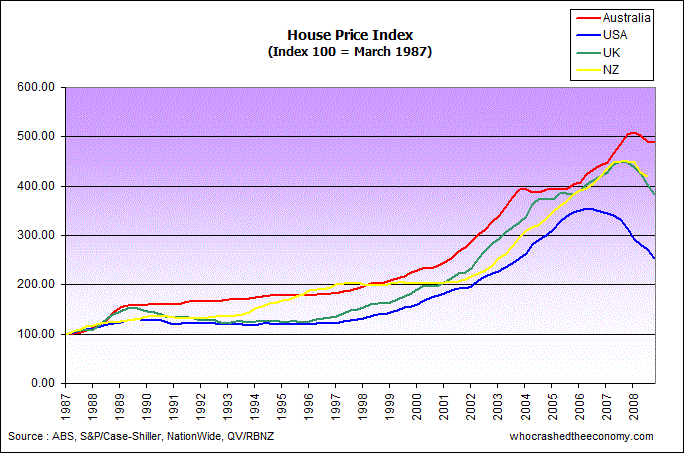
Renting looks good....
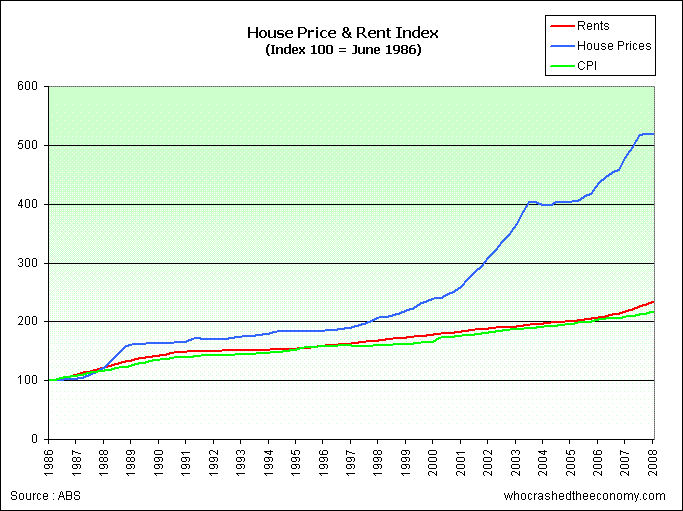
This seems reasonable for BrisVegas prices, imo..

But Dont worry Kev's on the job...
10 June 2009
My mate computers biggers than your mates so House prices will RISE!! Get it..
Doesn't Michael Pascoe know that the RBA and the big boys can only acknowledge disaster after it would be profoundly impoosible to deny it and still maintain a shread of credibility, many reports aren't predictions, they are expectation management...
House prices NOT tipped to slide
What a dangerous thing an economist with a model can be, capable of scaring the horses, wrecking the financial system and generating internet traffic.
Yesterday's strange call by JPMorgan that Australian house prices will fall by 14 per cent in the next year is a case in point. It provided a scary headline that certainly had readers clicking their mice and probably worried some home buyers. I don't know what the horses thought.
And it was most likely hopelessly wrong. If it's a choice between JPMorgan's model echoing the Dr Steven Keen's doomsday scenario on one hand and the combined efforts of the Reserve Bank of Australia, the Australian Prudential Regulation Authority and Macquarie Bank's Rory Robertson on the other, my money is on the latter.
The RBA and APRA also run economic models, on, I suspect, more powerful computers than JPMorgan's Australian office - and they're not worried about house prices at all.
The most public faces of the house price debate have been Robertson vs Keen thanks to their bet on the issue with the loser having to walk to Mt Kosciusko. We reported Robertson's debunking of Keen's 40 per cent forecast three months ago and since then the Macquarie interest rate strategist has strengthened his case with the help of the official family.
The JPMorgan milder version of doom - just a 14 per cent crash - first and foremost fails the historical test of what happened here in the last recession - average house prices actually rose. JPMorgan's model might claim house prices fall by 1.25 per cent for every one per cent rise in unemployment, but the real world doesn't.
The are a number of reasons why the Australian housing market is fundamentally different from those of the US and UK, including our tax policies, that we had a housing boom that topped out in 2003, monetary policy that was rising ahead of this global recession, economic counter-measures put in place early in our slow-down, our banks not completely losing the plot, our home loans are not non-recourse and that we have something like a shortage of housing, as opposed to the over-building that occurred elsewhere.
For hard-core buffs of housing number crunching, papers by the RBA's economic analysis department head, Anthony Richards and financial stability department head Luci Ellis should leave your equines quite relaxed and confident.
Of course it's not good news at the top of the market, but despite all the attention given to Mosman, Toorak, Peppermint Grove and Noosa, that's only a small fraction of total Australian housing and doesn't matter very much in the overall economic scheme of things.
Certainly APRA is very relaxed about any impact the housing market might have on Australia's banks. Indeed, the rivers of gold flowing from residential mortgages to the banks is one of the key ingredients in our financial system's present stability.
Yes, rising unemployment is not good for maintaining house prices, but sharply lower interest rates are. Of those who do lose their jobs, relatively few will actually face foreclosure. Most Australian workers actually don't have a mortgage and of the rest, most have built up a healthy equity buffer to see them through a period of unemployment - which is why our big banks are prepared to capitalise repayments for a year.
On the other hand, as Rory Robertson has repeatedly stressed, monetary policy does work: lift interest rates as the RBA did during the boom and it creates pent-up demand; cut interest rates as the RBA did as the economy slowed and that pent-up demand is unleashed.
But mere history and all the work done by much larger teams of economic thinkers with bigger computers won't stand in the way of a headline and an economist with a model with a nasty prediction.
Which brings one to the whole question of economic models and their serious flaws.
It was a couple of elementary, almost childish flaws in the models used by dopey credit rating agencies that enabled the sub-prime crisis to occur, that falsely blessed rubbish loans with AAA ratings. Fitch had a model that simply assumed house prices rose every year. And when they didn't, the model - and the US economy - clearly failed.
But not only is it likely that things that are too good to be true aren't true, things that are too bad to be true generally aren't true either.
One of the nicest jobs of putting models in their flawed place was done by the Bank of England's executive director for financial stability, Andrew Haldane, in a February speech on risk management. With dry British wit, take it away Andrew Haldane:
"Back in August 2007, the chief financial officer of Goldman Sachs, David Viniar, commented to the Financial Times:
'We are seeing things that were 25-standard deviation moves, several days in a row'
To provide some context, assuming a normal distribution, a 7.26-sigma daily loss would be expected to occur once every 13.7 billion or so years. That is roughly the estimated age of the universe.
A 25-sigma event would be expected to occur once every 6 x 10 to the 124th power lives of the universe. That is quite a lot of human histories.
When I tried to calculate the probability of a 25-sigma event occurring on several successive days, the lights visibly dimmed over London and, in a scene reminiscent of that Lit-tle Britain sketch, the computer said 'No'."
Suffice to say, time is very unlikely to tell whether Mr Viniar's empirical observation proves correct.
Fortunately, there is a simpler explanation - the model was wrong.
Of course, all models are wrong. The only model that is not wrong is reality and reality is not, by definition, a model.
But risk management models have during this crisis proved themselves wrong in a more fundamental sense. They failed Keynes' test - that it is better to be roughly right than precisely wrong. With hindsight, these models were both very precise and very wrong.
For that reason, 2008 might well be remembered as the year stress-testing failed.
Failed those institutions who invested in it in the hope it would transform their management of risk.
Failed the authorities who had relied - perhaps over-relied - on the signal it provided about financial firms' risk management capabilities.
And, perhaps most important of all, failed the financial system as a whole by contributing, first, to the decade of credit boom and, latterly, the credit bust.
Michael Pascoe is a BusinessDay contributing editor.
This story was found at: http://business.smh.com.au/business/house-prices-not-tipped-to-slide-20090603-bv6p.html
http://business.smh.com.au/business/house-prices-not-tipped-to-slide-20090603-bv6p.html?page=-1
House prices NOT tipped to slide
What a dangerous thing an economist with a model can be, capable of scaring the horses, wrecking the financial system and generating internet traffic.
Yesterday's strange call by JPMorgan that Australian house prices will fall by 14 per cent in the next year is a case in point. It provided a scary headline that certainly had readers clicking their mice and probably worried some home buyers. I don't know what the horses thought.
And it was most likely hopelessly wrong. If it's a choice between JPMorgan's model echoing the Dr Steven Keen's doomsday scenario on one hand and the combined efforts of the Reserve Bank of Australia, the Australian Prudential Regulation Authority and Macquarie Bank's Rory Robertson on the other, my money is on the latter.
The RBA and APRA also run economic models, on, I suspect, more powerful computers than JPMorgan's Australian office - and they're not worried about house prices at all.
The most public faces of the house price debate have been Robertson vs Keen thanks to their bet on the issue with the loser having to walk to Mt Kosciusko. We reported Robertson's debunking of Keen's 40 per cent forecast three months ago and since then the Macquarie interest rate strategist has strengthened his case with the help of the official family.
The JPMorgan milder version of doom - just a 14 per cent crash - first and foremost fails the historical test of what happened here in the last recession - average house prices actually rose. JPMorgan's model might claim house prices fall by 1.25 per cent for every one per cent rise in unemployment, but the real world doesn't.
The are a number of reasons why the Australian housing market is fundamentally different from those of the US and UK, including our tax policies, that we had a housing boom that topped out in 2003, monetary policy that was rising ahead of this global recession, economic counter-measures put in place early in our slow-down, our banks not completely losing the plot, our home loans are not non-recourse and that we have something like a shortage of housing, as opposed to the over-building that occurred elsewhere.
For hard-core buffs of housing number crunching, papers by the RBA's economic analysis department head, Anthony Richards and financial stability department head Luci Ellis should leave your equines quite relaxed and confident.
Of course it's not good news at the top of the market, but despite all the attention given to Mosman, Toorak, Peppermint Grove and Noosa, that's only a small fraction of total Australian housing and doesn't matter very much in the overall economic scheme of things.
Certainly APRA is very relaxed about any impact the housing market might have on Australia's banks. Indeed, the rivers of gold flowing from residential mortgages to the banks is one of the key ingredients in our financial system's present stability.
Yes, rising unemployment is not good for maintaining house prices, but sharply lower interest rates are. Of those who do lose their jobs, relatively few will actually face foreclosure. Most Australian workers actually don't have a mortgage and of the rest, most have built up a healthy equity buffer to see them through a period of unemployment - which is why our big banks are prepared to capitalise repayments for a year.
On the other hand, as Rory Robertson has repeatedly stressed, monetary policy does work: lift interest rates as the RBA did during the boom and it creates pent-up demand; cut interest rates as the RBA did as the economy slowed and that pent-up demand is unleashed.
But mere history and all the work done by much larger teams of economic thinkers with bigger computers won't stand in the way of a headline and an economist with a model with a nasty prediction.
Which brings one to the whole question of economic models and their serious flaws.
It was a couple of elementary, almost childish flaws in the models used by dopey credit rating agencies that enabled the sub-prime crisis to occur, that falsely blessed rubbish loans with AAA ratings. Fitch had a model that simply assumed house prices rose every year. And when they didn't, the model - and the US economy - clearly failed.
But not only is it likely that things that are too good to be true aren't true, things that are too bad to be true generally aren't true either.
One of the nicest jobs of putting models in their flawed place was done by the Bank of England's executive director for financial stability, Andrew Haldane, in a February speech on risk management. With dry British wit, take it away Andrew Haldane:
"Back in August 2007, the chief financial officer of Goldman Sachs, David Viniar, commented to the Financial Times:
'We are seeing things that were 25-standard deviation moves, several days in a row'
To provide some context, assuming a normal distribution, a 7.26-sigma daily loss would be expected to occur once every 13.7 billion or so years. That is roughly the estimated age of the universe.
A 25-sigma event would be expected to occur once every 6 x 10 to the 124th power lives of the universe. That is quite a lot of human histories.
When I tried to calculate the probability of a 25-sigma event occurring on several successive days, the lights visibly dimmed over London and, in a scene reminiscent of that Lit-tle Britain sketch, the computer said 'No'."
Suffice to say, time is very unlikely to tell whether Mr Viniar's empirical observation proves correct.
Fortunately, there is a simpler explanation - the model was wrong.
Of course, all models are wrong. The only model that is not wrong is reality and reality is not, by definition, a model.
But risk management models have during this crisis proved themselves wrong in a more fundamental sense. They failed Keynes' test - that it is better to be roughly right than precisely wrong. With hindsight, these models were both very precise and very wrong.
For that reason, 2008 might well be remembered as the year stress-testing failed.
Failed those institutions who invested in it in the hope it would transform their management of risk.
Failed the authorities who had relied - perhaps over-relied - on the signal it provided about financial firms' risk management capabilities.
And, perhaps most important of all, failed the financial system as a whole by contributing, first, to the decade of credit boom and, latterly, the credit bust.
Michael Pascoe is a BusinessDay contributing editor.
This story was found at: http://business.smh.com.au/business/house-prices-not-tipped-to-slide-20090603-bv6p.html
http://business.smh.com.au/business/house-prices-not-tipped-to-slide-20090603-bv6p.html?page=-1
30 April 2009
Unspun News from "Of two minds"
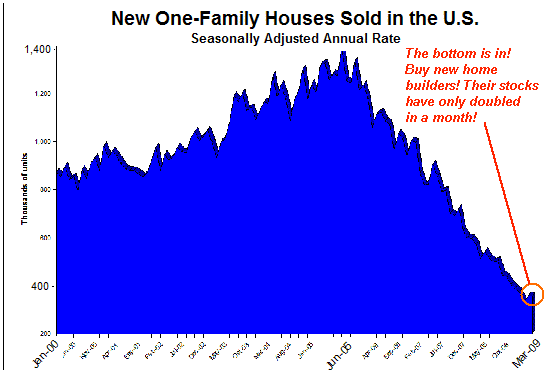
New Home Sales Plummet 30%; Govt and RE Industry Spin Phony "Bottom"
What few comment on is the complicity of all who remain silent in the face of the Big Lie because they have a self-serving interest in the Big Lie's success. Everyone with a stake in housing or the stock market is hoping the 24/7 propaganda tsunami succeeds in creating a renewed surge in stocks, housing, borrowing and spending, even as they know in their hearts and in their minds it's all lies, fabrications, dissembling, distortions, manipulation and brainwashing repetition of half-truths.
We all know the data is being spun so hard it's become a blur. New home sales fall from 1.4 million units a year to 350,000? Great! the bottom is in!
GDP is tanking? Great! Inventories will need to be restocked soon on a gigantic scale.
Banks made obscene profits from trading tricks and the usual accounting frauds? Great! The banking sector is healthy again! (Had a loss in December? Just drop that month from your reporting--it works every time!)
Ford only lost $1.4 billion last quarter? Great! It doesn't need a bailout (yet) so let's triple the stock because "the bottom is in."
http://www.oftwominds.com/blog.html
15 April 2009
US banks enjoy Mortgage "eye of storm" but worst to come
benefited from a perfect storm of low mortgage rates spurring increased mortgage activity; foreclosure moratorium pushing out losses and reserves alike; and massive government capital backing. The question going forward is can earnings outpace losses?
If the economy and housing have indeed bottomed and new loan defaults have peaked then perhaps the banks will do very well. But if Q1 was more of an ‘eye of the storm’ then can banks — relying upon consumers and business — out earn the losses at a time when consumers and businesses are experiencing increased balance sheet stress.
The following charts show why some banks may out earn their residential credit losses in Q1. But it is not about what happened in Q1 with the mortgage lender-banks and housing – it’s about going forward. Judging from the hard data over the past several month’s, real estate and mortgage have in fact been the eye of a storm that carries us from the Subprime Implosion to the overall Mortgage and Housing Implosion.
Monthly foreclosures at 1.5 year low…for now - the chart below shows actual CA monthly residential foreclosures for the past two years. As you can see, foreclosures — that result is significant losses especially in the bubble states — were down considerably due to gov’t intervention and bank/GSE specific moratoria. This will keep losses at a minimum for Q1. If banks chose to reserve based upon these temporary conditions in Q1, then that may benefit their bottom line. But foreclosures are a lagging indicator.
Charts and data
If the economy and housing have indeed bottomed and new loan defaults have peaked then perhaps the banks will do very well. But if Q1 was more of an ‘eye of the storm’ then can banks — relying upon consumers and business — out earn the losses at a time when consumers and businesses are experiencing increased balance sheet stress.
The following charts show why some banks may out earn their residential credit losses in Q1. But it is not about what happened in Q1 with the mortgage lender-banks and housing – it’s about going forward. Judging from the hard data over the past several month’s, real estate and mortgage have in fact been the eye of a storm that carries us from the Subprime Implosion to the overall Mortgage and Housing Implosion.
Monthly foreclosures at 1.5 year low…for now - the chart below shows actual CA monthly residential foreclosures for the past two years. As you can see, foreclosures — that result is significant losses especially in the bubble states — were down considerably due to gov’t intervention and bank/GSE specific moratoria. This will keep losses at a minimum for Q1. If banks chose to reserve based upon these temporary conditions in Q1, then that may benefit their bottom line. But foreclosures are a lagging indicator.
Charts and data
8 April 2009
Aussie home prices to absolutely crater ~ Keen
The ABS has only maintained a comprehensive index of Australian house prices since mid-1986–a time when the hills were alive to the sound of Alan Bond and Christopher Skase. House prices rose 60% in the first three years of the index, far above the rate of inflation at the time. They then stalled for the next few years before more than tripling over the next 17 years–again, a rate of growth that far exceeded the rate of inflation. This 30-year-plus experience of continuously rising prices has helped shape the belief that house prices “always” rise faster than consumer prices.

But “always” is a much longer time span than a mere 30 years–something Robert Shiller appreciated when he and Karl Case developed the index of US house prices now known as the Case-Shiller Index. The key comparison Shiller makes is between house prices and consumer prices; this is the premiere indicator of the American market, and there it’s clear that the bubble has popped.
If we take a 25 year view, like that which Richards used in his paper, it could be argued that the fall in the index has almost brought the real price of American housing back to the average. Having plateaued at a value of 217 between 2005 and 2007, it has now fallen to 138, which is just 11% above the 85-09 average.

But if we look at the really long term–over the whole data set from 1890 till now–it’s apparent that the American market has some way to fall before it hits the average: even though it has already fallen 30% from its peak, it still has another 46% to go, if the real price of housing is constant over the long term.
That’s an if to which Shiller gives an emphatic “yes” to, based partly on his own data–which shows no trend to rising real house prices prior to the current bubble that clearly began in 1997–and partly on a yet longer term series still: the “Herengracht Index” that shows the real price of housing on a famous canal in Amsterdam over the three and a half centuries from 1628 till 1970. This index has at times risen for extended periods–such as over the 7 decades between 1814 and 1887 when the real price of a house on the Herengracht Canal rose almost fourfold. Anyone born at the beginning of that period could have easily been persuaded that house prices “always” rise faster than consumer prices.
But over the long term, there is no trend. For the next 7 decades, house prices tended down in real terms: the index fell 55% from the 1887 peak to be 40% below the long term average of 198 in 1951, when yet another upward trend occurred.
Could a similar proposition apply to Australia? Dr Nigel Stapledon set out to answer this question in his PhD, where he observed that:
The period since the early 1970s has been one in which house prices have risen quite significantly by any measure with the median capital city house prices in Australia having risen on average 3% per annum in real terms in the period 1970-2006. While the rises in Australia have been above the average for developed countries, the picture is similar in most OECD economies and Australia is by no means unique.
The question that can be asked is whether this period is unique for housing? Eichholtz (1997) has constructed a long term series for Amsterdam in Holland which spans the period 1628-1973. The broad picture that his time series paints is one of prices essentially showing no trend for three centuries, with cycles related to the economic events. Against that long term perspective the post 1970 rise in house prices in Holland stands out. But one city is probably not convincing…” (Stapledon 2007, p. 1)
Stapledon’s key data table gave the median capital city house price in current dollars, 2005 dollars, and 2005 dollars deflated by 0.6% p.a. to reflect increasing house quality. In the following graph I take Stapledon’s CPI and quality deflated index, extended to today using the last 2 years of ABS data deflated by the CPI. I then set the value to 100 in 1890 to enable easy comparison with the Case-Shiller real house price index for the USA.

One inference from this graph is that the recent Australian house price bubble began earlier at much the same time as the USA’s (1997), but began from an already higher base that can be dated back to the 1987 Stock Market Crash.
At that time, the Australian index was only marginally higher than the USA’s–132 for Australia versus 120.5 for the USA, a 10% difference. But the 25% fall in the Australian stock market on Black Tuesday ended the Antipodean flirtation with stocks, and we piled right back into our favourite speculative play: bricks and mortar. Most of the money borrowed by Australian households for speculative purposes then drove up house prices, whereas Americans spread their leveraged dollars between stocks and houses.
As a result, Australian house prices absorbed most of the speculative excess of the last thirty years, driving them to 3.5 times the long term average versus “just” twice the average in the USA.
Of course, it could be true that, as the property lobby keeps asserting, Australia is “different”, and trends that don’t exist elsewhere in the world rule in the land of the marsupials. Especially since virtually everyone now describes this crisis as “the worst since the Great Depression, it would have helped if the RBA had referred to this publicly available data when preparing its own comparison of current house prices to “long term” trends.
The Never-Ending UnderSupply Story
Richards did express some scepticism here on behalf of the RBA that Australia’s undersupply of housing was as marked as some commentators claim, but he still came down on the side of this widely shared belief:
“Whatever the true shortfall of dwellings, we can say with some confidence that our housing market is relatively tight. This can be contrasted with the US market which many observers characterise as having been subject to overbuilding during their housing boom. And the relative tightness of the Australian housing market is one factor that will support home-building in the period ahead.”
Curiously, one group that does not share this belief is Hometrack, the local branch of the UK housing intelligence research group. Just days after Richards’ speech, it released a press release in which it stated that:
the widely quoted views of many property market commentators who believe that Australia’s current building levels are not enough to meet the future demand for housing, may be based on inaccurate data calculations.
“Our analysis indicates Australia may already have an excess of housing. We estimate there are at least 10 million dwellings in Australia compared with ABS data showing occupied dwellings of 8.3 million. The extra one to two million dwellings consists of a mixture of housing awaiting sale or development, vacant dwellings, second homes, and abandoned homes,” he said.
He went on to say that the ABS method for calculating the ratio of people per dwellings is based on ABS census data which in turn is based upon occupied dwellings. However, he said, Hometrack analysis which is based on postal address data indicates that Australia’s current level of housing relative to its population is in line with other Anglo economies.
Following on from this, Darcy said that when looked at in the context of population growth, total residential building approvals have been running above demand.
“This points to a build-up of excess stock of housing over the past six years, despite the gap between building approvals and demand narrowing over recent months,” he said.
“The concern is that business and government decisions regarding the residential housing market in Australia are being made based on demand assumptions that differ from the actual behavior of the housing market. There will always be examples of areas with an undersupply, but it’s not clear from the data that we have an overall shortage relative to future demand.”
One must read Keen's article
But “always” is a much longer time span than a mere 30 years–something Robert Shiller appreciated when he and Karl Case developed the index of US house prices now known as the Case-Shiller Index. The key comparison Shiller makes is between house prices and consumer prices; this is the premiere indicator of the American market, and there it’s clear that the bubble has popped.
If we take a 25 year view, like that which Richards used in his paper, it could be argued that the fall in the index has almost brought the real price of American housing back to the average. Having plateaued at a value of 217 between 2005 and 2007, it has now fallen to 138, which is just 11% above the 85-09 average.
But if we look at the really long term–over the whole data set from 1890 till now–it’s apparent that the American market has some way to fall before it hits the average: even though it has already fallen 30% from its peak, it still has another 46% to go, if the real price of housing is constant over the long term.
That’s an if to which Shiller gives an emphatic “yes” to, based partly on his own data–which shows no trend to rising real house prices prior to the current bubble that clearly began in 1997–and partly on a yet longer term series still: the “Herengracht Index” that shows the real price of housing on a famous canal in Amsterdam over the three and a half centuries from 1628 till 1970. This index has at times risen for extended periods–such as over the 7 decades between 1814 and 1887 when the real price of a house on the Herengracht Canal rose almost fourfold. Anyone born at the beginning of that period could have easily been persuaded that house prices “always” rise faster than consumer prices.
But over the long term, there is no trend. For the next 7 decades, house prices tended down in real terms: the index fell 55% from the 1887 peak to be 40% below the long term average of 198 in 1951, when yet another upward trend occurred.
Could a similar proposition apply to Australia? Dr Nigel Stapledon set out to answer this question in his PhD, where he observed that:
The period since the early 1970s has been one in which house prices have risen quite significantly by any measure with the median capital city house prices in Australia having risen on average 3% per annum in real terms in the period 1970-2006. While the rises in Australia have been above the average for developed countries, the picture is similar in most OECD economies and Australia is by no means unique.
The question that can be asked is whether this period is unique for housing? Eichholtz (1997) has constructed a long term series for Amsterdam in Holland which spans the period 1628-1973. The broad picture that his time series paints is one of prices essentially showing no trend for three centuries, with cycles related to the economic events. Against that long term perspective the post 1970 rise in house prices in Holland stands out. But one city is probably not convincing…” (Stapledon 2007, p. 1)
Stapledon’s key data table gave the median capital city house price in current dollars, 2005 dollars, and 2005 dollars deflated by 0.6% p.a. to reflect increasing house quality. In the following graph I take Stapledon’s CPI and quality deflated index, extended to today using the last 2 years of ABS data deflated by the CPI. I then set the value to 100 in 1890 to enable easy comparison with the Case-Shiller real house price index for the USA.
One inference from this graph is that the recent Australian house price bubble began earlier at much the same time as the USA’s (1997), but began from an already higher base that can be dated back to the 1987 Stock Market Crash.
At that time, the Australian index was only marginally higher than the USA’s–132 for Australia versus 120.5 for the USA, a 10% difference. But the 25% fall in the Australian stock market on Black Tuesday ended the Antipodean flirtation with stocks, and we piled right back into our favourite speculative play: bricks and mortar. Most of the money borrowed by Australian households for speculative purposes then drove up house prices, whereas Americans spread their leveraged dollars between stocks and houses.
As a result, Australian house prices absorbed most of the speculative excess of the last thirty years, driving them to 3.5 times the long term average versus “just” twice the average in the USA.
Of course, it could be true that, as the property lobby keeps asserting, Australia is “different”, and trends that don’t exist elsewhere in the world rule in the land of the marsupials. Especially since virtually everyone now describes this crisis as “the worst since the Great Depression, it would have helped if the RBA had referred to this publicly available data when preparing its own comparison of current house prices to “long term” trends.
The Never-Ending UnderSupply Story
Richards did express some scepticism here on behalf of the RBA that Australia’s undersupply of housing was as marked as some commentators claim, but he still came down on the side of this widely shared belief:
“Whatever the true shortfall of dwellings, we can say with some confidence that our housing market is relatively tight. This can be contrasted with the US market which many observers characterise as having been subject to overbuilding during their housing boom. And the relative tightness of the Australian housing market is one factor that will support home-building in the period ahead.”
Curiously, one group that does not share this belief is Hometrack, the local branch of the UK housing intelligence research group. Just days after Richards’ speech, it released a press release in which it stated that:
the widely quoted views of many property market commentators who believe that Australia’s current building levels are not enough to meet the future demand for housing, may be based on inaccurate data calculations.
“Our analysis indicates Australia may already have an excess of housing. We estimate there are at least 10 million dwellings in Australia compared with ABS data showing occupied dwellings of 8.3 million. The extra one to two million dwellings consists of a mixture of housing awaiting sale or development, vacant dwellings, second homes, and abandoned homes,” he said.
He went on to say that the ABS method for calculating the ratio of people per dwellings is based on ABS census data which in turn is based upon occupied dwellings. However, he said, Hometrack analysis which is based on postal address data indicates that Australia’s current level of housing relative to its population is in line with other Anglo economies.
Following on from this, Darcy said that when looked at in the context of population growth, total residential building approvals have been running above demand.
“This points to a build-up of excess stock of housing over the past six years, despite the gap between building approvals and demand narrowing over recent months,” he said.
“The concern is that business and government decisions regarding the residential housing market in Australia are being made based on demand assumptions that differ from the actual behavior of the housing market. There will always be examples of areas with an undersupply, but it’s not clear from the data that we have an overall shortage relative to future demand.”
One must read Keen's article
18 March 2009
Aussie home prices to fall 30% ~ No Question!!
This is a given, we are merely the last dominio to fall.....
THE Australian housing market is facing the prospect of a "perfect storm" of financial pressures - including high mortgage debt, overvalued homes and rising unemployment - in which prices could eventually fall by as much as 30 per cent, investors have been warned.
Research compiled by international analysts has indicated that while domestic house prices held up well amid the breaking global financial crisis, in the impact of the worsening local downturn they have come off their peak.
Prices are beginning to slide in line with declines in the US and Britain, the report suggests.
There, the fall in housing values has exacerbated recessions and prices have started dropping below or sharply back to what is described as "fair value" levels after nearly 10 years of soaring property costs.
The special report was compiled by BCA Research in Canada. It shows that the residential market fell 25 per cent in the US and 18 per cent in Britain last year.
By contrast, Australian prices slipped a "mere" 4 per cent from the all-time highs recorded in the first quarter of last year.
The authors of the report say the "ferocity of the price collapses" in the US and Britain was made worse by the meltdown in the financial services industry - a factor that is affecting Australia's two financial centres, Sydney and Melbourne.
"The housing market is looking particularly vulnerable, with overinflated prices, deteriorating affordability and slowing household income growth," the report says. "There is an increasing possibility of a major housing bust in Australia."
The authors of last month's report, which is now circulating among local investors, accept that a variety of positive factors could help cushion any fall.
These include past budget surpluses, the Federal Government's two stimulus packages, the strength of the Australian banks, which have avoided a "disastrous lending binge", falling interest rates and the drop in the value of the Australian dollar.
The report's conclusions are set against a background of tentative signs that the housing market is shrugging off the immediate effects of the downturn, helped in part by the Government's $14,000 first-home buyer's grant and an extra $7000 for people who purchase new homes.
Latest figures showed that $8 billion of new home loans were taken out at the end of January of which a quarter were advanced to first-time buyers who are driving a mini-revival in sales at the lower end of the market.
That has prompted the Sydney Chamber of Commerce to press the Federal Government to extend the level of cash support to first-time buyers beyond the current June 30 cut-off point.
Warning t the grant's removal could send the housing market into a tailspin, the chamber's executive director, Patricia Forsythe, said: "Next to the massive reduction in interest rates, the first-home buyer boost has been the most successful stimulatory measure for the economy."
link
THE Australian housing market is facing the prospect of a "perfect storm" of financial pressures - including high mortgage debt, overvalued homes and rising unemployment - in which prices could eventually fall by as much as 30 per cent, investors have been warned.
Research compiled by international analysts has indicated that while domestic house prices held up well amid the breaking global financial crisis, in the impact of the worsening local downturn they have come off their peak.
Prices are beginning to slide in line with declines in the US and Britain, the report suggests.
There, the fall in housing values has exacerbated recessions and prices have started dropping below or sharply back to what is described as "fair value" levels after nearly 10 years of soaring property costs.
The special report was compiled by BCA Research in Canada. It shows that the residential market fell 25 per cent in the US and 18 per cent in Britain last year.
By contrast, Australian prices slipped a "mere" 4 per cent from the all-time highs recorded in the first quarter of last year.
The authors of the report say the "ferocity of the price collapses" in the US and Britain was made worse by the meltdown in the financial services industry - a factor that is affecting Australia's two financial centres, Sydney and Melbourne.
"The housing market is looking particularly vulnerable, with overinflated prices, deteriorating affordability and slowing household income growth," the report says. "There is an increasing possibility of a major housing bust in Australia."
The authors of last month's report, which is now circulating among local investors, accept that a variety of positive factors could help cushion any fall.
These include past budget surpluses, the Federal Government's two stimulus packages, the strength of the Australian banks, which have avoided a "disastrous lending binge", falling interest rates and the drop in the value of the Australian dollar.
The report's conclusions are set against a background of tentative signs that the housing market is shrugging off the immediate effects of the downturn, helped in part by the Government's $14,000 first-home buyer's grant and an extra $7000 for people who purchase new homes.
Latest figures showed that $8 billion of new home loans were taken out at the end of January of which a quarter were advanced to first-time buyers who are driving a mini-revival in sales at the lower end of the market.
That has prompted the Sydney Chamber of Commerce to press the Federal Government to extend the level of cash support to first-time buyers beyond the current June 30 cut-off point.
Warning t the grant's removal could send the housing market into a tailspin, the chamber's executive director, Patricia Forsythe, said: "Next to the massive reduction in interest rates, the first-home buyer boost has been the most successful stimulatory measure for the economy."
link
Cath Fitts on the housing bubble origins
Ladies and Gentlemen:
In his article on your opinion page, “The Fed Didn’t Cause the Housing Bubble,” Alan Greenspan attributes the housing bubble to lower interest rates between 2002 and 2005. That’s amazing to me.
My company served as lead financial advisor to the Federal Housing Administration between 1994 and 1997. I watched both the Administration and the Federal Reserve aggressively implement the policies that engineered the housing bubble. These are described at my website and in my on-line book,Dillon Read & the Aristocracy of Stock Profits (http://www.dunwalke.com).
One story, for example, is the following:
“In 1995, a senior Clinton Administration official shared with me the Administration’s targets for Fannie Mae and Freddie Mac mortgage volumes in low- and moderate-income communities. We had recently reviewed the Administration’s plans to increase government mortgage guarantees — most of these mortgages would also be pooled and sold as securities to investors. Even in 1995, I could see that these plans would create unserviceable debt loads in communities struggling with the falling incomes expected from globalization. Homeowners would default on mortgages while losses on mortgage-backed securities would drain retirement savings from 401(k)s and pension plans. Taxpayers would ultimately be hit with a large bill . . . but insiders would make a bundle. I looked at the official and said that the Administration was planning on issuing more mortgages than there were houses or residents. “Shut up, this is none of your business,” the official snapped back.”
From: “Sub-Prime Mortgage Woes Are No Accident” (http://solari.com/news/announcements/08-07-07/)
One of the dirty little secrets behind the housing bubble is the long standing partnership of narcotics trafficking and mortgage fraud and the use of the two in combination to target and destroy minority and poor communities with highly profitable economic warfare. This model is global. It is operating in counties throughout the world as well as in US communities.
Of all the actions that the Federal Reserve took to engineer this housing bubble, the one that I would note is Mr. Greenspan’s efforts to pacify Congresswoman Waters regarding allegations of government sponsored narcotics trafficking at a time when open Congressional hearings would have contributed to an important discussion of the operations engaging in mortgage fraud in minority communities. See, “Financial Coup d’Etat,” Chapter 16, Dillon Read & the Aristocracy of Stock Profits which was written in 2005 and published in April 2006, drawing from an article I first published in May 1999.
“On December 18, 1997, the CIA Inspector General delivered Volume I of their report to the Senate Select Committee on Intelligence regarding charges that the CIA was complicit in narcotics trafficking in South Central Los Angeles. Washington, D.C. ’s response was compatible with attracting the continued flow of an estimated $500 billion–$1 trillion a year of money laundering into the U.S. financial system. Federal Reserve Chairman Alan Greenspan in January 1998 visited Los Angeles with Congresswoman Maxine Waters — who had been a vocal critic of the government’s involvement in narcotics trafficking — with news reports that he had pledged billions to come to her district. In February Al Gore announced that Water’s district in Los Angeles had been awarded Empowerment Zone status by HUD (under Secretary Cuomo’s leadership) and made eligible for $300 million in federal grants and tax benefits.”
Alan Greenspan is a liar. The Federal Reserve and its long standing partner, the US Treasury, engineered the housing bubble, including the fraudulent inducement of America as part of a financial coup d’etat. Our bankruptcy was not an accident. It was engineered at the highest levels.
Your publication of Greenspan’s breezy and bogus history of the housing bubble insults your readership.
Best Regards,
Catherine Austin Fitts
Assistant Secretary of Housing - Federal Housing Commissioner, Bush I
In his article on your opinion page, “The Fed Didn’t Cause the Housing Bubble,” Alan Greenspan attributes the housing bubble to lower interest rates between 2002 and 2005. That’s amazing to me.
My company served as lead financial advisor to the Federal Housing Administration between 1994 and 1997. I watched both the Administration and the Federal Reserve aggressively implement the policies that engineered the housing bubble. These are described at my website and in my on-line book,Dillon Read & the Aristocracy of Stock Profits (http://www.dunwalke.com).
One story, for example, is the following:
“In 1995, a senior Clinton Administration official shared with me the Administration’s targets for Fannie Mae and Freddie Mac mortgage volumes in low- and moderate-income communities. We had recently reviewed the Administration’s plans to increase government mortgage guarantees — most of these mortgages would also be pooled and sold as securities to investors. Even in 1995, I could see that these plans would create unserviceable debt loads in communities struggling with the falling incomes expected from globalization. Homeowners would default on mortgages while losses on mortgage-backed securities would drain retirement savings from 401(k)s and pension plans. Taxpayers would ultimately be hit with a large bill . . . but insiders would make a bundle. I looked at the official and said that the Administration was planning on issuing more mortgages than there were houses or residents. “Shut up, this is none of your business,” the official snapped back.”
From: “Sub-Prime Mortgage Woes Are No Accident” (http://solari.com/news/announcements/08-07-07/)
One of the dirty little secrets behind the housing bubble is the long standing partnership of narcotics trafficking and mortgage fraud and the use of the two in combination to target and destroy minority and poor communities with highly profitable economic warfare. This model is global. It is operating in counties throughout the world as well as in US communities.
Of all the actions that the Federal Reserve took to engineer this housing bubble, the one that I would note is Mr. Greenspan’s efforts to pacify Congresswoman Waters regarding allegations of government sponsored narcotics trafficking at a time when open Congressional hearings would have contributed to an important discussion of the operations engaging in mortgage fraud in minority communities. See, “Financial Coup d’Etat,” Chapter 16, Dillon Read & the Aristocracy of Stock Profits which was written in 2005 and published in April 2006, drawing from an article I first published in May 1999.
“On December 18, 1997, the CIA Inspector General delivered Volume I of their report to the Senate Select Committee on Intelligence regarding charges that the CIA was complicit in narcotics trafficking in South Central Los Angeles. Washington, D.C. ’s response was compatible with attracting the continued flow of an estimated $500 billion–$1 trillion a year of money laundering into the U.S. financial system. Federal Reserve Chairman Alan Greenspan in January 1998 visited Los Angeles with Congresswoman Maxine Waters — who had been a vocal critic of the government’s involvement in narcotics trafficking — with news reports that he had pledged billions to come to her district. In February Al Gore announced that Water’s district in Los Angeles had been awarded Empowerment Zone status by HUD (under Secretary Cuomo’s leadership) and made eligible for $300 million in federal grants and tax benefits.”
Alan Greenspan is a liar. The Federal Reserve and its long standing partner, the US Treasury, engineered the housing bubble, including the fraudulent inducement of America as part of a financial coup d’etat. Our bankruptcy was not an accident. It was engineered at the highest levels.
Your publication of Greenspan’s breezy and bogus history of the housing bubble insults your readership.
Best Regards,
Catherine Austin Fitts
Assistant Secretary of Housing - Federal Housing Commissioner, Bush I
15 February 2009
Signposts Towards The Inevitable
While many people (thanks to the MSM) place the blame for the source of our current economic woes on the Sub-Prime mortgage problem, this was but one symptom that first manifested from the fundamental American Govt. disease of abusive largesse of its world reserve currency. However, with this flawed former line of reasoning, the same people come to the erroneous conclusion that solving the housing crisis will solve the whole problem. This is only partly true. Whilst underpinning the deteriorating housing situation would be a great first step forward in this mess, the FED seems more intent on bailing out the investment banks which were complicit in willfully slicing, dicing and packaging all the highly complex and highly suspect derived debt instruments in the first place.
Yet the Sub-Prime problem pales in comparison to the next wave of loan resets and associated defaults that is about to hit. With the bulk of the Sub-Prime ARM resets out of the way, we have another wave of Alt-A and Option ARM resets to undergo. This will be an additional blow on top of all the other financial fallout that is currently hitting the fan.
The graph below shows an extended Wave 2 due to hit an already stressed and systemically weakened financial shoreline in April/May09.

If we are to believe certain analysts, this second wave (affecting $2 trillion worth of mortgages) is twice as large as the first in terms of dollars lent although to me the areas under each wave look comparable. Larger or similar in size, it matters not. With an already cash-strapped US home owner and an already battered US economy, the ensuing fallout may be multiples of the Sub-Prime defaults. We are already seeing huge declines in home real estate prices especially in the hotter areas. Bob Chapman estimates average house price declines could reach 35% from their Jun05 highs while hotter areas could fall by 60%.
Growing consensus expects the commercial real estate market to be the next property class to go pear-shaped, as retail outlets and financial firms go bust. New York real estate was already down 61% in Nov08 by Gerald Celente’s reckoning. We can expect these figures to be periodically revised downwards as the full extent of the wash-out becomes apparent. My gut feeling is an average decline figure around 80% from the high as we will not simply be returning to sensible pre-binge norms but diving deeper below them. The following is from the Wall Street Journal:
“In the typical severe financial crisis, the real (inflation-adjusted) price of housing tends to decline 36%, with the duration of peak to trough lasting five to six years. Given that U.S. housing prices peaked at the end of 2005, this means that the bottom won't come before the end of 2010, with real housing prices falling perhaps another 8%-10% from current levels.
Perhaps the most stunning message from crisis history is the simply staggering rise in government debt most countries experience. Central government debt tends to rise over 85% in real terms during the first three years after a banking crisis. This would mean another $8 trillion or $9 trillion in the case of the U.S.
Interestingly, the main reason why debt explodes is not the much ballyhooed cost of bailing out the financial system, painful as that may be. Instead, the real culprit is the inevitable collapse of tax revenues that comes as countries sink into deep and prolonged recession.” (What Other Financial Crises Tell Us)
My point being that this is not your typical severe financial crisis. So even if President Obama does suddenly find religion and decide to bailout real estate owners rather than giving TARP (tax payer’s) money to the investment banks, or into infrastructure spending, we can expect another wave of foreclosures coming to a shoreline near you to scuttle any hope of a quick recovery that many fairy-tale MSM analysts proffer. This second wave will not only hit consumers where it hurts but also put the final nail into the coffin of an already beleaguered US construction industry. With consumerism and home-related service industries having made up such a large proportion of past US GDP, it is not hard to read where this signpost leads.
Yet the Sub-Prime problem pales in comparison to the next wave of loan resets and associated defaults that is about to hit. With the bulk of the Sub-Prime ARM resets out of the way, we have another wave of Alt-A and Option ARM resets to undergo. This will be an additional blow on top of all the other financial fallout that is currently hitting the fan.
The graph below shows an extended Wave 2 due to hit an already stressed and systemically weakened financial shoreline in April/May09.

If we are to believe certain analysts, this second wave (affecting $2 trillion worth of mortgages) is twice as large as the first in terms of dollars lent although to me the areas under each wave look comparable. Larger or similar in size, it matters not. With an already cash-strapped US home owner and an already battered US economy, the ensuing fallout may be multiples of the Sub-Prime defaults. We are already seeing huge declines in home real estate prices especially in the hotter areas. Bob Chapman estimates average house price declines could reach 35% from their Jun05 highs while hotter areas could fall by 60%.
Growing consensus expects the commercial real estate market to be the next property class to go pear-shaped, as retail outlets and financial firms go bust. New York real estate was already down 61% in Nov08 by Gerald Celente’s reckoning. We can expect these figures to be periodically revised downwards as the full extent of the wash-out becomes apparent. My gut feeling is an average decline figure around 80% from the high as we will not simply be returning to sensible pre-binge norms but diving deeper below them. The following is from the Wall Street Journal:
“In the typical severe financial crisis, the real (inflation-adjusted) price of housing tends to decline 36%, with the duration of peak to trough lasting five to six years. Given that U.S. housing prices peaked at the end of 2005, this means that the bottom won't come before the end of 2010, with real housing prices falling perhaps another 8%-10% from current levels.
Perhaps the most stunning message from crisis history is the simply staggering rise in government debt most countries experience. Central government debt tends to rise over 85% in real terms during the first three years after a banking crisis. This would mean another $8 trillion or $9 trillion in the case of the U.S.
Interestingly, the main reason why debt explodes is not the much ballyhooed cost of bailing out the financial system, painful as that may be. Instead, the real culprit is the inevitable collapse of tax revenues that comes as countries sink into deep and prolonged recession.” (What Other Financial Crises Tell Us)
My point being that this is not your typical severe financial crisis. So even if President Obama does suddenly find religion and decide to bailout real estate owners rather than giving TARP (tax payer’s) money to the investment banks, or into infrastructure spending, we can expect another wave of foreclosures coming to a shoreline near you to scuttle any hope of a quick recovery that many fairy-tale MSM analysts proffer. This second wave will not only hit consumers where it hurts but also put the final nail into the coffin of an already beleaguered US construction industry. With consumerism and home-related service industries having made up such a large proportion of past US GDP, it is not hard to read where this signpost leads.
5 February 2009
Same old story
Economics has become a bit of a farce lately. Why? For the last 200 years the root cause of economic downturns has been the same: land speculation. Consider American history:
1. Panic of 1818 - preceded by a huge land bubble (which popped due to exoberant debt and an increase in land taxes)
2. Panic of 1837 - preceded by a huge land bubble, speculative frenzy in canals (which popped due to the Specie Circular)
3. Panic of 1854 - speculative frenzy in lands near railways and canals (popped due to exoberant debt)
4. Panic of 1873 - speculation in commercial property (popped due to exoberant debt)
4. Panic of 1893 - another land boom in silver lands
5. Panic of 1907 - overbuilding due to land speculation
6. Great Depression - huge levels of mortgage debt in city areas, farm banks collapsed due to excessive land speculation in farm lands - in Chicago a huge land boom occured, so big, in fact, that after 1928 not one property was built there 1948!
7. 1954 and 1960 - tightened monetary policy (albeit, it did hurt the housing market, which simply implies housing is a transmission mechanism for consumption and investment).
8. 1970 - land boom
9.1975 and 1983 - huge residential property boom, millions of acres of farm land were displaced for the purposes of residential housing (hence, why inflation in agricutral lands was occuring *even before* any oil shock) - companies had invested millions in land, and when interest rates were hiked, these turned into malinvestments
10. 1990- commercial property boom
11. 2001 - housing did contract, although its probably a false negative
12. 2008 - just another part of the story - excessive investment in land which fuelled consumption and investment. In this case a massive boom in real estate everywhere, but China, UK, US and emerging europe in particular.
This bust will be mighty. In 1929 it was the US bubble causing contagion. This is universal.
1. Panic of 1818 - preceded by a huge land bubble (which popped due to exoberant debt and an increase in land taxes)
2. Panic of 1837 - preceded by a huge land bubble, speculative frenzy in canals (which popped due to the Specie Circular)
3. Panic of 1854 - speculative frenzy in lands near railways and canals (popped due to exoberant debt)
4. Panic of 1873 - speculation in commercial property (popped due to exoberant debt)
4. Panic of 1893 - another land boom in silver lands
5. Panic of 1907 - overbuilding due to land speculation
6. Great Depression - huge levels of mortgage debt in city areas, farm banks collapsed due to excessive land speculation in farm lands - in Chicago a huge land boom occured, so big, in fact, that after 1928 not one property was built there 1948!
7. 1954 and 1960 - tightened monetary policy (albeit, it did hurt the housing market, which simply implies housing is a transmission mechanism for consumption and investment).
8. 1970 - land boom
9.1975 and 1983 - huge residential property boom, millions of acres of farm land were displaced for the purposes of residential housing (hence, why inflation in agricutral lands was occuring *even before* any oil shock) - companies had invested millions in land, and when interest rates were hiked, these turned into malinvestments
10. 1990- commercial property boom
11. 2001 - housing did contract, although its probably a false negative
12. 2008 - just another part of the story - excessive investment in land which fuelled consumption and investment. In this case a massive boom in real estate everywhere, but China, UK, US and emerging europe in particular.
This bust will be mighty. In 1929 it was the US bubble causing contagion. This is universal.
13 January 2009
Dividing up McMansions~ NYT
"I did visit a housing development last year that offered “quartets,” McMansions subdivided into four units with four separate entrances. These promised potential buyers the status of a McMansion with the convenience of a condominium, but the concept felt like it was created more to preserve the property values of larger neighboring homes than to serve the needs of the community’s residents.
There has been a nationwide shift toward de-construction (led by companies like Planet Reuse and Buffalo Reuse, the surgical taking-apart of homes to salvage the building materials for reuse, but often the building materials used in these developments aren’t of good enough quality to warrant salvaging.
I don’t have the perfect solution for how to transform these broad swaths of subdivisions, and while I’ve heard much talk of the foreclosure tragedy, I’ve heard nary a peep about what to do about it.
A recent article in The Times spotted an emerging trend of kids usurping the abandoned pools of foreclosed homes for use as temporary skate parks. (Interestingly, this was big in the ‘70s, as you can see by watching the rad skate documentary “Dogtown and Z-Boys.”) It’s a great short-term strategy for adolescent recreation (and for ridding neighborhoods of fetid pools, which often harbor West Nile virus), though it’s not a comprehensive solution to the problem of increasingly abandoned, ill-maintained and more dangerous streetscapes.
But there are some interesting avenues to be pursued. Part of President-elect Obama’s proposed massive public works program, for example, is to be dedicated to clean tech infrastructure. Included in this is the intent to weatherize (that is, make energy-efficient) one million low-income homes a year.
One can already see how those in the construction industry can begin to make the shift from new construction to home retrofitting. It’s the centerpiece of “The Green Collar Economy: How One Solution Can Fix Our Two Biggest Problems,” the best-selling, Al Gore- and Nancy Pelosi-endorsed book by environmental activist Van Jones. Though we hear a lot in the news about new LEED (Leadership in Energy and Environmental Design/) buildings and incentives for implementing the latest green technology, it’s often the case that fixing leaks and insulation are just as effective in reducing the carbon footprint of single-family homes (which account for about 18 percent of the country’s carbon footprint).
As people increasingly stay put — and re-sell homes less — this retrofit strategy makes sense. Millions of homes, not just low-income ones, are in need of the sort of weatherization the Obama plan describes. The non-profit Architecture 2030, established in 2002 in response to the global warming crisis, is leading a major effort in this arena with the goal of dramatically reducing greenhouse gas (GHG) emissions of the building sector by changing the way buildings and developments are planned, designed and constructed.
And after decades of renovation-obsession that has simply gotten out of hand, it seems a prudent time to swap Viking ranges for double-paned windows and high-efficiency furnaces. It’s the perfect moment to fix what we’ve got. Despite their currently low numbers, green homes typically re-sell for more money than their conventional counterparts.
I still dream that some major overhaul can occur: that a self-sufficient mixed-use neighborhood can emerge. That three-car-garaged McMansions can be subdivided into rental units with streetfront cafés, shops and other local businesses.
In short, that creative ways are found not just to rehabilitate these homes and communities, but to keep people in them."
There has been a nationwide shift toward de-construction (led by companies like Planet Reuse and Buffalo Reuse, the surgical taking-apart of homes to salvage the building materials for reuse, but often the building materials used in these developments aren’t of good enough quality to warrant salvaging.
I don’t have the perfect solution for how to transform these broad swaths of subdivisions, and while I’ve heard much talk of the foreclosure tragedy, I’ve heard nary a peep about what to do about it.
A recent article in The Times spotted an emerging trend of kids usurping the abandoned pools of foreclosed homes for use as temporary skate parks. (Interestingly, this was big in the ‘70s, as you can see by watching the rad skate documentary “Dogtown and Z-Boys.”) It’s a great short-term strategy for adolescent recreation (and for ridding neighborhoods of fetid pools, which often harbor West Nile virus), though it’s not a comprehensive solution to the problem of increasingly abandoned, ill-maintained and more dangerous streetscapes.
But there are some interesting avenues to be pursued. Part of President-elect Obama’s proposed massive public works program, for example, is to be dedicated to clean tech infrastructure. Included in this is the intent to weatherize (that is, make energy-efficient) one million low-income homes a year.
One can already see how those in the construction industry can begin to make the shift from new construction to home retrofitting. It’s the centerpiece of “The Green Collar Economy: How One Solution Can Fix Our Two Biggest Problems,” the best-selling, Al Gore- and Nancy Pelosi-endorsed book by environmental activist Van Jones. Though we hear a lot in the news about new LEED (Leadership in Energy and Environmental Design/) buildings and incentives for implementing the latest green technology, it’s often the case that fixing leaks and insulation are just as effective in reducing the carbon footprint of single-family homes (which account for about 18 percent of the country’s carbon footprint).
As people increasingly stay put — and re-sell homes less — this retrofit strategy makes sense. Millions of homes, not just low-income ones, are in need of the sort of weatherization the Obama plan describes. The non-profit Architecture 2030, established in 2002 in response to the global warming crisis, is leading a major effort in this arena with the goal of dramatically reducing greenhouse gas (GHG) emissions of the building sector by changing the way buildings and developments are planned, designed and constructed.
And after decades of renovation-obsession that has simply gotten out of hand, it seems a prudent time to swap Viking ranges for double-paned windows and high-efficiency furnaces. It’s the perfect moment to fix what we’ve got. Despite their currently low numbers, green homes typically re-sell for more money than their conventional counterparts.
I still dream that some major overhaul can occur: that a self-sufficient mixed-use neighborhood can emerge. That three-car-garaged McMansions can be subdivided into rental units with streetfront cafés, shops and other local businesses.
In short, that creative ways are found not just to rehabilitate these homes and communities, but to keep people in them."
25 November 2008
“Dramatic Rise” in Alt-A Loan Delinquencies May Continue

CreditSights reports a “dramatic rise” in the number of delinquent Alt-A borrowers over the past three months, and anticipates a further increase in delinquencies in these “not-quite prime” mortgages by the end of this year.
According to CreditSights’ Alt-A Residential Mortgage-Backed Securities sample:
The 2007-RMBS experienced their largest three-month rises in delinquencies yet. Delinquencies grew by 167 bp to 6.8% of the remaining balance.
The growth in foreclosures slowed slightly in the three months to October.
The number of loans that are in or near default rose roughly 200 bp in both the 2006 and 2007 Alt-A RMBS to respectively 16.4% and 12.6% of the remaining balances.
Now that delinquencies have started to rise once more - and given that foreclosures and REOs have, like delinquencies, tended to accelerate into year end - we expect to see the growth in foreclosures and REOs to pick up once again.
link
CreditSights’ detailed analysis is available here
14 November 2008
Woo Hoo ~ Australia is the number one disaster

(Damn SMH and Merrill and Mr west catch my drift)
Merrill Lynch put out a global economic report last week in which it dubbed Australia the riskiest economy in the world. Counter-intuitive as it seemed, Nigeria was rated the safest.
The blogosphere went wild: "ridiculous'', "nutty, "what a joke'', said some. A few broadly agreed with the findings.
Titled "Everything you wanted to know about the world'' the Merrill economics team drew on 62 indicators from the 60 countries.
Australia was ranked riskiest on a table of rankings deduced from seven indicators. These were the current account financing gap, foreign exchange reserves/short-term external debt ratio, exports to-GDP ratio, private credit-to-GDP ratio, private credit growth, loans-to deposits ratio and banks capital-to-assets ratio.
As this country has zero national debt, a stable government and an apparently well-capitalised banking system we can take the Merrill report lightly. In any case, the nature of these things is a complete stab in the dark.
As one blogger put it: "Nigeria is clearly the least risky country in the world. Many Nigerians email me that they have $7.2 million that they wish to share with me on a 50/50 basis. They must be rolling in money!''
Vulnerable to capital flight
Still, it's worth looking at why Australia is at risk. The current account is coming home to roost and the economy is vulnerable to a flight of capital - not from institutional funds into banks but from foreign investors straight out of the country.
Though the Reserve Bank has taken the long-handle to the cash rate with aplomb, the boffins at the bank's headquarters in Martin Place will be quietly panicking.
We are now more susceptible than ever to our large private foreign debt. It is becoming expensive to service, even expensive for the banks to roll in the short term as the $A has fallen.
Offshore investors venture Down Under for two key reasons: to play in commodities and to enjoy the high yields. Commodities prices are getting smashed along with the unequivocally horrible economic and corporate data coming out of the US and Europe.
And as rates fall the attraction of Australia as a stable place to park some money is also diminished.
But there's a more pressing issue - the flip-side of the boom if you like - and that is the penalty for relying on overseas debt.
Despite a relieving thaw in interbank markets offshore, the RBA is not done with its liquidity campaign by a long-shot. And there may yet have to be draconian measures adopted to defend the $A.
To take an example of the banks' painful reliance on foreign credit, short-term money borrowed at 98c when the $A peaked earlier this year would now have to be refinanced at 65c.
That is expensive, and don't be fooled that it's all hedged. Even if it were, who might the counterparty be? Somebody must carry the risk.
According to the ABS (Australian Bureau of Statistics), which gets it numbers from APRA (Australian Prudential Regulatory Authority), Australian cash assets of $317 billion were held in US dollars as at June 2008. This is the money which Australian banks and financial institutions have invested overseas.
At that date our overseas exposures by value were in the following markets (the figures are rounded):
UK: $80 billion (some of which may be frozen).
US: $40 billion (some of which may be impaired)
New Zealand: $20 billion (in subsidiaries of Australian banks?)
Germany and France: $30 billion evenly split (partially impaired or frozen?).
There's $170 billion to be going on with, or 53% of the $317 billion held offshore. You could reasonably assume a similar level of impairment on the other national currency exposures (47%), although there would not be much in the Icelandic market.
Desperately seeking cash
Where are our banks going to get their liquidity if the UK has frozen its market and the US is so impaired? The Reserve Bank of Australia has certainly been helpful, injecting north of $50 billion in cash so far.
About $700 billion of the $1.88 trillion in borrowings - $700 billion is a guesstimate based on numbers in ABS National Accounts June 2008 being $250 billion lower (on account of additional credit growth) than the RBA's August 2008 numbers (were the $1.88 trillion comes from) - is on short-term debt markets turning over at least every 12 months.
Most of it though is in 90-day and 180-day bills which suggests near $60 billion in short-term debt has to be recycled every month.
Guesstimating further - and there will be much guesstimating in this piece as the official data does not provide sufficient detail - half the funding for short-term instruments derives from domestic sources and the other half from foreign sources. That would make $30 billion apiece for June, and so on.
One source reckons since September, some 70% was local and 30% was being sourced internationally. This was thanks to the RBA injecting $6.9 billion in September. The currency promptly plummeted.
The June quarter national accounts show $15 billion leaked out of the short-term market in the three-month period whether hailing from local funds or international remittances it is hard to tell but it is reasonable to assume that maybe 70% was due to international funds being repatriated.
It was pretty tough after all and funds throughout the world were cashing up.
RBA to the rescue
Were you to extrapolate from these figures you could come to the conclusion that the flight of funds from the short-term markets could be in the order of $35 billion. By Christmas therefore this market could have contracted by more than 10% or more, expunging another $60 billion in liquidity.
Hence the RBA hopping to the rescue with its $50 billion injection - more than enough to carry the market in the short term and shape the illusion of stability - albeit before the currency toppled.
All this throws up more questions than answers. Where will the banks get the cash they need to settle existing debt which are not being rolled over if they can't redeem their liquidity from offshore (some of it may be declared impaired perhaps)?
Liquidity ratios went pear-shaped in the past two months and APRA has some headaches.
The notes to the June 2008 National Accounts show some ``adjustments'' need to be made to certain ``assets''. It is not clear in which currency those international $A holdings are being held but one would expect it to be split between local domestic currencies and $US quite possibly in our own $A too and this is perhaps why APRA reports both $A value and $US equivalents to the ABS.
The $A has been shellacked since June but even if local players have taken a beating or made a killing they may still not be able to access the funds.
And this is where it gets tricky. Will the banks now have to revert to trying to get more cash from their RBA liquidity ratio holdings? Or somehow exploit their domestic deposit bases further to fill cover the shortfall?
We had better hope for dear life the money is there to fund loan growth. At least it seems Kevin Rudd's peremptory guarantee on deposits has bulked up the banks' deposit bases - was he anticipating a crisis from foreign debt shortfalls? - and the guarantees have delivered them a buffer at the expense of mortgage funds and the like.
All this would also go to explain why the banks have began to lobby the Government for tax breaks on deposits again (see BusinessDay story from Friday).
The numbers would suggest that there is roughly $130 billion now available on deposit. On our guesstimates, that would not be enough to cover the foreign debt obligations as well as finance loan growth at historical levels.
The rub would come when any substantial further flight of capital occurred, hence the trepidation over the $A.
And the disaster scenario would be the banks being unable to repay, or roll over the funding requirements without incurring substantial costs. Such would send Australian debt markets into a tailspin.
14 October 2008
U.K. Home Sales Fall to Three-Decade Low, RICS Says (Update1)
By Svenja O'Donnell
Oct. 14 (Bloomberg) -- U.K. home sales fell in September to the lowest level in at least three decades, led by London, as the financial crisis prompted price drops across the nation, the Royal Institution of Chartered Surveyors said.
Estate agents and surveyors sold an average of 11.5 homes in the quarter through last month, the least since the series began in 1978, RICS said in an e-mailed report today. In London, the figure was 8.3. The number of residential property agents and surveyors saying prices fell exceeded those reporting gains by 84, compared with 82 in August.
The global crisis sapped confidence among investors and consumers, pushed mortgage lending to the lowest since at least 1999 and sparked the worst weekly drop for the U.K. FTSE 100 benchmark stock index since 1987. Bank of England policy maker Andrew Sentance said yesterday that the economy may already be in a recession.
``London continues to occupy bottom place in the activity league'' for home sales, the report said. ``Further price falls in the near term are likely.''
Prices declined further in London, Wales, northern England, northwestern England and the East Midlands, and the price balance fell to the lowest on record in Scotland, RICS said.
Oct. 14 (Bloomberg) -- U.K. home sales fell in September to the lowest level in at least three decades, led by London, as the financial crisis prompted price drops across the nation, the Royal Institution of Chartered Surveyors said.
Estate agents and surveyors sold an average of 11.5 homes in the quarter through last month, the least since the series began in 1978, RICS said in an e-mailed report today. In London, the figure was 8.3. The number of residential property agents and surveyors saying prices fell exceeded those reporting gains by 84, compared with 82 in August.
The global crisis sapped confidence among investors and consumers, pushed mortgage lending to the lowest since at least 1999 and sparked the worst weekly drop for the U.K. FTSE 100 benchmark stock index since 1987. Bank of England policy maker Andrew Sentance said yesterday that the economy may already be in a recession.
``London continues to occupy bottom place in the activity league'' for home sales, the report said. ``Further price falls in the near term are likely.''
Prices declined further in London, Wales, northern England, northwestern England and the East Midlands, and the price balance fell to the lowest on record in Scotland, RICS said.
24 August 2008
The Real Cost of a Full Bailout
Don A. Rich | Posted on 8/22/2008
A recent study from the Congressional Budget Office (CBO) has zero credibility. It pegged likely taxpayer losses in the Fannie Mae and Freddie Mac bailouts at $25 billion. For those with a sense of history, it is worth remembering that the S&L bailout had a $160 billion price tag. The numbers diverge so far from reality as to be laugh-out-loud funny. Funny, that is, except that the CBO estimate demonstrates a willful disconnect with the actual consequences of federal government actions.
As demonstrated below, the real cost of the bailouts will easily exceed $1.3 trillion. In fact, the real cost is likely to range between $1.3 trillion to $1.6 trillion, and is not unlikely to reach $2.5 trillion.
Between 2001 and 2007, Fannie and Freddie purchased or guaranteed $700 billion of Alt-A and subprime loans. Given the default rates on these loans — and the fact that the price of the housing that is the ultimate security of the loans will, for reasons demonstrated below, fall by at least thirty percent — this alone implies a loss for Fannie and Freddie on the order of $210 billion.
Fannie and Freddie acknowledge already-impaired loans on the balance sheet of $19 billion, which they have used creative accounting to avoid deleting from the shareholder equity account. This means that Fannie and Freddie have a maximum of $64 billion in capital remaining.
Given the inevitable losses on the Alt-A/subprime portion of their portfolio, it must be the case that if the federal government, as it is doing, guarantees Fannie and Freddie's solvency, the difference between the loss and the capital to be made up by the government (i.e., the taxpayers) must equal, not $25 billion but $147 billion.
That alone would mean that the CBO is blowing smoke with their estimated cost figures, and if you think back to the S&L cost of $160 billion, this is not a surprising result. The real picture is so much worse that it is pretty obvious the CBO is flat out inventing figures just to get the politicians through November.
The real story is simple. We have witnessed the largest asset-price bubble in US history, making the tech-stock bubble seem like an overdone weekly rally.
When you look at the graph of the Case-Shiller residential real-estate index, an index dating from 1890 to the present and an index which measures the cost of housing in comparison to other goods, the first thing you see is that the 2001 to 2006 bubble stands out like a fifty foot saguaro cactus in a patch of daisies. There simply has never been anything like it before.
When you know what you are looking at — the biggest bubble in history — it is scary.
To be precise, the Case-Shiller Index in its entire 110-year history had never crossed 140 until the recent bubble. In 2006, it reached 210. Every single real-estate bubble in the past has at best been followed by a fall back to at least the 110 level in the postwar era, although the bubble preceding the Great Depression witnessed a fall to 60.
What this means is that in the best-case scenario, real-estate prices have to fall in the medium to long run by almost half.
Now consider Fannie and Freddie. Just looking at their portfolios on the balance sheet without the guarantees, let us accept (for no particular reason other than a desire that the reader sleep better at night) that real-estate prices only fall by thirty percent.
Well, since Uncle Sam is now committed to "doing whatever it takes," that is a loss right there of $1 trillion. This committment to keep financial markets open as usual is made in spite of the overwhelming evidence that what we have been taught is usual is in fact delusional, given that Fannie and Freddie own $3 trillion and change of mortgages.
The CBO is not fence-post stupid, so obviously just as in the S&L fiasco in 1988, they are outright inventing figures so that the politicians can slither into November and then announce, Whoops! our numbers were a little low.
The more realistic scenario is actually worse. Fannie and Freddie own and guarantee a total of more than $5 trillion in mortgages.
Given the long-run historically plausible equilibrium values of residential real estate as embodied in the Case-Shiller Index, that means that the taxpayer loss definitely reaches $1.3 trillion, easily ranging up to $1.6 trillion.
Unfortunately, that is the good news. The bad news is that if real-estate prices were to replicate the Great Depression (as would surely occur in the case that hedging instruments of Fannie and Freddie were to catastrophically fail due to counterparty failure — and given the absurdly low risk premiums on credit-default swaps at the height of the bubble, such an event cannot be considered unlikely) the Case-Shiller Index tells us that the loss to the taxpayers could exceed $2.5 trillion dollars.
I don't know what those people in Washington are taking to sleep at night after all their electorally driven accounting and finance exercises, but I can tell you what they will be doing to keep the government open for business: printing a whole lot of money.
Chairman Bernanke has the discount window open to any collateralization not worth the paper it is written on, so in effect he has the helicopters ready to drop hundred-dollar bills over Wall Street — as he once famously described the ultimate policy instrument of a fiat-money system.
$10 $7
The Creature from Jekyll Island
Of course, if he does that, we will have to change his nickname from Helicopter Ben to Hyperinflation Ben, which answers the question of who picks up the tab of bailing out Fannie and Freddie: anyone owning dollars.
Produce a lot of something, and it becomes worth less. And given the losses at Fannie and Freddie, the taxpayer guarantee, and the ongoing initiation of Boomer retirement, only the inflation tax will work to pay for keeping Fannie and Freddie afloat.
Like it or not, we are about to enter interesting times, and it is too bad our supposed professional civil servants at the Congressional Budget Office have failed to tell the emperor the truth: that he is buck-naked bankrupt and getting ready to take a lot of people with him.
Our only hope is to (1) accept up front a twenty-percent fall in American living standards for a people living beyond their means for the past twenty-five years on the delusions made possible by fiat money, and (2) simultaneously discipline the creature from Jekyll Island, a.k.a. the Federal Reserve System, not to create new money just to prop up asset-price bubbles.
A recent study from the Congressional Budget Office (CBO) has zero credibility. It pegged likely taxpayer losses in the Fannie Mae and Freddie Mac bailouts at $25 billion. For those with a sense of history, it is worth remembering that the S&L bailout had a $160 billion price tag. The numbers diverge so far from reality as to be laugh-out-loud funny. Funny, that is, except that the CBO estimate demonstrates a willful disconnect with the actual consequences of federal government actions.
As demonstrated below, the real cost of the bailouts will easily exceed $1.3 trillion. In fact, the real cost is likely to range between $1.3 trillion to $1.6 trillion, and is not unlikely to reach $2.5 trillion.
Between 2001 and 2007, Fannie and Freddie purchased or guaranteed $700 billion of Alt-A and subprime loans. Given the default rates on these loans — and the fact that the price of the housing that is the ultimate security of the loans will, for reasons demonstrated below, fall by at least thirty percent — this alone implies a loss for Fannie and Freddie on the order of $210 billion.
Fannie and Freddie acknowledge already-impaired loans on the balance sheet of $19 billion, which they have used creative accounting to avoid deleting from the shareholder equity account. This means that Fannie and Freddie have a maximum of $64 billion in capital remaining.
Given the inevitable losses on the Alt-A/subprime portion of their portfolio, it must be the case that if the federal government, as it is doing, guarantees Fannie and Freddie's solvency, the difference between the loss and the capital to be made up by the government (i.e., the taxpayers) must equal, not $25 billion but $147 billion.
That alone would mean that the CBO is blowing smoke with their estimated cost figures, and if you think back to the S&L cost of $160 billion, this is not a surprising result. The real picture is so much worse that it is pretty obvious the CBO is flat out inventing figures just to get the politicians through November.
The real story is simple. We have witnessed the largest asset-price bubble in US history, making the tech-stock bubble seem like an overdone weekly rally.
When you look at the graph of the Case-Shiller residential real-estate index, an index dating from 1890 to the present and an index which measures the cost of housing in comparison to other goods, the first thing you see is that the 2001 to 2006 bubble stands out like a fifty foot saguaro cactus in a patch of daisies. There simply has never been anything like it before.
When you know what you are looking at — the biggest bubble in history — it is scary.
To be precise, the Case-Shiller Index in its entire 110-year history had never crossed 140 until the recent bubble. In 2006, it reached 210. Every single real-estate bubble in the past has at best been followed by a fall back to at least the 110 level in the postwar era, although the bubble preceding the Great Depression witnessed a fall to 60.
What this means is that in the best-case scenario, real-estate prices have to fall in the medium to long run by almost half.
Now consider Fannie and Freddie. Just looking at their portfolios on the balance sheet without the guarantees, let us accept (for no particular reason other than a desire that the reader sleep better at night) that real-estate prices only fall by thirty percent.
Well, since Uncle Sam is now committed to "doing whatever it takes," that is a loss right there of $1 trillion. This committment to keep financial markets open as usual is made in spite of the overwhelming evidence that what we have been taught is usual is in fact delusional, given that Fannie and Freddie own $3 trillion and change of mortgages.
The CBO is not fence-post stupid, so obviously just as in the S&L fiasco in 1988, they are outright inventing figures so that the politicians can slither into November and then announce, Whoops! our numbers were a little low.
The more realistic scenario is actually worse. Fannie and Freddie own and guarantee a total of more than $5 trillion in mortgages.
Given the long-run historically plausible equilibrium values of residential real estate as embodied in the Case-Shiller Index, that means that the taxpayer loss definitely reaches $1.3 trillion, easily ranging up to $1.6 trillion.
Unfortunately, that is the good news. The bad news is that if real-estate prices were to replicate the Great Depression (as would surely occur in the case that hedging instruments of Fannie and Freddie were to catastrophically fail due to counterparty failure — and given the absurdly low risk premiums on credit-default swaps at the height of the bubble, such an event cannot be considered unlikely) the Case-Shiller Index tells us that the loss to the taxpayers could exceed $2.5 trillion dollars.
I don't know what those people in Washington are taking to sleep at night after all their electorally driven accounting and finance exercises, but I can tell you what they will be doing to keep the government open for business: printing a whole lot of money.
Chairman Bernanke has the discount window open to any collateralization not worth the paper it is written on, so in effect he has the helicopters ready to drop hundred-dollar bills over Wall Street — as he once famously described the ultimate policy instrument of a fiat-money system.
$10 $7
The Creature from Jekyll Island
Of course, if he does that, we will have to change his nickname from Helicopter Ben to Hyperinflation Ben, which answers the question of who picks up the tab of bailing out Fannie and Freddie: anyone owning dollars.
Produce a lot of something, and it becomes worth less. And given the losses at Fannie and Freddie, the taxpayer guarantee, and the ongoing initiation of Boomer retirement, only the inflation tax will work to pay for keeping Fannie and Freddie afloat.
Like it or not, we are about to enter interesting times, and it is too bad our supposed professional civil servants at the Congressional Budget Office have failed to tell the emperor the truth: that he is buck-naked bankrupt and getting ready to take a lot of people with him.
Our only hope is to (1) accept up front a twenty-percent fall in American living standards for a people living beyond their means for the past twenty-five years on the delusions made possible by fiat money, and (2) simultaneously discipline the creature from Jekyll Island, a.k.a. the Federal Reserve System, not to create new money just to prop up asset-price bubbles.
31 July 2008
Why the aussie dollar will fall
It is now clear that the Antipodes are tipping into a serious downturn. Australia's NAB business confidence index fell to its lowest level in seventeen years in June. New Zealand's central bank began to cut interest rates last week on fears that the economy may have contracted in the second quarter, and is now entering recession. Housing starts slumped 20pc in June to the lowest since 1986.
Gabriel Stein, from Lombard Street Research, said Australia could prove vulnerable once the global commodity cycle turns down. It has racked up a current account deficit of 6.2pc of GDP despite enjoying a coal, wheat, and metals boom, effectively spending its resources bonanza in advance. Household debt has reached 177pc of GDP, almost a world record.
"It is amazing that in the midst of the biggest commodity boom ever seen they have still been unable to get a current account surplus. They have been living beyond their means for 10 years. What worries me is that productivity growth has been very low: they have coasting after their reforms in the 1990s," he said.
*snip*
"The easy money went straight into real estate," said Hans Redeker, currency chief at BNP Paribas.
"Australia will now have to generate 4pc of GDP to meet payments to foreign holders of its assets," he said. This is twice as high as the burden faced by the US.
Gabriel Stein, from Lombard Street Research, said Australia could prove vulnerable once the global commodity cycle turns down. It has racked up a current account deficit of 6.2pc of GDP despite enjoying a coal, wheat, and metals boom, effectively spending its resources bonanza in advance. Household debt has reached 177pc of GDP, almost a world record.
"It is amazing that in the midst of the biggest commodity boom ever seen they have still been unable to get a current account surplus. They have been living beyond their means for 10 years. What worries me is that productivity growth has been very low: they have coasting after their reforms in the 1990s," he said.
*snip*
"The easy money went straight into real estate," said Hans Redeker, currency chief at BNP Paribas.
"Australia will now have to generate 4pc of GDP to meet payments to foreign holders of its assets," he said. This is twice as high as the burden faced by the US.
27 July 2008
The Fannie Mae Gang
By PAUL A. GIGOT
Angelo Mozilo was in one of his Napoleonic moods. It was October 2003, and the CEO of Countrywide Financial was berating me for The Wall Street Journal's editorials raising doubts about the accounting of Fannie Mae. I had just been introduced to him by Franklin Raines, then the CEO of Fannie, whom I had run into by chance at a reception hosted by the Business Council, the CEO group that had invited me to moderate a couple of panels.
Mr. Mozilo loudly declared that I didn't know what I was talking about, that I didn't understand accounting or the mortgage markets, and that I was in the pocket of Fannie's competitors, among other insults. Mr. Raines, always smoother than Mr. Mozilo, politely intervened to avoid an extended argument, and Countrywide's bantam rooster strutted off.
I've thought about that episode more than once recently amid the meltdown and government rescue of Fannie and its sibling, Freddie Mac. Trying to defend the mortgage giants, Paul Krugman of the New York Times recently wrote, "What you need to know here is that the right -- the WSJ editorial page, Heritage, etc. -- hates, hates, hates Fannie and Freddie. Why? Because they don't want quasi-public entities competing with Angelo Mozilo."
That's a howler even by Mr. Krugman's standards. Fannie Mae and Mr. Mozilo weren't competitors; they were partners. Fannie helped to make Countrywide as profitable as it once was by buying its mortgages in bulk. Mr. Raines -- following predecessor Jim Johnson -- and Mr. Mozilo made each other rich. Which explains why Mr. Johnson could feel so comfortable asking Sen. Kent Conrad (D., N.D.) to discuss a sweetheart mortgage with Mr. Mozilo, and also explains the Mozilo-Raines tag team in 2003.
I recount all this now because it illustrates the perverse nature of Fannie and Freddie that has made them such a relentless and untouchable political force. Their unique clout derives from a combination of liberal ideology and private profit. Fannie has been able to purchase political immunity for decades by disguising its vast profit-making machine in the cloak of "affordable housing." To be more precise, Fan and Fred have been protected by an alliance of Capitol Hill and Wall Street, of Barney Frank and Angelo Mozilo.
I know this because for more than six years I've been one of their antagonists. Any editor worth his expense account makes enemies, and complaints from CEOs, politicians and World Bank presidents are common. But Fannie Mae and Freddie Mac are unique in their thuggery, and their response to critics may help readers appreciate why taxpayers are now explicitly on the hook to rescue companies that some of us have spent years warning about.
My battles with Fan and Fred began with no great expectations. In late 2001, I got a tip that Fannie's derivatives accounting might be suspect. I asked Susan Lee to investigate, and the editorial she wrote in February 2002, "Fannie Mae Enron?", sent Fannie's shares down nearly 4% in a day. In retrospect, my only regret is the question mark.
Mr. Raines reacted with immediate fury, denouncing us in a letter to the editor as "glib, disingenuous, contorted, even irresponsible," and that was the subtle part. He turned up on CNBC to say, in essence, that we had made it all up because we didn't want poor people to own houses, while Freddie issued its own denunciation.
The companies also mobilized their Wall Street allies, who benefited both from promoting their shares and from selling their mortgage-backed securities, or MBSs. The latter is a beautiful racket, thanks to the previously implicit and now explicit government guarantee that the companies are too big to fail. The Street can hawk Fan and Fred MBSs as nearly as safe as Treasurys but with a higher yield. They make a bundle in fees.
At the time, Wall Street's Fannie apologists outdid themselves with their counterattack. One of the most slavish was Jonathan Gray, of Sanford C. Bernstein, who wrote to clients that the editorial was "unfounded and unsubstantiated" and "discredits the paper." My favorite point in his Feb. 20, 2002, Bernstein Research Call was this rebuttal to our point that "Taxpayers Are on The Hook: This is incorrect. The agencies' debt is not guaranteed by the U.S. Treasury or any agency of the Federal Government." Oops.
Mr. Gray's memo made its way to Wall Street Journal management via Michael Ellmann, a research analyst who had covered Dow Jones and was then at Grantham, Mayo, Van Otterloo & Co. "I think Gray is far more accurate than your editorial writer. Your subscribers deserve better," he wrote to one senior executive.
I also received several interventions from friends and even Dow Jones colleagues on behalf of the companies. But I was especially startled one day to find in my mail a personal letter from George Gould, an acquaintance about whom I'd written a favorable column when he was Treasury undersecretary for finance in 1988.
Mr. Gould's letter assailed our editorials and me in nasty personal terms, and I quickly discovered the root of his vitriol: Though his letter didn't say so, he had become a director of Freddie Mac. He was still on the board when Freddie's accounting lapses finally exploded into a scandal some months later.
The companies eased their assaults when they concluded we weren't about to stop, and in any case they soon had bigger problems. Freddie's accounting fiasco became public in 2003, while Fannie's accounting blew up in 2004. Mr. Raines was forced to resign, and a report by regulator James Lockhart discovered that Fannie had rigged its earnings in a way that allowed it to pay huge bonuses to Mr. Raines and other executives.
Such a debacle after so much denial would have sunk any normal financial company, but once again Fan and Fred could fall back on their political protection. In the wake of Freddie's implosion, Republican Rep. Cliff Stearns of Florida held one hearing on its accounting practices and scheduled more in early 2004.
He was soon told that not only could he hold no more hearings, but House Speaker Dennis Hastert was stripping his subcommittee of jurisdiction over Fan and Fred's accounting and giving it to Mike Oxley's Financial Services Committee. "It was because of all their lobbying work," explains Mr. Stearns today, in epic understatement. Mr. Oxley proceeded to let Barney Frank (D., Mass.), then in the minority, roll all over him and protect the companies from stronger regulatory oversight. Mr. Oxley, who has since retired, was the featured guest at no fewer than 19 Fannie-sponsored fund-raisers.
Or consider the experience of Wisconsin Rep. Paul Ryan, one of the GOP's bright young lights who decided in the 1990s that Fan and Fred needed more supervision. As he held town hall meetings in his district, he soon noticed a man in a well-tailored suit hanging out amid the John Deere caps and street clothes. Mr. Ryan was being stalked by a Fannie lobbyist monitoring his every word.
On another occasion, he was invited to a meeting with the Democratic mayor of Racine, which is in his district, though he wasn't sure why. When he arrived, Mr. Ryan discovered that both he and the mayor had been invited separately -- not by each other, but by a Fannie lobbyist who proceeded to tell them about the great things Fannie did for home ownership in Racine.
When none of that deterred Mr. Ryan, Fannie played rougher. It called every mortgage holder in his district, claiming (falsely) that Mr. Ryan wanted to raise the cost of their mortgage and asking if Fannie could tell the congressman to stop on their behalf. He received some 6,000 telegrams. When Mr. Ryan finally left Financial Services for a seat on Ways and Means, which doesn't oversee Fannie, he received a personal note from Mr. Raines congratulating him. "He meant good riddance," says Mr. Ryan.
Fan and Fred also couldn't prosper for as long as they have without the support of the political left, both in Congress and the intellectual class. This includes Mr. Frank and Sen. Chuck Schumer (D., N.Y.) on Capitol Hill, as well as Mr. Krugman and the Washington Post's Steven Pearlstein in the press. Their claim is that the companies are essential for homeownership.
Yet as studies have shown, about half of the implicit taxpayer subsidy for Fan and Fred is pocketed by shareholders and management. According to the Federal Reserve, the half that goes to homeowners adds up to a mere seven basis points on mortgages. In return for this, Fannie was able to pay no fewer than 21 of its executives more than $1 million in 2002, and in 2003 Mr. Raines pocketed more than $20 million. Fannie's left-wing defenders are underwriters of crony capitalism, not affordable housing.
So here we are this week, with the House and Senate preparing to commit taxpayer money to save Fannie and Freddie. The implicit taxpayer guarantee that Messrs. Gray and Raines and so many others said didn't exist has become explicit. Taxpayers may end up having to inject capital into the companies, in addition to guaranteeing their debt.
The abiding lesson here is what happens when you combine private profit with government power. You create political monsters that are protected both by journalists on the left and pseudo-capitalists on Wall Street, by liberal Democrats and country-club Republicans. Even now, after all of their dishonesty and failure, Fannie and Freddie could emerge from this taxpayer rescue more powerful than ever. Campaigning to spare taxpayers from that result would represent genuine "change," not that either presidential candidate seems interested.
Angelo Mozilo was in one of his Napoleonic moods. It was October 2003, and the CEO of Countrywide Financial was berating me for The Wall Street Journal's editorials raising doubts about the accounting of Fannie Mae. I had just been introduced to him by Franklin Raines, then the CEO of Fannie, whom I had run into by chance at a reception hosted by the Business Council, the CEO group that had invited me to moderate a couple of panels.
Mr. Mozilo loudly declared that I didn't know what I was talking about, that I didn't understand accounting or the mortgage markets, and that I was in the pocket of Fannie's competitors, among other insults. Mr. Raines, always smoother than Mr. Mozilo, politely intervened to avoid an extended argument, and Countrywide's bantam rooster strutted off.
I've thought about that episode more than once recently amid the meltdown and government rescue of Fannie and its sibling, Freddie Mac. Trying to defend the mortgage giants, Paul Krugman of the New York Times recently wrote, "What you need to know here is that the right -- the WSJ editorial page, Heritage, etc. -- hates, hates, hates Fannie and Freddie. Why? Because they don't want quasi-public entities competing with Angelo Mozilo."
That's a howler even by Mr. Krugman's standards. Fannie Mae and Mr. Mozilo weren't competitors; they were partners. Fannie helped to make Countrywide as profitable as it once was by buying its mortgages in bulk. Mr. Raines -- following predecessor Jim Johnson -- and Mr. Mozilo made each other rich. Which explains why Mr. Johnson could feel so comfortable asking Sen. Kent Conrad (D., N.D.) to discuss a sweetheart mortgage with Mr. Mozilo, and also explains the Mozilo-Raines tag team in 2003.
I recount all this now because it illustrates the perverse nature of Fannie and Freddie that has made them such a relentless and untouchable political force. Their unique clout derives from a combination of liberal ideology and private profit. Fannie has been able to purchase political immunity for decades by disguising its vast profit-making machine in the cloak of "affordable housing." To be more precise, Fan and Fred have been protected by an alliance of Capitol Hill and Wall Street, of Barney Frank and Angelo Mozilo.
I know this because for more than six years I've been one of their antagonists. Any editor worth his expense account makes enemies, and complaints from CEOs, politicians and World Bank presidents are common. But Fannie Mae and Freddie Mac are unique in their thuggery, and their response to critics may help readers appreciate why taxpayers are now explicitly on the hook to rescue companies that some of us have spent years warning about.
My battles with Fan and Fred began with no great expectations. In late 2001, I got a tip that Fannie's derivatives accounting might be suspect. I asked Susan Lee to investigate, and the editorial she wrote in February 2002, "Fannie Mae Enron?", sent Fannie's shares down nearly 4% in a day. In retrospect, my only regret is the question mark.
Mr. Raines reacted with immediate fury, denouncing us in a letter to the editor as "glib, disingenuous, contorted, even irresponsible," and that was the subtle part. He turned up on CNBC to say, in essence, that we had made it all up because we didn't want poor people to own houses, while Freddie issued its own denunciation.
The companies also mobilized their Wall Street allies, who benefited both from promoting their shares and from selling their mortgage-backed securities, or MBSs. The latter is a beautiful racket, thanks to the previously implicit and now explicit government guarantee that the companies are too big to fail. The Street can hawk Fan and Fred MBSs as nearly as safe as Treasurys but with a higher yield. They make a bundle in fees.
At the time, Wall Street's Fannie apologists outdid themselves with their counterattack. One of the most slavish was Jonathan Gray, of Sanford C. Bernstein, who wrote to clients that the editorial was "unfounded and unsubstantiated" and "discredits the paper." My favorite point in his Feb. 20, 2002, Bernstein Research Call was this rebuttal to our point that "Taxpayers Are on The Hook: This is incorrect. The agencies' debt is not guaranteed by the U.S. Treasury or any agency of the Federal Government." Oops.
Mr. Gray's memo made its way to Wall Street Journal management via Michael Ellmann, a research analyst who had covered Dow Jones and was then at Grantham, Mayo, Van Otterloo & Co. "I think Gray is far more accurate than your editorial writer. Your subscribers deserve better," he wrote to one senior executive.
I also received several interventions from friends and even Dow Jones colleagues on behalf of the companies. But I was especially startled one day to find in my mail a personal letter from George Gould, an acquaintance about whom I'd written a favorable column when he was Treasury undersecretary for finance in 1988.
Mr. Gould's letter assailed our editorials and me in nasty personal terms, and I quickly discovered the root of his vitriol: Though his letter didn't say so, he had become a director of Freddie Mac. He was still on the board when Freddie's accounting lapses finally exploded into a scandal some months later.
The companies eased their assaults when they concluded we weren't about to stop, and in any case they soon had bigger problems. Freddie's accounting fiasco became public in 2003, while Fannie's accounting blew up in 2004. Mr. Raines was forced to resign, and a report by regulator James Lockhart discovered that Fannie had rigged its earnings in a way that allowed it to pay huge bonuses to Mr. Raines and other executives.
Such a debacle after so much denial would have sunk any normal financial company, but once again Fan and Fred could fall back on their political protection. In the wake of Freddie's implosion, Republican Rep. Cliff Stearns of Florida held one hearing on its accounting practices and scheduled more in early 2004.
He was soon told that not only could he hold no more hearings, but House Speaker Dennis Hastert was stripping his subcommittee of jurisdiction over Fan and Fred's accounting and giving it to Mike Oxley's Financial Services Committee. "It was because of all their lobbying work," explains Mr. Stearns today, in epic understatement. Mr. Oxley proceeded to let Barney Frank (D., Mass.), then in the minority, roll all over him and protect the companies from stronger regulatory oversight. Mr. Oxley, who has since retired, was the featured guest at no fewer than 19 Fannie-sponsored fund-raisers.
Or consider the experience of Wisconsin Rep. Paul Ryan, one of the GOP's bright young lights who decided in the 1990s that Fan and Fred needed more supervision. As he held town hall meetings in his district, he soon noticed a man in a well-tailored suit hanging out amid the John Deere caps and street clothes. Mr. Ryan was being stalked by a Fannie lobbyist monitoring his every word.
On another occasion, he was invited to a meeting with the Democratic mayor of Racine, which is in his district, though he wasn't sure why. When he arrived, Mr. Ryan discovered that both he and the mayor had been invited separately -- not by each other, but by a Fannie lobbyist who proceeded to tell them about the great things Fannie did for home ownership in Racine.
When none of that deterred Mr. Ryan, Fannie played rougher. It called every mortgage holder in his district, claiming (falsely) that Mr. Ryan wanted to raise the cost of their mortgage and asking if Fannie could tell the congressman to stop on their behalf. He received some 6,000 telegrams. When Mr. Ryan finally left Financial Services for a seat on Ways and Means, which doesn't oversee Fannie, he received a personal note from Mr. Raines congratulating him. "He meant good riddance," says Mr. Ryan.
Fan and Fred also couldn't prosper for as long as they have without the support of the political left, both in Congress and the intellectual class. This includes Mr. Frank and Sen. Chuck Schumer (D., N.Y.) on Capitol Hill, as well as Mr. Krugman and the Washington Post's Steven Pearlstein in the press. Their claim is that the companies are essential for homeownership.
Yet as studies have shown, about half of the implicit taxpayer subsidy for Fan and Fred is pocketed by shareholders and management. According to the Federal Reserve, the half that goes to homeowners adds up to a mere seven basis points on mortgages. In return for this, Fannie was able to pay no fewer than 21 of its executives more than $1 million in 2002, and in 2003 Mr. Raines pocketed more than $20 million. Fannie's left-wing defenders are underwriters of crony capitalism, not affordable housing.
So here we are this week, with the House and Senate preparing to commit taxpayer money to save Fannie and Freddie. The implicit taxpayer guarantee that Messrs. Gray and Raines and so many others said didn't exist has become explicit. Taxpayers may end up having to inject capital into the companies, in addition to guaranteeing their debt.
The abiding lesson here is what happens when you combine private profit with government power. You create political monsters that are protected both by journalists on the left and pseudo-capitalists on Wall Street, by liberal Democrats and country-club Republicans. Even now, after all of their dishonesty and failure, Fannie and Freddie could emerge from this taxpayer rescue more powerful than ever. Campaigning to spare taxpayers from that result would represent genuine "change," not that either presidential candidate seems interested.
2 July 2008
Australia Home Lending At Lowest Level Since 1991
The worldwide housing bust continues to pick up steam. Down under, Home lending growth plunges to lowest level since 1991.
HOME lending growth has suffered its biggest decline since the 1991 recession while inflation continues to soar, confronting the Reserve Bank with the dilemma of a slowing economy and simultaneously rising prices as it meets today to set interest rates.
The slump in home loan growth led a general slowdown in credit, with increases in total borrowing at a three-year low and personal loans growing at their slowest pace in six years.
Soaring petrol prices and rising rents caused by a tight housing market are feeding inflationary expectations.
ABN Amro chief economist Kieran Davies said it was possible the Reserve Bank had come to the end of its interest rate rises. "The news on inflation hasn't been good, particularly with oil prices continuing to climb, but the credit figures show borrowing is responding to higher rates," Mr Davies said.
"It's not a clear-cut case for the Reserve Bank," he said. "The danger is that although growth appears to be slowing in the economy, people may well want to embody higher food and fuel prices in their wage claims. If that happens, you start to get into a wage-price spiral, which would be anathema to the (Reserve) bank.
Big Standoff
We all know how this is going to end, or at least we should, but a big Stand-off between Brisbane house buyers and sellers proves otherwise, at least for the moment.
SELLERS want up to 30 per cent more for their homes than buyers will pay, and the stand-off has caused falling sales volumes in southeast Queensland.
A stagnant market, fuelled by uncertain economic conditions has buyers hungry for bargains. But many sellers are still refusing to budge from their dream prices, in the face of offers tens and in some cases hundreds of thousands below what they are asking.
Johnston Dixon principal John Johnston said that in a usual market there was a disparity of between 10 per cent and 15 per cent from buyer to seller - a gap agents could often negotiate closer.
But he said the difference recently had blown out to 30 per cent. He said right across Brisbane there were instances of people wanting $800,000 for their homes, and buyers wanting to pay around $600,000.
RP Data research shows homes were selling at about 6.1 per cent below the asking price in April.
"There has been some movement in the level of discounting since April and I would estimate the average level of market discount in Brisbane now to be closer to 6.5 per cent to 7 per cent," Mr Lawless said.
The Pattern Repeats
It all starts with an attitude change.
The pool of greater fools dries up.
Sellers refuse to admit the market has turned.
Volume of sales plunges.
Home prices eventually follow.
Sellers chase last month's price all the way down.
Eventually the sellers get underwater.
Defaults and bankruptcies soar.
This process can go on for years, or even a decade. The process is 3 years old in the US now in many markets, with Florida acting as ground zero. In Japan, property prices fell for 18 consecutive years, rising last year for the first time in 19. History suggests those expecting prices in Oz to recover anytime soon are sadly mistaken.
HOME lending growth has suffered its biggest decline since the 1991 recession while inflation continues to soar, confronting the Reserve Bank with the dilemma of a slowing economy and simultaneously rising prices as it meets today to set interest rates.
The slump in home loan growth led a general slowdown in credit, with increases in total borrowing at a three-year low and personal loans growing at their slowest pace in six years.
Soaring petrol prices and rising rents caused by a tight housing market are feeding inflationary expectations.
ABN Amro chief economist Kieran Davies said it was possible the Reserve Bank had come to the end of its interest rate rises. "The news on inflation hasn't been good, particularly with oil prices continuing to climb, but the credit figures show borrowing is responding to higher rates," Mr Davies said.
"It's not a clear-cut case for the Reserve Bank," he said. "The danger is that although growth appears to be slowing in the economy, people may well want to embody higher food and fuel prices in their wage claims. If that happens, you start to get into a wage-price spiral, which would be anathema to the (Reserve) bank.
Big Standoff
We all know how this is going to end, or at least we should, but a big Stand-off between Brisbane house buyers and sellers proves otherwise, at least for the moment.
SELLERS want up to 30 per cent more for their homes than buyers will pay, and the stand-off has caused falling sales volumes in southeast Queensland.
A stagnant market, fuelled by uncertain economic conditions has buyers hungry for bargains. But many sellers are still refusing to budge from their dream prices, in the face of offers tens and in some cases hundreds of thousands below what they are asking.
Johnston Dixon principal John Johnston said that in a usual market there was a disparity of between 10 per cent and 15 per cent from buyer to seller - a gap agents could often negotiate closer.
But he said the difference recently had blown out to 30 per cent. He said right across Brisbane there were instances of people wanting $800,000 for their homes, and buyers wanting to pay around $600,000.
RP Data research shows homes were selling at about 6.1 per cent below the asking price in April.
"There has been some movement in the level of discounting since April and I would estimate the average level of market discount in Brisbane now to be closer to 6.5 per cent to 7 per cent," Mr Lawless said.
The Pattern Repeats
It all starts with an attitude change.
The pool of greater fools dries up.
Sellers refuse to admit the market has turned.
Volume of sales plunges.
Home prices eventually follow.
Sellers chase last month's price all the way down.
Eventually the sellers get underwater.
Defaults and bankruptcies soar.
This process can go on for years, or even a decade. The process is 3 years old in the US now in many markets, with Florida acting as ground zero. In Japan, property prices fell for 18 consecutive years, rising last year for the first time in 19. History suggests those expecting prices in Oz to recover anytime soon are sadly mistaken.
Subscribe to:
Posts (Atom)