Showing posts with label Steve Keen. Show all posts
Showing posts with label Steve Keen. Show all posts
7 November 2009
Steve Keen talks about debt
open this talk by referring to the first presentation at the conference (after Julia Gillard’s opening speech) by Professor Joshua Gans, in which he began by describing both Milton Friedman and Hyman Minsky as “Keynesians”. Had one of the students in my History of Economic Thought subject at UWS made such an observation, he/she would have been well on the way to a fail grade. I was hoping that SlowTV might have also posted Joshua’s talk so that you could make your own minds up on this, but that doesn’t seem to have occurred. Those curious about his approach to economics should check this link to his home page and a blog he established called Core Economics.
http://www.debtdeflation.com/blogs/2009/11/06/my-per-capita-talk-on-debt/


3 November 2009
"Have we dodged the Iceberg? " ~ Nope, I also posit...
The combination of massive fiscal stimulus and a monetary policy set to "full flood" did a lot of the heavy lifting but the real kicker was a flood of "hot money" driven by a carry trade by investment banks flush with bailout money looking for a yield differential and currency gains as the pound and buck dive. The Ruddster bought some time but it will end badly, imo.
Keen notes...
2010 will be a bad year for the Australian economy:
The combination of the RBA’s rate rises and the ending of the First Home Buyers Boost will in all likelihood prick the house price bubble inspired by the Boost in the first place—and lead as many as 175,000 households to be very angry that they were enticed into this speculative bubble in the first place. If this happens, there is little prospect of making the House Price Souffle rise twice by yet another foolish enticement into debt.
The political pressure on the government may lead it to unwind its stimulus, which will remove a key prop from the economy; and
Deleveraging, which has been the looming problem that government policy (especially the First Home Vendors Grant) has simply delayed, will kick in as it has in the USA. The most likely manifestation would be a decline in discretionary consumption and non-mining investment.
I therefore expect that the RBA won’t get to complete its intended program of raising interest rates, but will be forced to go into reverse in 2010 as it was in 2008. It shouldn’t be forgotten that the RBA was still raising rates in mid-2008 to fight inflation. They didn’t see the GFC coming, and I believe that they’re making a similar mistake this time—believing that it’s all behind us when the special factors that minimised the impact are terminating.
So no I don’t believe we have dodged the iceberg—we’ve merely pushed it below the surface, from where it will rise again to dent out economic hull once more. And all the while the neoclassical economists who didn’t realise they were in an ice field in the first place are busily rearranging the deckchairs on the Titanic.
http://www.debtdeflation.com/blogs/2009/11/02/debtwatch-no-40-november-2009-have-we-dodged-the-iceberg/
Keen notes...
2010 will be a bad year for the Australian economy:
The combination of the RBA’s rate rises and the ending of the First Home Buyers Boost will in all likelihood prick the house price bubble inspired by the Boost in the first place—and lead as many as 175,000 households to be very angry that they were enticed into this speculative bubble in the first place. If this happens, there is little prospect of making the House Price Souffle rise twice by yet another foolish enticement into debt.
The political pressure on the government may lead it to unwind its stimulus, which will remove a key prop from the economy; and
Deleveraging, which has been the looming problem that government policy (especially the First Home Vendors Grant) has simply delayed, will kick in as it has in the USA. The most likely manifestation would be a decline in discretionary consumption and non-mining investment.
I therefore expect that the RBA won’t get to complete its intended program of raising interest rates, but will be forced to go into reverse in 2010 as it was in 2008. It shouldn’t be forgotten that the RBA was still raising rates in mid-2008 to fight inflation. They didn’t see the GFC coming, and I believe that they’re making a similar mistake this time—believing that it’s all behind us when the special factors that minimised the impact are terminating.
So no I don’t believe we have dodged the iceberg—we’ve merely pushed it below the surface, from where it will rise again to dent out economic hull once more. And all the while the neoclassical economists who didn’t realise they were in an ice field in the first place are busily rearranging the deckchairs on the Titanic.
http://www.debtdeflation.com/blogs/2009/11/02/debtwatch-no-40-november-2009-have-we-dodged-the-iceberg/
15 September 2009
There will be no recovery until debt tumour is excised
YOU have just come from your annual medical check-up, where your doctor assures you that you are in robust health.
Walking jauntily down the street, you bump into a practitioner of alternative medicine. He takes one look and declares: "You have a serious tumour. It must be removed or you will die."
You ignore him as you always have. One day later, a stabbing pain cripples you. You call your doctor, who initially refuses to send an ambulance because he knows you are well. Only when you lapse into a coma does he send one. Initially the doctor waits for you to revive spontaneously. But as your pulse starts to weaken, reluctantly he calls a retired doctor who has experience of a similar inexplicable malady in the distant past.
She prescribes massive doses of tranquillisers, painkillers, vitamins, and oxygen - all substances that had been removed from the medical panoply due to recent advances in medical theory.
After a year of expensive medical treatment, you return to health, and are released from intensive care. As you stride from the hospital, you bump into the practitioner of alternative medicine. "But they haven't removed the tumour," he declares.
One shouldn't have to spell out the details of such an analogy, but in times of widespread denial, it is necessary.
You are the economy; the tumour is a massive accumulation of private debt; your doctor is neoclassical economics; and the retired colleague is a so-called ''Keynesian'' economist (who doesn't know it - since her medical textbooks were poorly written - but she's actually following another economist called Paul Samuelson, not Keynes).
The alternative medicine practitioner follows Hyman Minsky's financial instability hypothesis (based on what Keynes actually did say - as well as the wisdom of Joseph Schumpeter and, in whispers, Karl Marx).
The collapse of Lehman Brothers is the moment you slip into a coma, and the day the doctor takes you off life support and declares all is well … is next month.
The final reason for me being a bear is that I am that practitioner of alternative medicine. Minsky's financial instability hypothesis has been ignored by conventional economists for reasons both ideological and delusional. A small band of "post-Keynesian" economists, of whom I am one, have kept this theory alive.
According to Minsky's theory, capitalist economies can and do periodically experience financial crises (something believers in the dominant neoclassical approach to economics vehemently denied until reality - in the form of the global financial crisis - slapped them in the face last year).
These financial crises are caused by debt-financed speculation on asset prices, which leads to bubbles in asset prices. These bubbles must eventually burst, because they add nothing to the economy's productive capacity while simultaneously increasing the debt-servicing burden the economy faces.
When they burst, asset prices collapse but the debt remains. The attempts by both borrowers and lenders to reduce leverage reduces aggregate demand, causing a recession.
If the economy survives such a crisis, it can go through the same process again, with another boom driving debt up even higher, followed by yet another crash. But ultimately this process has to lead to a level of debt that is so great that another revival becomes impossible, since no one is willing to take on any more debt. Then a depression ensues.
That is where we were in 1987. The great tragedy of today is that naive neoclassical economists like Alan Greenspan and Ben Bernanke allowed this process to continue for another three or more cycles than would have occurred without their rescues.
Last year they did it again - only with methods they would have disparaged a mere year earlier (rational expectations macroeconomics, a modern neoclassical fad, preaches that government intervention cannot influence the level of economic activity at all - yet another belief that reality has recently crucified). This time, while the rescue has worked, the recovery they expect afterwards cannot happen - because there is almost no one left who will willingly take on any more debt.
This time, there is no re-leveraging way out. The tumour of debt has to be removed.
Steve Keen is associate professor of economics at the University of Western Sydney.
http://www.smh.com.au/business/there-will-be-no-recovery-until-debt-tumour-is-excised-20090914-fnug.html
Walking jauntily down the street, you bump into a practitioner of alternative medicine. He takes one look and declares: "You have a serious tumour. It must be removed or you will die."
You ignore him as you always have. One day later, a stabbing pain cripples you. You call your doctor, who initially refuses to send an ambulance because he knows you are well. Only when you lapse into a coma does he send one. Initially the doctor waits for you to revive spontaneously. But as your pulse starts to weaken, reluctantly he calls a retired doctor who has experience of a similar inexplicable malady in the distant past.
She prescribes massive doses of tranquillisers, painkillers, vitamins, and oxygen - all substances that had been removed from the medical panoply due to recent advances in medical theory.
After a year of expensive medical treatment, you return to health, and are released from intensive care. As you stride from the hospital, you bump into the practitioner of alternative medicine. "But they haven't removed the tumour," he declares.
One shouldn't have to spell out the details of such an analogy, but in times of widespread denial, it is necessary.
You are the economy; the tumour is a massive accumulation of private debt; your doctor is neoclassical economics; and the retired colleague is a so-called ''Keynesian'' economist (who doesn't know it - since her medical textbooks were poorly written - but she's actually following another economist called Paul Samuelson, not Keynes).
The alternative medicine practitioner follows Hyman Minsky's financial instability hypothesis (based on what Keynes actually did say - as well as the wisdom of Joseph Schumpeter and, in whispers, Karl Marx).
The collapse of Lehman Brothers is the moment you slip into a coma, and the day the doctor takes you off life support and declares all is well … is next month.
The final reason for me being a bear is that I am that practitioner of alternative medicine. Minsky's financial instability hypothesis has been ignored by conventional economists for reasons both ideological and delusional. A small band of "post-Keynesian" economists, of whom I am one, have kept this theory alive.
According to Minsky's theory, capitalist economies can and do periodically experience financial crises (something believers in the dominant neoclassical approach to economics vehemently denied until reality - in the form of the global financial crisis - slapped them in the face last year).
These financial crises are caused by debt-financed speculation on asset prices, which leads to bubbles in asset prices. These bubbles must eventually burst, because they add nothing to the economy's productive capacity while simultaneously increasing the debt-servicing burden the economy faces.
When they burst, asset prices collapse but the debt remains. The attempts by both borrowers and lenders to reduce leverage reduces aggregate demand, causing a recession.
If the economy survives such a crisis, it can go through the same process again, with another boom driving debt up even higher, followed by yet another crash. But ultimately this process has to lead to a level of debt that is so great that another revival becomes impossible, since no one is willing to take on any more debt. Then a depression ensues.
That is where we were in 1987. The great tragedy of today is that naive neoclassical economists like Alan Greenspan and Ben Bernanke allowed this process to continue for another three or more cycles than would have occurred without their rescues.
Last year they did it again - only with methods they would have disparaged a mere year earlier (rational expectations macroeconomics, a modern neoclassical fad, preaches that government intervention cannot influence the level of economic activity at all - yet another belief that reality has recently crucified). This time, while the rescue has worked, the recovery they expect afterwards cannot happen - because there is almost no one left who will willingly take on any more debt.
This time, there is no re-leveraging way out. The tumour of debt has to be removed.
Steve Keen is associate professor of economics at the University of Western Sydney.
http://www.smh.com.au/business/there-will-be-no-recovery-until-debt-tumour-is-excised-20090914-fnug.html
8 September 2009
Why its all uphill from here....

Steve Keen has a grip, at least. I for one am completely confident this view is right.
When Australia began its most recent descent into debt in mid-1964, the average annual increase of 4.2% in the ratio added only a trivial amount to aggregate demand—since at the time debt was a mere 25% of GDP. But at the end of the debt bubble in 2008, when debt had become 165% of GDP, that same rate of debt growth added a huge amount to demand—the economic “car” gained speed as the slope of the debt mountain increased.
We hit the bottom of that mountain in March 2008, and now we’re starting to climb out of the valley—though not yet in absolute terms, since thanks to the First Home Vendors Boost, mortgage debt is still growing as business busily delevers (see comments on the data, below). But once deleveraging takes hold, the acceleration caused by racing down Debt Mountain will be replaced by an economic car straining up the Mount Debt Reduction. This change in the terrain will constrain private economic performance until debt has fallen significantly, as it did after the 1890s and the 1930s.
A similar, if more extreme, picture applies in the USA, where private debt is now 300% of GDP. In contrast to Australia, the USA’s debt ratio began to rise as soon as WWII ended: on average, US private debt rose 2.9% faster than GDP every year until 2008, taking the debt ratio from 45% at the end of the War to 300% now. Deleveraging from this level of debt must exert a substantial break on economic performance, by diverting income from expenditure to debt reduction.
I am therefore one of a minority of economic commentators who regard “deflation and deleveraging” as the main dangers facing the global economy in the near future (curiously, this minority might include Australian Prime Minister Kevin Rudd). From my perspective, the Global Financial Crisis marks “a change in the terrain”: for decades, rising debt has turbocharged economic performance; now falling debt will be a drag on economic activity.
The vast majority of economists who perceive the GFC as a pothole on the road that is now behind us do not consider debt and deleveraging in their analysis. Their models have neither credit nor money nor private debt in them, so from their point of view, there is no terrain at all beneath the car—merely a long flat highway of history along which the economic car drives at the speed it is underlying “real” economic performance.
17 August 2009
Simulating the GFC ~ Steve Keen presents
My presentation includes simulations of two dynamic models that are the core of my analysis of the financial crisis:
The Minsky Model simulates a cyclical economy with debt in the form of both productive borrowing–where the money borrowed finances increases in productive capacity–and “Ponzi” borrowing–which gambles on asset prices (which are not explicitly modelled here as yet) and therefore adds to debt without increasing productive capacity;
The Circuit Model models the endogenous creation of credit in a pure credit economy, and also simulates a crisis caused by a sudden shift in the willingness to lend and to take on debt–a “credit crunch”. I also model an “exogenous” government rescue one year into the crisis in one of two ways:
By injecting a $100 billion sum into banks unlent reserves over a one year period; and
By injecting the same sum into the bank accounts of the debtors (firms in this model) over the same period
The simulations are run in the visual simulation program Vissim; I have embedded a link to download the free Vissim Viewer into the presentation; that embedded link may no longer work, but the one given here should do so after a registration process (I use Vissim mainly to showcase the models; I develop them in the mathematical program Mathcad).
My main research objective for the next year is to combine these two models to develop an explicitly monetary model of financial instability. This will be the bedrock of the book Finance and Economic Breakdown that will be published by Edward Elgar Publishers.
http://www.debtdeflation.com/blogs/2009/08/15/video-of-whitlam-institute-talk/
The Minsky Model simulates a cyclical economy with debt in the form of both productive borrowing–where the money borrowed finances increases in productive capacity–and “Ponzi” borrowing–which gambles on asset prices (which are not explicitly modelled here as yet) and therefore adds to debt without increasing productive capacity;
The Circuit Model models the endogenous creation of credit in a pure credit economy, and also simulates a crisis caused by a sudden shift in the willingness to lend and to take on debt–a “credit crunch”. I also model an “exogenous” government rescue one year into the crisis in one of two ways:
By injecting a $100 billion sum into banks unlent reserves over a one year period; and
By injecting the same sum into the bank accounts of the debtors (firms in this model) over the same period
The simulations are run in the visual simulation program Vissim; I have embedded a link to download the free Vissim Viewer into the presentation; that embedded link may no longer work, but the one given here should do so after a registration process (I use Vissim mainly to showcase the models; I develop them in the mathematical program Mathcad).
My main research objective for the next year is to combine these two models to develop an explicitly monetary model of financial instability. This will be the bedrock of the book Finance and Economic Breakdown that will be published by Edward Elgar Publishers.
http://www.debtdeflation.com/blogs/2009/08/15/video-of-whitlam-institute-talk/
31 July 2009
Keen on Rudd: "On the money"
Rudd’s essay shows a stronger appreciation of the causes of this crisis, and the fragility of the economy in its wake, than I’ve yet seen from any other official source (with the sole exception of the Bank of International Settlements, where Bill White’s influence appears to remain, even though he is no longer its Economic Adviser–check this story on Bill and his forlorn attempts to raise the alarm during the Bubble).
Its one weakness is continued reliance upon neoclassical economic models to predict the future course of the economy after this crisis–when those same models ignore the role of private debt (which caused the bubble in the first place) and deleveraging (which will in fact drive the future course of the economy).
We can expect Rudd and Swann to continue with a large scale fiscal stimulus, in the hope that this will end the crisis. The next stage will come when this stimulus fails to achieve the level of growth predicted by neoclassical economic models, and as a result unemployment exceeds forecasts, public debt continues to run up, and deficit reduction strategies get pushed back in time.
So though Rudd is aware of the problem of deleveraging, he hasn’t yet taken developed policies that directly tackle it. But awareness of the problem is a necessary first step in addressing it, and Rudd has taken that first step.
http://www.debtdeflation.com/blogs/2009/07/27/rudds-essay-is-on-the-money/
Its one weakness is continued reliance upon neoclassical economic models to predict the future course of the economy after this crisis–when those same models ignore the role of private debt (which caused the bubble in the first place) and deleveraging (which will in fact drive the future course of the economy).
We can expect Rudd and Swann to continue with a large scale fiscal stimulus, in the hope that this will end the crisis. The next stage will come when this stimulus fails to achieve the level of growth predicted by neoclassical economic models, and as a result unemployment exceeds forecasts, public debt continues to run up, and deficit reduction strategies get pushed back in time.
So though Rudd is aware of the problem of deleveraging, he hasn’t yet taken developed policies that directly tackle it. But awareness of the problem is a necessary first step in addressing it, and Rudd has taken that first step.
http://www.debtdeflation.com/blogs/2009/07/27/rudds-essay-is-on-the-money/
18 July 2009
I saw it coming, that's for sure.... Why didn't you buddy!!!
I thought the whole post tech wreck rally from 2002 was a debt fueled fake and I was drawn to the guys who agreed with me on the interwebs. I had been somewhat prepped by an interest in economic history and philosophy and my status as iconoclast with "issues". LOL. This item from Keen identifies what was different about these guys, like me they saw that one of the reasons the numerical economic models and equations had taken over was to hide the fact they were "too silly for words".
I tell you as fact that I felt the credit mania 2003-2007 as a sort of profound existential pain, a kind of desperate angst and doubt that comes with the feeling that your living in a mad house. I've got so much better since Jan 08 when confirmation of my basic sanity finally arrived.
I did blow a bundle shorting early but that process served to focus my attention on the fact that trading requires more than a single brilliant intuition, it requires psychological health and the discipline of the love of a methodology, an insight that might have otherwise required a once quite wounded unit like me a decade of analysis....
I've had my little brag, lets read Keen.
The widely believed proposition that this financial crisis was “a tsunami that no-one saw coming”, and that could not have been predicted, has been given the lie to by an excellent survey of economic models by Dirk Bezemer, a Professor of Economics at the University of Groningen in the Netherlands.
Bezemer did an extensive survey of research by economists or financial market commentators, looking for papers that met four criteria:
“Only analysts were included who:
provide some account on how they arrived at their conclusions.
went beyond predicting a real estate crisis, also making the link to real-sector recessionary implications, including an analytical account of those links.
the actual prediction must have been made by the analyst and available in the public domain, rather than being asserted by others.
the prediction had to have some timing attached to it.”
On that basis, Bezemer found eleven researchers who qualified:Researcher Role Forecast Date
Dean Baker, US Co-director, Center for Economic and Policy Research 2006
Wynne Godley, US Distinguished Scholar, Levy Economics Institute of Bard College 2007
Fred Harrison, UK Economic Commentator 2005
Michael Hudson, US Professor, University of Missouri 2006
Eric Janszen, US Investor & iTulip commentator 2007
Stephen Keen, Australia Associate Professor, University of Western Sydney 2006
Jakob Brøchner Madsen & Jens Kjaer Sørensen, Denmark Professor and Graduate Student, Copenhagen University 2006
Kurt Richebächer, US Private consultant and investment newsletter writer 2006
Nouriel Roubini, US Professor, New York University 2006
Peter Schiff, US Stock Broker, investment adviser and commentator 2007
Robert Shiller, US Professor, Yale University 2006
Having identified eleven researchers who did “see it coming”, Bezemer then looked for the common elements in the way that these researchers analysed the economy. He argued that if there were common elements—and if these differed from the approach taken by the overwhelming majority of economists, who didn’t have a clue that a crisis was approaching—then the only useful economic models would be ones that included these common elements.
He identified four common elements:
“a concern with financial assets as distinct from real-sector assets,
with the credit flows that finance both forms of wealth,
with the debt growth accompanying growth in financial wealth, and
with the accounting relation between the financial and real economy.”
A non-economist might look at these elements in puzzlement: surely all economic models include these factors?
Actually, no. Most macroeconomic models lack these features. Bezemer gives the topical example of the OECD’s “small global forecasting” model, which makes forecasts for the global economy that are then disaggregated to generate predictions for individual countries—like the ones touted recently as indicating that Australia will avoid a serious recession.
He notes that this OECD model includes monetary and financial variables, however these are not taken from data, but are instead derived from theoretical assumptions about the relationship between “real” variables—such as “the gap between actual output and potential output”—and financial variables. As Bezemer notes, in the OECD’s model:
“There are no credit flows, asset prices or increasing net worth driving a borrowing boom, nor interest payment indicating growing debt burdens, and no balance sheet stock and flow variables that would reflect all this.”
How come? Because standard “neoclassical” economic models assume that the financial system is like lubricating oil in an engine—it enables the “real economy” to work smoothly, but has no driving effect—and that the real economy is a miracle machine that always returns to a state of steady growth, and never generates any pollution—like a car engine that, once you take your foot off the accelerator or brake, always returns to a steady 3,000 revs per minute, and simply pumps pure water into the atmosphere.
The common elements in the models developed by the Gang of Eleven that Bezemer identified are that they see finance as more akin to petrol than oil—without it, your “real economy” engine revs not at 3,000 rpm, but zero—which can contain large doses of impurities as well as hydrocarbons. The engine itself is seen as a rather more typical gas-guzzler that pumps not merely water and carbon dioxide, but sometimes unhealthy amounts of carbon monoxide as well.
That’s encapsulated in the flowchart that Bezemer copied from a paper by Michael Hudson, shown below. Without credit from the Finance sector, producer/employers don’t get the finance needed to run their factories and hire workers; but with credit they accumulate debt that has to be serviced from the cash flows those businesses generate.
The component left out of the above flowchart—but incorporated in all the models praised by Bezemer for seeing the crisis coming—is that the finance system can fund not merely “good” real economy action but “bad” speculation on financial assets and real estate as well. This also leads to debt, but unlike the lending to finance production, it doesn’t add to the economy’s capacity to service that debt.
The growth in thus unproductive debt was the common element identified by Bezemer’s “Gang of Eleven”, which was why we most definitely did see “It” coming.
I’ll finish this analogy-laden article with a sideswipe at an inappropriate one—that this crisis is “like a tsunami”. Though that image captures the suddenness and devastating nature of the crisis, it is wrong not merely once but twice in characterizing how it came about.
Firstly, unlike a tsunami, this crisis was predictable by economists who take what Bezemer characterized as a “Flow-of-fund or accounting” approach. Secondly, a tsunami is actually caused by a huge shift in the planet’s tectonic plates, and the shift itself relieves the tension that caused the tsunami in the first place: in a sense, the tsunami resets the system to a tranquil state.
This financial tsunami was caused by the bursting of asset price bubbles driven by excessive levels of debt, but the bursting of those asset bubbles hasn’t eliminated the debt—far from it. Instead, economic performance for the next decade or more will be driven by the private sector’s attempts to reduce its debt levels, and this will depress economic activity for years. Unlike a tsunami, a debt crisis is a wave of destruction that keeps on rolling unless the debt is deliberately eliminated.
Everything that is being done by policy makers around the world is instead trying to restart private borrowing. A better analogy is therefore not a tsunami but a drug overdose—and our “neoclassical” economic doctors are attempting to bring the patient back to health by administering more of the same drug.
http://www.debtdeflation.com/blogs/2009/07/15/no-one-saw-this-coming-balderdash/
I tell you as fact that I felt the credit mania 2003-2007 as a sort of profound existential pain, a kind of desperate angst and doubt that comes with the feeling that your living in a mad house. I've got so much better since Jan 08 when confirmation of my basic sanity finally arrived.
I did blow a bundle shorting early but that process served to focus my attention on the fact that trading requires more than a single brilliant intuition, it requires psychological health and the discipline of the love of a methodology, an insight that might have otherwise required a once quite wounded unit like me a decade of analysis....
I've had my little brag, lets read Keen.
The widely believed proposition that this financial crisis was “a tsunami that no-one saw coming”, and that could not have been predicted, has been given the lie to by an excellent survey of economic models by Dirk Bezemer, a Professor of Economics at the University of Groningen in the Netherlands.
Bezemer did an extensive survey of research by economists or financial market commentators, looking for papers that met four criteria:
“Only analysts were included who:
provide some account on how they arrived at their conclusions.
went beyond predicting a real estate crisis, also making the link to real-sector recessionary implications, including an analytical account of those links.
the actual prediction must have been made by the analyst and available in the public domain, rather than being asserted by others.
the prediction had to have some timing attached to it.”
On that basis, Bezemer found eleven researchers who qualified:Researcher Role Forecast Date
Dean Baker, US Co-director, Center for Economic and Policy Research 2006
Wynne Godley, US Distinguished Scholar, Levy Economics Institute of Bard College 2007
Fred Harrison, UK Economic Commentator 2005
Michael Hudson, US Professor, University of Missouri 2006
Eric Janszen, US Investor & iTulip commentator 2007
Stephen Keen, Australia Associate Professor, University of Western Sydney 2006
Jakob Brøchner Madsen & Jens Kjaer Sørensen, Denmark Professor and Graduate Student, Copenhagen University 2006
Kurt Richebächer, US Private consultant and investment newsletter writer 2006
Nouriel Roubini, US Professor, New York University 2006
Peter Schiff, US Stock Broker, investment adviser and commentator 2007
Robert Shiller, US Professor, Yale University 2006
Having identified eleven researchers who did “see it coming”, Bezemer then looked for the common elements in the way that these researchers analysed the economy. He argued that if there were common elements—and if these differed from the approach taken by the overwhelming majority of economists, who didn’t have a clue that a crisis was approaching—then the only useful economic models would be ones that included these common elements.
He identified four common elements:
“a concern with financial assets as distinct from real-sector assets,
with the credit flows that finance both forms of wealth,
with the debt growth accompanying growth in financial wealth, and
with the accounting relation between the financial and real economy.”
A non-economist might look at these elements in puzzlement: surely all economic models include these factors?
Actually, no. Most macroeconomic models lack these features. Bezemer gives the topical example of the OECD’s “small global forecasting” model, which makes forecasts for the global economy that are then disaggregated to generate predictions for individual countries—like the ones touted recently as indicating that Australia will avoid a serious recession.
He notes that this OECD model includes monetary and financial variables, however these are not taken from data, but are instead derived from theoretical assumptions about the relationship between “real” variables—such as “the gap between actual output and potential output”—and financial variables. As Bezemer notes, in the OECD’s model:
“There are no credit flows, asset prices or increasing net worth driving a borrowing boom, nor interest payment indicating growing debt burdens, and no balance sheet stock and flow variables that would reflect all this.”
How come? Because standard “neoclassical” economic models assume that the financial system is like lubricating oil in an engine—it enables the “real economy” to work smoothly, but has no driving effect—and that the real economy is a miracle machine that always returns to a state of steady growth, and never generates any pollution—like a car engine that, once you take your foot off the accelerator or brake, always returns to a steady 3,000 revs per minute, and simply pumps pure water into the atmosphere.
The common elements in the models developed by the Gang of Eleven that Bezemer identified are that they see finance as more akin to petrol than oil—without it, your “real economy” engine revs not at 3,000 rpm, but zero—which can contain large doses of impurities as well as hydrocarbons. The engine itself is seen as a rather more typical gas-guzzler that pumps not merely water and carbon dioxide, but sometimes unhealthy amounts of carbon monoxide as well.
That’s encapsulated in the flowchart that Bezemer copied from a paper by Michael Hudson, shown below. Without credit from the Finance sector, producer/employers don’t get the finance needed to run their factories and hire workers; but with credit they accumulate debt that has to be serviced from the cash flows those businesses generate.
The component left out of the above flowchart—but incorporated in all the models praised by Bezemer for seeing the crisis coming—is that the finance system can fund not merely “good” real economy action but “bad” speculation on financial assets and real estate as well. This also leads to debt, but unlike the lending to finance production, it doesn’t add to the economy’s capacity to service that debt.
The growth in thus unproductive debt was the common element identified by Bezemer’s “Gang of Eleven”, which was why we most definitely did see “It” coming.
I’ll finish this analogy-laden article with a sideswipe at an inappropriate one—that this crisis is “like a tsunami”. Though that image captures the suddenness and devastating nature of the crisis, it is wrong not merely once but twice in characterizing how it came about.
Firstly, unlike a tsunami, this crisis was predictable by economists who take what Bezemer characterized as a “Flow-of-fund or accounting” approach. Secondly, a tsunami is actually caused by a huge shift in the planet’s tectonic plates, and the shift itself relieves the tension that caused the tsunami in the first place: in a sense, the tsunami resets the system to a tranquil state.
This financial tsunami was caused by the bursting of asset price bubbles driven by excessive levels of debt, but the bursting of those asset bubbles hasn’t eliminated the debt—far from it. Instead, economic performance for the next decade or more will be driven by the private sector’s attempts to reduce its debt levels, and this will depress economic activity for years. Unlike a tsunami, a debt crisis is a wave of destruction that keeps on rolling unless the debt is deliberately eliminated.
Everything that is being done by policy makers around the world is instead trying to restart private borrowing. A better analogy is therefore not a tsunami but a drug overdose—and our “neoclassical” economic doctors are attempting to bring the patient back to health by administering more of the same drug.
http://www.debtdeflation.com/blogs/2009/07/15/no-one-saw-this-coming-balderdash/
5 July 2009
Keen was right and I was right for reading him
When everybody in the western world thought we would all get wealthy doing up kitchens and making television about it, I thought I was living in a madhouse.
For predicting the slump, just a few get medals
TIM COLEBATCH
July 4, 2009
F ONLY these crystal balls always worked. A year ago, our panel thought Australia would muddle through the 2008-09 financial year without too much damage.
Growth would slow a bit, they warned. Unemployment would rise a bit. But the team saw the sharemarket rebounding strongly from the falls of 2007-08, with the S&P/ASX 200 index nudging 6000. The world economy would keep growing. There was no crisis ahead.
Only one forecaster last June did foresee the full extent of what lay ahead — indeed, he saw more ahead than we actually got. That was Steve Keen, of the University of Western Sydney, who for years has warned that Australia's reliance on debt to drive growth would one day bring it down.
Professor Keen told us that growth in 2008-09 would shrink to zero. He forecast that unemployment would rise to 6 per cent, that the sharemarket would fall further, the budget would fall into deficit, and the Reserve Bank would be forced to cut interest rates significantly. By and large, all that has come true.
He was not alone in warning that 2008-09 would be worse than Treasury, the International Monetary Fund and the OECD were then forecasting. (Last July the IMF even declared: "In our view, the balance of risks to growth is tilted toward the upside"; it warned the Reserve Bank to be ready to raise interest rates. No medals for that forecast.)
Stephen Roberts is now with Nomura Securities but was then working for some dudes called Lehman Brothers; perhaps it's not surprising that he saw serious trouble ahead. So did Jakob Madsen at Monash University, Saul Eslake at the ANZ bank, and Heather Ridout and her team at the Australian Industry Group. But none of them saw a slump of this magnitude.
No one a year ago predicted a world recession, not even Keen, who thought it would be confined to chronic debtor countries such as the US and Australia. No one thought the sharemarket would dive to less than half its former value before a minor rebound. Keen was the only forecaster who thought it would fall, but only to about 5000 now. We'll give him a silver medal for that.
No one thought interest rates would dive as low as they have. Keen, Peter Osborne of Merrill Lynch, and the Australian Industry Group team under Ridout all saw big falls in some rates. But the only tip worth gold was Osborne's forecast for the 10-year bond rate to be 5.75 per cent right now.
Roberts deserves a gold medal for tipping the Aussie dollar to be worth US78¢ at this point, and 76 yen. Pity that Lehman Bros is no longer around to pay him the bonus he deserves, because he also won gold for tipping that consumer spending would grow 1 per cent, while housing investment would fall marginally.
The NAB's John Sharma and Peter Jones of Master Builders win gold for tipping the dollar to now be 64 and 65 respectively on the trade-weighted index — well below its value at the time of the tips.
Madsen was the only forecaster to tip the extent of the plunge in the current account deficit, and with Keen, the only one to tip that unemployment would soar to 6 per cent.
Overall, Madsen wins the bronze medal for 2008-09. Roberts takes silver, but the Palme d'Or for the forecaster of the year clearly belongs to Keen.
The bad news is that Keen thinks 2009-10 will be much worse. He says Australia and the world are in the early stages of another Great Depression. The global boom of the past decade was financed largely by increasing leverage; we now face a decade or so of deleveraging.
"We still have massive private debt that has been run up over the past 40 years," Keen says. "The ratio of private debt to GDP now is 1.7 times what it was at the start of the Great Depression. The deleveraging of that debt will swamp anything the Government tries to do in stimulus."
Keen predicts that GDP will slump by 6 per cent in 2009-10, that unemployment will double to 12 per cent, the S&P/ASX 200 will shrink by a third to 2500 — and the Reserve Bank will end up cutting cash rates to 0.5 per cent. Others disagree.
I don't want to be accused of bias, but I hope we won't be handing Keen the Palme d'Or again next year.
Source: The Age
For predicting the slump, just a few get medals
TIM COLEBATCH
July 4, 2009
F ONLY these crystal balls always worked. A year ago, our panel thought Australia would muddle through the 2008-09 financial year without too much damage.
Growth would slow a bit, they warned. Unemployment would rise a bit. But the team saw the sharemarket rebounding strongly from the falls of 2007-08, with the S&P/ASX 200 index nudging 6000. The world economy would keep growing. There was no crisis ahead.
Only one forecaster last June did foresee the full extent of what lay ahead — indeed, he saw more ahead than we actually got. That was Steve Keen, of the University of Western Sydney, who for years has warned that Australia's reliance on debt to drive growth would one day bring it down.
Professor Keen told us that growth in 2008-09 would shrink to zero. He forecast that unemployment would rise to 6 per cent, that the sharemarket would fall further, the budget would fall into deficit, and the Reserve Bank would be forced to cut interest rates significantly. By and large, all that has come true.
He was not alone in warning that 2008-09 would be worse than Treasury, the International Monetary Fund and the OECD were then forecasting. (Last July the IMF even declared: "In our view, the balance of risks to growth is tilted toward the upside"; it warned the Reserve Bank to be ready to raise interest rates. No medals for that forecast.)
Stephen Roberts is now with Nomura Securities but was then working for some dudes called Lehman Brothers; perhaps it's not surprising that he saw serious trouble ahead. So did Jakob Madsen at Monash University, Saul Eslake at the ANZ bank, and Heather Ridout and her team at the Australian Industry Group. But none of them saw a slump of this magnitude.
No one a year ago predicted a world recession, not even Keen, who thought it would be confined to chronic debtor countries such as the US and Australia. No one thought the sharemarket would dive to less than half its former value before a minor rebound. Keen was the only forecaster who thought it would fall, but only to about 5000 now. We'll give him a silver medal for that.
No one thought interest rates would dive as low as they have. Keen, Peter Osborne of Merrill Lynch, and the Australian Industry Group team under Ridout all saw big falls in some rates. But the only tip worth gold was Osborne's forecast for the 10-year bond rate to be 5.75 per cent right now.
Roberts deserves a gold medal for tipping the Aussie dollar to be worth US78¢ at this point, and 76 yen. Pity that Lehman Bros is no longer around to pay him the bonus he deserves, because he also won gold for tipping that consumer spending would grow 1 per cent, while housing investment would fall marginally.
The NAB's John Sharma and Peter Jones of Master Builders win gold for tipping the dollar to now be 64 and 65 respectively on the trade-weighted index — well below its value at the time of the tips.
Madsen was the only forecaster to tip the extent of the plunge in the current account deficit, and with Keen, the only one to tip that unemployment would soar to 6 per cent.
Overall, Madsen wins the bronze medal for 2008-09. Roberts takes silver, but the Palme d'Or for the forecaster of the year clearly belongs to Keen.
The bad news is that Keen thinks 2009-10 will be much worse. He says Australia and the world are in the early stages of another Great Depression. The global boom of the past decade was financed largely by increasing leverage; we now face a decade or so of deleveraging.
"We still have massive private debt that has been run up over the past 40 years," Keen says. "The ratio of private debt to GDP now is 1.7 times what it was at the start of the Great Depression. The deleveraging of that debt will swamp anything the Government tries to do in stimulus."
Keen predicts that GDP will slump by 6 per cent in 2009-10, that unemployment will double to 12 per cent, the S&P/ASX 200 will shrink by a third to 2500 — and the Reserve Bank will end up cutting cash rates to 0.5 per cent. Others disagree.
I don't want to be accused of bias, but I hope we won't be handing Keen the Palme d'Or again next year.
Source: The Age
3 June 2009
What's wrong with the Treasuries models for Australian Growth
Steve Keen takes them to the woodshed, in detail.
Firstly, there is no discussion of what actually caused the GFC, here or anywhere else in Henry’s speech. The fact that it originated in the financial system is noted, but why it originated there, and what caused it, is not considered.
Secondly, “the long run” in the Budget papers is determined by assumptions the Treasury made about the economy’s future in its Intergenerational Report, which was published in 2007. Since those assumptions were made prior to the Global Financial Crisis, that means that the Treasury is assuming that the GFC will have no long term effect on the economy: it will suppress output and employment for a couple of years, but after that everything will return to how it was before the GFC came along.
Thirdly, the Treasury produced its Budget estimates for GDP growth by decomposing growth into 5 factors, making assumptions about those factors over time, and adding them up to produce estimates for 2010-2017. Four of the five numbers used–and the Treasury’s expectations for inflation as well–are shown below (the Treasury didn’t provide its estimates of average hours worked, so that factor is presumably collapsed into the employment rate; and their table [Table One on page 15] says “Unemployment Rate” where I believe they meant “Employment Rate”).
Note that Henry describes this decomposition as a “supply side decomposition”. There’s no argument that population is a “supply side” issue–not withstanding Peter Costello’s “Baby Bonus”, it’s fair to assume that the households decisions about whether to have children are not determined by economic conditions. Ditto productivity to some degree: higher economic growth should lead to higher productivity, but there will be productivity growth even when the economy is stagnant, so at a first pass one can treat productivity growth as independent of aggregate demand.
But are the participation rate and the employment rate “supply side” factors–set by household decisions alone rather than influenced by the demand that currently exists for workers? Henry also notes that all these factors “are cyclically sensitive”, which implies they are affected by demand conditions. So why call them “supply side” factors?
Because if you follow neoclassical economic theory, the rate of growth “in the long run” is determined by the labour supply decisions of households and the rate of productivity growth. While “in the short run”, neoclassical economists will concede that there can be insufficient aggregate demand to employ all workers who wish to work, in the long run they assume that everyone who wants a job can get one, so that “in the long run” the unemployment rate is determined by households, based on their preferences for income and leisure.
Credit issues–even ones as severe as the GFC–don’t factor into the Treasury’s modelling because, following neoclassical economics, they assume that money and credit don’t have any long term impact. Monetary factors like credit and debt are not included in Treasury’s macroeconomic model (TRYM) in any way. Ultimately, their model assumes that the economy will settle down to a long run equilibrium rate of growth determined solely by household labour supply decisions and the rate of technological progress.
http://www.debtdeflation.com/blogs/2009/06/01/debtwatch-no-35-lets-do-the-time-warp-again/
Firstly, there is no discussion of what actually caused the GFC, here or anywhere else in Henry’s speech. The fact that it originated in the financial system is noted, but why it originated there, and what caused it, is not considered.
Secondly, “the long run” in the Budget papers is determined by assumptions the Treasury made about the economy’s future in its Intergenerational Report, which was published in 2007. Since those assumptions were made prior to the Global Financial Crisis, that means that the Treasury is assuming that the GFC will have no long term effect on the economy: it will suppress output and employment for a couple of years, but after that everything will return to how it was before the GFC came along.
Thirdly, the Treasury produced its Budget estimates for GDP growth by decomposing growth into 5 factors, making assumptions about those factors over time, and adding them up to produce estimates for 2010-2017. Four of the five numbers used–and the Treasury’s expectations for inflation as well–are shown below (the Treasury didn’t provide its estimates of average hours worked, so that factor is presumably collapsed into the employment rate; and their table [Table One on page 15] says “Unemployment Rate” where I believe they meant “Employment Rate”).
Note that Henry describes this decomposition as a “supply side decomposition”. There’s no argument that population is a “supply side” issue–not withstanding Peter Costello’s “Baby Bonus”, it’s fair to assume that the households decisions about whether to have children are not determined by economic conditions. Ditto productivity to some degree: higher economic growth should lead to higher productivity, but there will be productivity growth even when the economy is stagnant, so at a first pass one can treat productivity growth as independent of aggregate demand.
But are the participation rate and the employment rate “supply side” factors–set by household decisions alone rather than influenced by the demand that currently exists for workers? Henry also notes that all these factors “are cyclically sensitive”, which implies they are affected by demand conditions. So why call them “supply side” factors?
Because if you follow neoclassical economic theory, the rate of growth “in the long run” is determined by the labour supply decisions of households and the rate of productivity growth. While “in the short run”, neoclassical economists will concede that there can be insufficient aggregate demand to employ all workers who wish to work, in the long run they assume that everyone who wants a job can get one, so that “in the long run” the unemployment rate is determined by households, based on their preferences for income and leisure.
Credit issues–even ones as severe as the GFC–don’t factor into the Treasury’s modelling because, following neoclassical economics, they assume that money and credit don’t have any long term impact. Monetary factors like credit and debt are not included in Treasury’s macroeconomic model (TRYM) in any way. Ultimately, their model assumes that the economy will settle down to a long run equilibrium rate of growth determined solely by household labour supply decisions and the rate of technological progress.
http://www.debtdeflation.com/blogs/2009/06/01/debtwatch-no-35-lets-do-the-time-warp-again/
26 May 2009
Got to repost the latest Keen, its too good not to...
NEVER MIND THE NEOCLASSICAL BOLLOCKS.......
Writing in the New York Times, Gregory Mankiw could see some need to modify economics courses a bit in response to the GFC, but overall he felt that:
“Despite the enormity of recent events, the principles of economics are largely unchanged. Students still need to learn about the gains from trade, supply and demand, the efficiency properties of market outcomes, and so on. These topics will remain the bread-and-butter of introductory courses.” (That Freshman Course Won’t Be Quite the Same, New York Times May 23 2009)
Writing on a blog The East Asia Forum, authors Doug McTaggart, Christopher Findlay and Michael Parkin wrote that:
“The crisis has also brought calls for the heads of economists for failing to anticipate and avoid it. That idea, too, is wrong: much economic research pointed to the emerging problem.
More economic research (and teaching), not less, is the best hope of both emerging from the current crisis and of avoiding future ones.” (The state of economics, East Asia Forum, May 21 2009)
What a load of bollocks.
The “principles of economics” that Mankiw champions, and the ”More economic research (and teaching)” that McTaggart et al are calling for, are the major reason why economists in general were oblivious to this crisis until well after it had broken out.
If they meant “Principles of Hyman Minsky’s Financial Instability Hypothesis”, or “More Post Keynesian and Evolutionary economic research”, there might be some validity to their claims. But what they really mean is “principles of neoclassical economics” and ”More neoclassical economic research (and teaching)”–precisely the stuff that led to this crisis in the first place.
Neoclassical economic theory supported the deregulation of the financial system that helped set this crisis in train. See for example this New York Times report on the abolition of the Glass-Steagall Act in 1999 “CONGRESS PASSES WIDE-RANGING BILL EASING BANK LAWS” (New York Times November 5th 1999). The reporter Stephem Labaton noted that:
The opponents of the measure gloomily predicted that by unshackling banks and enabling them to move more freely into new kinds of financial activities, the new law could lead to an economic crisis down the road when the marketplace is no longer growing briskly…
Then he observed that
Supporters of the legislation rejected those arguments. They responded that historians and economists have concluded that the Glass-Steagall Act was not the correct response to the banking crisis because it was the failure of the Federal Reserve in carrying out monetary policy, not speculation in the stock market, that caused the collapse of 11,000 banks. If anything, the supporters said, the new law will give financial companies the ability to diversify and therefore reduce their risks. The new law, they said, will also give regulators new tools to supervise shaky institutions.
This is a very apt description of the role of neoclassical economists over the last 40 years: every step of the way, they have argued for deregulation of the financial system. Now we have McTaggart and colleagues making the self-serving claim that:
The current crisis is a failure of regulation that calls for not more regulation, but the right regulation.
So the same economic theory that supported the abolition of Glass-Steagall, amongst many other Depression-inspired controls, is suddenly going to be able to do a volte-face and tell us what “the right regulation” might be? Garbage.
What is really needed is a thorough revolution in economic thought. First and foremost this has to be based on empirical reality, and from this perspective almost everything that current textbooks treat as gospel truth will end up in the dustbin.
Coincidentally, many non-neoclassical economists whose writings have been put into the dustbin by today’s economics orthodoxy will be back on the shelves once more. Minsky, Schumpeter, Keynes, Veblen and Marx don’t rate a mention in in most current economic textbooks; they had better feature in future texts, or by 2060 or so we’ll be back here again.
Though I’m clearly annoyed at Mankiw’s and McTaggart’s drivel, I’m not surprised by it–in fact I predicted it (I doubt that they can point to anything they wrote prior to the GFC that predicted it!). I said the following in an article “Mad, bad, and dangerous to know” published on March 12 2009 in issue 49 of the Real World Economics Review:
Despite the severity of the crisis in the real world, academic neoclassical economists will continue to teach from the same textbooks in 2009 and 2010 that they used in 2008 and earlier…
they will interpret the crisis as due to poor regulation,…
They will seriously believe that the crisis calls not for the abolition of neoclassical economics, but for its teachings to be more widely known. The very thought that this financial crisis should require any change in what they do, let alone necessitate the rejection of neoclassical theory completely, will strike them as incredible.
Sometimes, I would like to be wrong…
Finally, what lesson did neoclassical economists take from the Great Depression? That the Federal Reserve caused it via poor economic policy. Who do current neoclassical economists blame for this crisis? The Federal Reserve of course, for poor economic policy:
By 2007, fuelled by the Federal Reserve’s egregious policy errors, markets were moving into unsustainable bubble territory. The Fed by this time had realized the problem was getting out of hand and had moved interest rates up sharply—too sharply—and burst the house price bubble. (McTaggart et al).
But who staffs the Federal Reserve? Neoclassical economists of course…
Please, let’s not fall for this nonsense a second time. Keynes tried to free us from neoclassical economic thinking back in the 1930s, only to have neoclassical economists like John Hicks and Paul Samuelson eviscerate Keynes’s thought and re-establish a revitalised neoclassical economics after the Depression was over. This time, let’s do it right and get rid of neoclassical economics once and for all.
http://www.debtdeflation.com/blogs/2009/05/25/what-a-load-of-bollocks/
Writing in the New York Times, Gregory Mankiw could see some need to modify economics courses a bit in response to the GFC, but overall he felt that:
“Despite the enormity of recent events, the principles of economics are largely unchanged. Students still need to learn about the gains from trade, supply and demand, the efficiency properties of market outcomes, and so on. These topics will remain the bread-and-butter of introductory courses.” (That Freshman Course Won’t Be Quite the Same, New York Times May 23 2009)
Writing on a blog The East Asia Forum, authors Doug McTaggart, Christopher Findlay and Michael Parkin wrote that:
“The crisis has also brought calls for the heads of economists for failing to anticipate and avoid it. That idea, too, is wrong: much economic research pointed to the emerging problem.
More economic research (and teaching), not less, is the best hope of both emerging from the current crisis and of avoiding future ones.” (The state of economics, East Asia Forum, May 21 2009)
What a load of bollocks.
The “principles of economics” that Mankiw champions, and the ”More economic research (and teaching)” that McTaggart et al are calling for, are the major reason why economists in general were oblivious to this crisis until well after it had broken out.
If they meant “Principles of Hyman Minsky’s Financial Instability Hypothesis”, or “More Post Keynesian and Evolutionary economic research”, there might be some validity to their claims. But what they really mean is “principles of neoclassical economics” and ”More neoclassical economic research (and teaching)”–precisely the stuff that led to this crisis in the first place.
Neoclassical economic theory supported the deregulation of the financial system that helped set this crisis in train. See for example this New York Times report on the abolition of the Glass-Steagall Act in 1999 “CONGRESS PASSES WIDE-RANGING BILL EASING BANK LAWS” (New York Times November 5th 1999). The reporter Stephem Labaton noted that:
The opponents of the measure gloomily predicted that by unshackling banks and enabling them to move more freely into new kinds of financial activities, the new law could lead to an economic crisis down the road when the marketplace is no longer growing briskly…
Then he observed that
Supporters of the legislation rejected those arguments. They responded that historians and economists have concluded that the Glass-Steagall Act was not the correct response to the banking crisis because it was the failure of the Federal Reserve in carrying out monetary policy, not speculation in the stock market, that caused the collapse of 11,000 banks. If anything, the supporters said, the new law will give financial companies the ability to diversify and therefore reduce their risks. The new law, they said, will also give regulators new tools to supervise shaky institutions.
This is a very apt description of the role of neoclassical economists over the last 40 years: every step of the way, they have argued for deregulation of the financial system. Now we have McTaggart and colleagues making the self-serving claim that:
The current crisis is a failure of regulation that calls for not more regulation, but the right regulation.
So the same economic theory that supported the abolition of Glass-Steagall, amongst many other Depression-inspired controls, is suddenly going to be able to do a volte-face and tell us what “the right regulation” might be? Garbage.
What is really needed is a thorough revolution in economic thought. First and foremost this has to be based on empirical reality, and from this perspective almost everything that current textbooks treat as gospel truth will end up in the dustbin.
Coincidentally, many non-neoclassical economists whose writings have been put into the dustbin by today’s economics orthodoxy will be back on the shelves once more. Minsky, Schumpeter, Keynes, Veblen and Marx don’t rate a mention in in most current economic textbooks; they had better feature in future texts, or by 2060 or so we’ll be back here again.
Though I’m clearly annoyed at Mankiw’s and McTaggart’s drivel, I’m not surprised by it–in fact I predicted it (I doubt that they can point to anything they wrote prior to the GFC that predicted it!). I said the following in an article “Mad, bad, and dangerous to know” published on March 12 2009 in issue 49 of the Real World Economics Review:
Despite the severity of the crisis in the real world, academic neoclassical economists will continue to teach from the same textbooks in 2009 and 2010 that they used in 2008 and earlier…
they will interpret the crisis as due to poor regulation,…
They will seriously believe that the crisis calls not for the abolition of neoclassical economics, but for its teachings to be more widely known. The very thought that this financial crisis should require any change in what they do, let alone necessitate the rejection of neoclassical theory completely, will strike them as incredible.
Sometimes, I would like to be wrong…
Finally, what lesson did neoclassical economists take from the Great Depression? That the Federal Reserve caused it via poor economic policy. Who do current neoclassical economists blame for this crisis? The Federal Reserve of course, for poor economic policy:
By 2007, fuelled by the Federal Reserve’s egregious policy errors, markets were moving into unsustainable bubble territory. The Fed by this time had realized the problem was getting out of hand and had moved interest rates up sharply—too sharply—and burst the house price bubble. (McTaggart et al).
But who staffs the Federal Reserve? Neoclassical economists of course…
Please, let’s not fall for this nonsense a second time. Keynes tried to free us from neoclassical economic thinking back in the 1930s, only to have neoclassical economists like John Hicks and Paul Samuelson eviscerate Keynes’s thought and re-establish a revitalised neoclassical economics after the Depression was over. This time, let’s do it right and get rid of neoclassical economics once and for all.
http://www.debtdeflation.com/blogs/2009/05/25/what-a-load-of-bollocks/
4 May 2009
Double digit unemployment in Australia by 2010 ~ Keen
So confidence is not “all it is about”: confidence played its role over the last thirty years as it “beguiled its victims into debt”, in Fisher’s evocative phrase. We don’t need more of it now, so much as less of it back then–but of course, we can’t amend history.
The victims of past overconfidence include Central Bankers, whose rescues of the financial system simply encouraged it to search out a new group of potential borrowers to replace those who had already been debt-saturated. They were victims of debt, as much as were the borrowers, because the naive theory of economics they followed ignored the role of debt completely. They therefore couldn’t see the process that was leading to crisis, even as their interventions egged that process on to heights that it could never have reached without them.
Had Greenspan and his equivalents around the world not intervened in 1987, it is quite possible that we would have experienced a mild Depression back then–mild because debt was only equivalent to 1929 levels then, because a larger Government sector than in the 1920s would have counterbalanced the private sector downturn, and because higher inflation in the late 80s would have helped reduced the real burden of debt.
Now we are sitting on the precipice of a mountain of debt twice as high as in the Great Depression, with low inflation turning into deflation as Fisher warned, and with Central Bankers who do not have a clue why the economy has suddenly gone from “the Great Moderation” to “the Greatest Crisis Since the Great Depression”.
Over-confidence in the face of rising debt did beguile us during the long boom. Confidence in the face of deleveraging will not save us during the coming Depression.
END OF COMMENTARY
Comments on the Australian Data
Debt levels in Australia are very close to falling in nominal terms, and in fact only mortgage debt is still rising: both business and personal debt (other than mortgages) have fallen in the last few months. It is conceivable that, were it not for the “First Home Buyers Boost”, mortgage debt as well would be falling now too (the scheme is more aptly described as the “First Home Vendors Boost”, since prices at the low end of the market have been driven up by far more than the $7,000 increase in the grant).
As a result, the debt to GDP ratio has fallen for the last four months–though this is to some extent masked by Australia’s practice of summing the previous four quarters of GDP data to derive annual GDP, versus the American practice of simply multiplying the current quarter’s GDP figure by 4. Using the Australian approach, our debt to GDP ratio is now 160%; using the American, it is 162%, since GDP fell by 0.5% in the previous quarter.
Whichever way you cut it, deleveraging is now well and truly underway, and unemployment will therefore rise dramatically in the next few months. Most neoclassical economists are predicting 7.5% unemployment by mid-2010; I expect it will have entered double figures by early in 2010.
http://www.debtdeflation.com/blogs/2009/05/04/debtwatch-no-34-the-confidence-trick/
The victims of past overconfidence include Central Bankers, whose rescues of the financial system simply encouraged it to search out a new group of potential borrowers to replace those who had already been debt-saturated. They were victims of debt, as much as were the borrowers, because the naive theory of economics they followed ignored the role of debt completely. They therefore couldn’t see the process that was leading to crisis, even as their interventions egged that process on to heights that it could never have reached without them.
Had Greenspan and his equivalents around the world not intervened in 1987, it is quite possible that we would have experienced a mild Depression back then–mild because debt was only equivalent to 1929 levels then, because a larger Government sector than in the 1920s would have counterbalanced the private sector downturn, and because higher inflation in the late 80s would have helped reduced the real burden of debt.
Now we are sitting on the precipice of a mountain of debt twice as high as in the Great Depression, with low inflation turning into deflation as Fisher warned, and with Central Bankers who do not have a clue why the economy has suddenly gone from “the Great Moderation” to “the Greatest Crisis Since the Great Depression”.
Over-confidence in the face of rising debt did beguile us during the long boom. Confidence in the face of deleveraging will not save us during the coming Depression.
END OF COMMENTARY
Comments on the Australian Data
Debt levels in Australia are very close to falling in nominal terms, and in fact only mortgage debt is still rising: both business and personal debt (other than mortgages) have fallen in the last few months. It is conceivable that, were it not for the “First Home Buyers Boost”, mortgage debt as well would be falling now too (the scheme is more aptly described as the “First Home Vendors Boost”, since prices at the low end of the market have been driven up by far more than the $7,000 increase in the grant).
As a result, the debt to GDP ratio has fallen for the last four months–though this is to some extent masked by Australia’s practice of summing the previous four quarters of GDP data to derive annual GDP, versus the American practice of simply multiplying the current quarter’s GDP figure by 4. Using the Australian approach, our debt to GDP ratio is now 160%; using the American, it is 162%, since GDP fell by 0.5% in the previous quarter.
Whichever way you cut it, deleveraging is now well and truly underway, and unemployment will therefore rise dramatically in the next few months. Most neoclassical economists are predicting 7.5% unemployment by mid-2010; I expect it will have entered double figures by early in 2010.
http://www.debtdeflation.com/blogs/2009/05/04/debtwatch-no-34-the-confidence-trick/
14 April 2009
Dollar hegemony and Australian debt
Dollar hegemony and Australian Debt.
The linkage between dollar hegemony, capital inflows and rising debt and leverage in the Australian economy is worthy of examination. As an observer, I noticed a subtle change in the zeitgeist in the early seventies, big inflows of dollars coincided with the dismantling of australian tariffs.
All this will be clear in retrospect one day when we see the past with the clarity of a new economic order.
"Probably the best period of economic performance in Australia’s history was the post war period from 1945 to 1965 even though it includes the credit crunch Bernie talked about a moment ago. Across that whole period, that 20 to 25 year period, the ratio of debt to GDP was stable at about 25% of GDP. Now, at that stage, debt was doing what debt should, and that’s providing working capital to corporations, investment funds for those who don’t have enough retained earnings to do it and a small amount of money for people to buy houses who wanted to own their own houses rather than renting. That’s the legitimate function of the financial system.
In Australia’s case, in mid-1964, the ratio of debt to GDP started to accelerate, and from that stage on, debt was grown 4.2% faster than GDP on average for the next 45 years. Now, that’s unsustainable. I know that, again having some conversations with Reserve Bank staff, their attitude was, and this in print from the current Governor in a hearing before the House of Representatives committee about 3 or 4 years ago, that there’s an inverse relationship between debt servicing and interest rates. So, when interest rates fall, debt will rise. And when interest rate rise, debt will fall.
That’s not at all what happened, unfortunately. A good look at the data shows simply an exponential take off of debt to GDP, independent of what interest rates were doing. If you simply look at the ratio of debt to GDP, and do a regression on that, using an exponential function, you’ll find a correlation between a simple exponential growth of that ratio and the actual data of .9912.
Now, I know most people don’t know what I’m talking about, but I’m saying 99% of the increase in the debt ratio can be explained by simply saying debt grows 4.2% faster than GDP. Now, that is an impossible situation to maintain indefinitely because ultimately your debt is going to be a hundred times your GDP and of course you can’t service that amount no matter what interest rates are. It’s going to have to change direction.
It’s changing direction now. In Australia’s case the level of debt to GDP, is almost 3 times what we had prior to the Great Depression. And there I come to a strong criticism of how our Reserve Banks have behaved. Because they have ignored the actual dynamics of the capitalist economy, because they haven’t understood them, they followed the wrong theories. I might actually add, without knowing that there are alternative theories. Because they’ve done that, they’ve ignored the actual problem as it’s run away from us."
http://www.debtdeflation.com/blogs/2009/04/13/talk-to-the-fabian-forum-the-global-financial-crisis-how-bad-will-it-get/
The linkage between dollar hegemony, capital inflows and rising debt and leverage in the Australian economy is worthy of examination. As an observer, I noticed a subtle change in the zeitgeist in the early seventies, big inflows of dollars coincided with the dismantling of australian tariffs.
All this will be clear in retrospect one day when we see the past with the clarity of a new economic order.
"Probably the best period of economic performance in Australia’s history was the post war period from 1945 to 1965 even though it includes the credit crunch Bernie talked about a moment ago. Across that whole period, that 20 to 25 year period, the ratio of debt to GDP was stable at about 25% of GDP. Now, at that stage, debt was doing what debt should, and that’s providing working capital to corporations, investment funds for those who don’t have enough retained earnings to do it and a small amount of money for people to buy houses who wanted to own their own houses rather than renting. That’s the legitimate function of the financial system.
In Australia’s case, in mid-1964, the ratio of debt to GDP started to accelerate, and from that stage on, debt was grown 4.2% faster than GDP on average for the next 45 years. Now, that’s unsustainable. I know that, again having some conversations with Reserve Bank staff, their attitude was, and this in print from the current Governor in a hearing before the House of Representatives committee about 3 or 4 years ago, that there’s an inverse relationship between debt servicing and interest rates. So, when interest rates fall, debt will rise. And when interest rate rise, debt will fall.
That’s not at all what happened, unfortunately. A good look at the data shows simply an exponential take off of debt to GDP, independent of what interest rates were doing. If you simply look at the ratio of debt to GDP, and do a regression on that, using an exponential function, you’ll find a correlation between a simple exponential growth of that ratio and the actual data of .9912.
Now, I know most people don’t know what I’m talking about, but I’m saying 99% of the increase in the debt ratio can be explained by simply saying debt grows 4.2% faster than GDP. Now, that is an impossible situation to maintain indefinitely because ultimately your debt is going to be a hundred times your GDP and of course you can’t service that amount no matter what interest rates are. It’s going to have to change direction.
It’s changing direction now. In Australia’s case the level of debt to GDP, is almost 3 times what we had prior to the Great Depression. And there I come to a strong criticism of how our Reserve Banks have behaved. Because they have ignored the actual dynamics of the capitalist economy, because they haven’t understood them, they followed the wrong theories. I might actually add, without knowing that there are alternative theories. Because they’ve done that, they’ve ignored the actual problem as it’s run away from us."
http://www.debtdeflation.com/blogs/2009/04/13/talk-to-the-fabian-forum-the-global-financial-crisis-how-bad-will-it-get/
10 April 2009
Who’d a thought it? Unemployment leaps 0.5% in a month
As usual, the latest set of data from the ABS on the economy was “unexpectedly worse” than (neoclassical) economists had been expecting. The consensus was for a 0.2% increase over the month of March, from 5.2 to 5.4 percent. In fact, it leapt by two and a half times as much, to 5.7%.
This was right in line with what I was expecting from a non-orthodox, “Hyman Minsky” point of view. As I have argued in numerous blogs, aggregate demand is the sum of GDP plus the change in debt. Now that our economy is utterly debt-dependent, the debt-financed asset-price bubbles have burst, and debt de-leveraging has begun in earnest, the economy will tank and unemployment will explode as debt-financed spending evaporates.
The key chart I’ve published on this a number of times is the following: it shows the correlation between the contribution the change in private debt makes to aggregate demand and the unemployment rate (the red line is the change in debt, divided by the sum of the change in debt plus GDP; the blue line is unemployment, inverted and plotted on the right hand axis).

As the economy has become more and more debt-dependent–as the ratio of Debt to GDP has risen–this correlation has gone from being trivial to explaining 95% of the level of unemployment.
For those who believe that “Australia is different”, here’s the matching chart for the USA. The only difference is one of time: they began their decline in this Depression about a year before we did. But we are rapidly catching up.
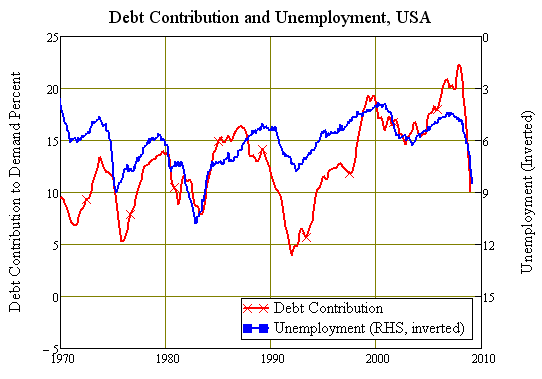
The dramatic deterioration in the economy comes as a surprise to conventional “neoclassical” economists because they exclude debt (and money) from their model of how the economy works. This failed model of the operations of a market economy is why they are incapable of explaining the economy’s behaviour today.
With the debt contribution to demand now plummeting, unemployment will rise to levels that are unprecedented in the post WWII period–and they may even rival the Great Depression.
Attempts to inflate our way out of this via either government spending or quantitative easing will also fail.
The sheer scale of private debt de-leveraging swamps the government’s pump priming, while there is so much debt relative to government created money that the latter will have to be increased by astronomical amounts–and given to those in debt, rather than to the banks–to counter the collapse in demand caused by private deleveraging.
To labour a comparison I’ve made numerous times, Rudd’s stimulus package will inject $42 billion into the economy, but a 5% reduction in debt by the private sector will remove $100 billion from it.
Even the slowdown in debt accumulation will swamp the government’s stimulus. In 2007-08, the last year of our debt bubble, private debt rose by $259 billion–adding 20% to aggregate demand. The fall of this to zero–a simple stabilisation of private debt–will remove 20% of demand from the economy. This is what is causing unemployment to explode now.
On the monetary front, Bernanke has literally doubled government-created money in the USA in a matter of months, but even so the ratio of private debt to this is close to 30 to 1. He’d need to create twenty times as much (and give it to the debtors to cancel their debts, rather than to the banks in a futile attempt to maintain their facade of solvency) before there would be any chance of a monetary stimulus working. I simply can’t see him trying it.
Even if he did (and our local RBA followed suit), and even if governments maintained the scale of fiscal stimulus they are now imparting, there would still be the reality (for the USA, the UK and Australia, and some European nations) that, courtesy of the globalisation of production, they no longer have the productive capacity to employ those who are going to be thrown into unemployment via this debt-driven collapse.
The problems caused by the neoclassical economic philosophy of the last 40 years were papered over by debt. To steal a phrase from Warren Buffett, now that debt is collapsing–and debt-finance can no longer be used to purchase cheap Asian goods–the nakedness of that philosophy will be exposed by the outgoing tide.
Australia, which has for some time deluded itself that it is different to the rest of the world, and will therefore come through this crisis relatively unscathed, may in fact be the most naked of all.
http://www.debtdeflation.com/blogs/2009/04/09/whod-a-thought-it-unemployment-leaps-05-in-a-month/
This was right in line with what I was expecting from a non-orthodox, “Hyman Minsky” point of view. As I have argued in numerous blogs, aggregate demand is the sum of GDP plus the change in debt. Now that our economy is utterly debt-dependent, the debt-financed asset-price bubbles have burst, and debt de-leveraging has begun in earnest, the economy will tank and unemployment will explode as debt-financed spending evaporates.
The key chart I’ve published on this a number of times is the following: it shows the correlation between the contribution the change in private debt makes to aggregate demand and the unemployment rate (the red line is the change in debt, divided by the sum of the change in debt plus GDP; the blue line is unemployment, inverted and plotted on the right hand axis).
As the economy has become more and more debt-dependent–as the ratio of Debt to GDP has risen–this correlation has gone from being trivial to explaining 95% of the level of unemployment.
For those who believe that “Australia is different”, here’s the matching chart for the USA. The only difference is one of time: they began their decline in this Depression about a year before we did. But we are rapidly catching up.
The dramatic deterioration in the economy comes as a surprise to conventional “neoclassical” economists because they exclude debt (and money) from their model of how the economy works. This failed model of the operations of a market economy is why they are incapable of explaining the economy’s behaviour today.
With the debt contribution to demand now plummeting, unemployment will rise to levels that are unprecedented in the post WWII period–and they may even rival the Great Depression.
Attempts to inflate our way out of this via either government spending or quantitative easing will also fail.
The sheer scale of private debt de-leveraging swamps the government’s pump priming, while there is so much debt relative to government created money that the latter will have to be increased by astronomical amounts–and given to those in debt, rather than to the banks–to counter the collapse in demand caused by private deleveraging.
To labour a comparison I’ve made numerous times, Rudd’s stimulus package will inject $42 billion into the economy, but a 5% reduction in debt by the private sector will remove $100 billion from it.
Even the slowdown in debt accumulation will swamp the government’s stimulus. In 2007-08, the last year of our debt bubble, private debt rose by $259 billion–adding 20% to aggregate demand. The fall of this to zero–a simple stabilisation of private debt–will remove 20% of demand from the economy. This is what is causing unemployment to explode now.
On the monetary front, Bernanke has literally doubled government-created money in the USA in a matter of months, but even so the ratio of private debt to this is close to 30 to 1. He’d need to create twenty times as much (and give it to the debtors to cancel their debts, rather than to the banks in a futile attempt to maintain their facade of solvency) before there would be any chance of a monetary stimulus working. I simply can’t see him trying it.
Even if he did (and our local RBA followed suit), and even if governments maintained the scale of fiscal stimulus they are now imparting, there would still be the reality (for the USA, the UK and Australia, and some European nations) that, courtesy of the globalisation of production, they no longer have the productive capacity to employ those who are going to be thrown into unemployment via this debt-driven collapse.
The problems caused by the neoclassical economic philosophy of the last 40 years were papered over by debt. To steal a phrase from Warren Buffett, now that debt is collapsing–and debt-finance can no longer be used to purchase cheap Asian goods–the nakedness of that philosophy will be exposed by the outgoing tide.
Australia, which has for some time deluded itself that it is different to the rest of the world, and will therefore come through this crisis relatively unscathed, may in fact be the most naked of all.
http://www.debtdeflation.com/blogs/2009/04/09/whod-a-thought-it-unemployment-leaps-05-in-a-month/
8 April 2009
Aussie home prices to absolutely crater ~ Keen
The ABS has only maintained a comprehensive index of Australian house prices since mid-1986–a time when the hills were alive to the sound of Alan Bond and Christopher Skase. House prices rose 60% in the first three years of the index, far above the rate of inflation at the time. They then stalled for the next few years before more than tripling over the next 17 years–again, a rate of growth that far exceeded the rate of inflation. This 30-year-plus experience of continuously rising prices has helped shape the belief that house prices “always” rise faster than consumer prices.

But “always” is a much longer time span than a mere 30 years–something Robert Shiller appreciated when he and Karl Case developed the index of US house prices now known as the Case-Shiller Index. The key comparison Shiller makes is between house prices and consumer prices; this is the premiere indicator of the American market, and there it’s clear that the bubble has popped.
If we take a 25 year view, like that which Richards used in his paper, it could be argued that the fall in the index has almost brought the real price of American housing back to the average. Having plateaued at a value of 217 between 2005 and 2007, it has now fallen to 138, which is just 11% above the 85-09 average.

But if we look at the really long term–over the whole data set from 1890 till now–it’s apparent that the American market has some way to fall before it hits the average: even though it has already fallen 30% from its peak, it still has another 46% to go, if the real price of housing is constant over the long term.
That’s an if to which Shiller gives an emphatic “yes” to, based partly on his own data–which shows no trend to rising real house prices prior to the current bubble that clearly began in 1997–and partly on a yet longer term series still: the “Herengracht Index” that shows the real price of housing on a famous canal in Amsterdam over the three and a half centuries from 1628 till 1970. This index has at times risen for extended periods–such as over the 7 decades between 1814 and 1887 when the real price of a house on the Herengracht Canal rose almost fourfold. Anyone born at the beginning of that period could have easily been persuaded that house prices “always” rise faster than consumer prices.
But over the long term, there is no trend. For the next 7 decades, house prices tended down in real terms: the index fell 55% from the 1887 peak to be 40% below the long term average of 198 in 1951, when yet another upward trend occurred.
Could a similar proposition apply to Australia? Dr Nigel Stapledon set out to answer this question in his PhD, where he observed that:
The period since the early 1970s has been one in which house prices have risen quite significantly by any measure with the median capital city house prices in Australia having risen on average 3% per annum in real terms in the period 1970-2006. While the rises in Australia have been above the average for developed countries, the picture is similar in most OECD economies and Australia is by no means unique.
The question that can be asked is whether this period is unique for housing? Eichholtz (1997) has constructed a long term series for Amsterdam in Holland which spans the period 1628-1973. The broad picture that his time series paints is one of prices essentially showing no trend for three centuries, with cycles related to the economic events. Against that long term perspective the post 1970 rise in house prices in Holland stands out. But one city is probably not convincing…” (Stapledon 2007, p. 1)
Stapledon’s key data table gave the median capital city house price in current dollars, 2005 dollars, and 2005 dollars deflated by 0.6% p.a. to reflect increasing house quality. In the following graph I take Stapledon’s CPI and quality deflated index, extended to today using the last 2 years of ABS data deflated by the CPI. I then set the value to 100 in 1890 to enable easy comparison with the Case-Shiller real house price index for the USA.

One inference from this graph is that the recent Australian house price bubble began earlier at much the same time as the USA’s (1997), but began from an already higher base that can be dated back to the 1987 Stock Market Crash.
At that time, the Australian index was only marginally higher than the USA’s–132 for Australia versus 120.5 for the USA, a 10% difference. But the 25% fall in the Australian stock market on Black Tuesday ended the Antipodean flirtation with stocks, and we piled right back into our favourite speculative play: bricks and mortar. Most of the money borrowed by Australian households for speculative purposes then drove up house prices, whereas Americans spread their leveraged dollars between stocks and houses.
As a result, Australian house prices absorbed most of the speculative excess of the last thirty years, driving them to 3.5 times the long term average versus “just” twice the average in the USA.
Of course, it could be true that, as the property lobby keeps asserting, Australia is “different”, and trends that don’t exist elsewhere in the world rule in the land of the marsupials. Especially since virtually everyone now describes this crisis as “the worst since the Great Depression, it would have helped if the RBA had referred to this publicly available data when preparing its own comparison of current house prices to “long term” trends.
The Never-Ending UnderSupply Story
Richards did express some scepticism here on behalf of the RBA that Australia’s undersupply of housing was as marked as some commentators claim, but he still came down on the side of this widely shared belief:
“Whatever the true shortfall of dwellings, we can say with some confidence that our housing market is relatively tight. This can be contrasted with the US market which many observers characterise as having been subject to overbuilding during their housing boom. And the relative tightness of the Australian housing market is one factor that will support home-building in the period ahead.”
Curiously, one group that does not share this belief is Hometrack, the local branch of the UK housing intelligence research group. Just days after Richards’ speech, it released a press release in which it stated that:
the widely quoted views of many property market commentators who believe that Australia’s current building levels are not enough to meet the future demand for housing, may be based on inaccurate data calculations.
“Our analysis indicates Australia may already have an excess of housing. We estimate there are at least 10 million dwellings in Australia compared with ABS data showing occupied dwellings of 8.3 million. The extra one to two million dwellings consists of a mixture of housing awaiting sale or development, vacant dwellings, second homes, and abandoned homes,” he said.
He went on to say that the ABS method for calculating the ratio of people per dwellings is based on ABS census data which in turn is based upon occupied dwellings. However, he said, Hometrack analysis which is based on postal address data indicates that Australia’s current level of housing relative to its population is in line with other Anglo economies.
Following on from this, Darcy said that when looked at in the context of population growth, total residential building approvals have been running above demand.
“This points to a build-up of excess stock of housing over the past six years, despite the gap between building approvals and demand narrowing over recent months,” he said.
“The concern is that business and government decisions regarding the residential housing market in Australia are being made based on demand assumptions that differ from the actual behavior of the housing market. There will always be examples of areas with an undersupply, but it’s not clear from the data that we have an overall shortage relative to future demand.”
One must read Keen's article
But “always” is a much longer time span than a mere 30 years–something Robert Shiller appreciated when he and Karl Case developed the index of US house prices now known as the Case-Shiller Index. The key comparison Shiller makes is between house prices and consumer prices; this is the premiere indicator of the American market, and there it’s clear that the bubble has popped.
If we take a 25 year view, like that which Richards used in his paper, it could be argued that the fall in the index has almost brought the real price of American housing back to the average. Having plateaued at a value of 217 between 2005 and 2007, it has now fallen to 138, which is just 11% above the 85-09 average.
But if we look at the really long term–over the whole data set from 1890 till now–it’s apparent that the American market has some way to fall before it hits the average: even though it has already fallen 30% from its peak, it still has another 46% to go, if the real price of housing is constant over the long term.
That’s an if to which Shiller gives an emphatic “yes” to, based partly on his own data–which shows no trend to rising real house prices prior to the current bubble that clearly began in 1997–and partly on a yet longer term series still: the “Herengracht Index” that shows the real price of housing on a famous canal in Amsterdam over the three and a half centuries from 1628 till 1970. This index has at times risen for extended periods–such as over the 7 decades between 1814 and 1887 when the real price of a house on the Herengracht Canal rose almost fourfold. Anyone born at the beginning of that period could have easily been persuaded that house prices “always” rise faster than consumer prices.
But over the long term, there is no trend. For the next 7 decades, house prices tended down in real terms: the index fell 55% from the 1887 peak to be 40% below the long term average of 198 in 1951, when yet another upward trend occurred.
Could a similar proposition apply to Australia? Dr Nigel Stapledon set out to answer this question in his PhD, where he observed that:
The period since the early 1970s has been one in which house prices have risen quite significantly by any measure with the median capital city house prices in Australia having risen on average 3% per annum in real terms in the period 1970-2006. While the rises in Australia have been above the average for developed countries, the picture is similar in most OECD economies and Australia is by no means unique.
The question that can be asked is whether this period is unique for housing? Eichholtz (1997) has constructed a long term series for Amsterdam in Holland which spans the period 1628-1973. The broad picture that his time series paints is one of prices essentially showing no trend for three centuries, with cycles related to the economic events. Against that long term perspective the post 1970 rise in house prices in Holland stands out. But one city is probably not convincing…” (Stapledon 2007, p. 1)
Stapledon’s key data table gave the median capital city house price in current dollars, 2005 dollars, and 2005 dollars deflated by 0.6% p.a. to reflect increasing house quality. In the following graph I take Stapledon’s CPI and quality deflated index, extended to today using the last 2 years of ABS data deflated by the CPI. I then set the value to 100 in 1890 to enable easy comparison with the Case-Shiller real house price index for the USA.
One inference from this graph is that the recent Australian house price bubble began earlier at much the same time as the USA’s (1997), but began from an already higher base that can be dated back to the 1987 Stock Market Crash.
At that time, the Australian index was only marginally higher than the USA’s–132 for Australia versus 120.5 for the USA, a 10% difference. But the 25% fall in the Australian stock market on Black Tuesday ended the Antipodean flirtation with stocks, and we piled right back into our favourite speculative play: bricks and mortar. Most of the money borrowed by Australian households for speculative purposes then drove up house prices, whereas Americans spread their leveraged dollars between stocks and houses.
As a result, Australian house prices absorbed most of the speculative excess of the last thirty years, driving them to 3.5 times the long term average versus “just” twice the average in the USA.
Of course, it could be true that, as the property lobby keeps asserting, Australia is “different”, and trends that don’t exist elsewhere in the world rule in the land of the marsupials. Especially since virtually everyone now describes this crisis as “the worst since the Great Depression, it would have helped if the RBA had referred to this publicly available data when preparing its own comparison of current house prices to “long term” trends.
The Never-Ending UnderSupply Story
Richards did express some scepticism here on behalf of the RBA that Australia’s undersupply of housing was as marked as some commentators claim, but he still came down on the side of this widely shared belief:
“Whatever the true shortfall of dwellings, we can say with some confidence that our housing market is relatively tight. This can be contrasted with the US market which many observers characterise as having been subject to overbuilding during their housing boom. And the relative tightness of the Australian housing market is one factor that will support home-building in the period ahead.”
Curiously, one group that does not share this belief is Hometrack, the local branch of the UK housing intelligence research group. Just days after Richards’ speech, it released a press release in which it stated that:
the widely quoted views of many property market commentators who believe that Australia’s current building levels are not enough to meet the future demand for housing, may be based on inaccurate data calculations.
“Our analysis indicates Australia may already have an excess of housing. We estimate there are at least 10 million dwellings in Australia compared with ABS data showing occupied dwellings of 8.3 million. The extra one to two million dwellings consists of a mixture of housing awaiting sale or development, vacant dwellings, second homes, and abandoned homes,” he said.
He went on to say that the ABS method for calculating the ratio of people per dwellings is based on ABS census data which in turn is based upon occupied dwellings. However, he said, Hometrack analysis which is based on postal address data indicates that Australia’s current level of housing relative to its population is in line with other Anglo economies.
Following on from this, Darcy said that when looked at in the context of population growth, total residential building approvals have been running above demand.
“This points to a build-up of excess stock of housing over the past six years, despite the gap between building approvals and demand narrowing over recent months,” he said.
“The concern is that business and government decisions regarding the residential housing market in Australia are being made based on demand assumptions that differ from the actual behavior of the housing market. There will always be examples of areas with an undersupply, but it’s not clear from the data that we have an overall shortage relative to future demand.”
One must read Keen's article
23 March 2009
Don't buy a home now unless you have a ton of equity
So while The Boost may give a temporary fillip to the bottom end of the housing market, the construction industry, and the economy, when unemployment continues its unexpected (there’s that word again!) rise, many First Home Buyers will be at the head of the dole queues. And as well as being unemployed, they will also be homeless and bankrupt.
Had they not been enticed into the housing market at absolutely the worst time by a misguided Government policy, they would still have lost their jobs. But at least they would not also be facing bankruptcy as well.
There are multiple influences that have enticed a flurry of First Home Buyers into the market–falling mortgage rates, and the ceaseless spruiking of The Australian Dream amongst them (the latter reminds me of the promo for the Terry Gilliam movie Time Bandits: “Like all the dreams you’ve ever had. And not just the good ones”).
But The Boost clearly was the major force behind the 4% jump in the proportion of housing loans going to First Home Buyers in November 2008. The extent to which First Home Buyers have been used as pawns by governments of both political persuasion to reflate the housing bubble is obvious in the following chart:
Read on
Had they not been enticed into the housing market at absolutely the worst time by a misguided Government policy, they would still have lost their jobs. But at least they would not also be facing bankruptcy as well.
There are multiple influences that have enticed a flurry of First Home Buyers into the market–falling mortgage rates, and the ceaseless spruiking of The Australian Dream amongst them (the latter reminds me of the promo for the Terry Gilliam movie Time Bandits: “Like all the dreams you’ve ever had. And not just the good ones”).
But The Boost clearly was the major force behind the 4% jump in the proportion of housing loans going to First Home Buyers in November 2008. The extent to which First Home Buyers have been used as pawns by governments of both political persuasion to reflate the housing bubble is obvious in the following chart:
Read on
21 March 2009
James Galbraith: No Return to Normal
James Galbraith has written a very good analysis of the crisis and why the policies being followed in the USA (and, by implication, here) will not work.
I reproduce some extracts here to give you a flavour of the article, but I recommend a read of the full paper in the Washington Monthly–thanks to blog member Warren Raftshol for bringing it to my attention. The emphasis added to some points is mine.
No Return to Normal. Why the economic crisis, and its solution, are bigger than you think.
The deepest belief of the modern economist is that the economy is a self-stabilizing system. This means that, even if nothing is done, normal rates of employment and production will someday return. Practically all modern economists believe this, often without thinking much about it. (Federal Reserve Chairman Ben Bernanke said it reflexively in a major speech in London in January: “The global economy will recover.” He did not say how he knew.) The difference between conservatives and liberals is over whether policy can usefully speed things up. Conservatives say no, liberals say yes, and on this point Obama’s economists lean left. Hence the priority they gave, in their first days, to the stimulus package.
But did they get the scale right? Was the plan big enough? Policies are based on models; in a slump, plans for spending depend on a forecast of how deep and long the slump would otherwise be. The program will only be correctly sized if the forecast is accurate. And the forecast depends on the underlying belief. If recovery is not built into the genes of the system, then the forecast will be too optimistic, and the stimulus based on it will be too small…
Why did the CBO reach this conclusion? On depth, CBO’s model is based on the postwar experience, and such models cannot predict outcomes more serious than anything already seen. If we are facing a downturn worse than 1982, our computers won’t tell us; we will be surprised. And if the slump is destined to drag on, the computers won’t tell us that either. Baked into the CBO model we find a “natural rate of unemployment” of 4.8 percent; the model moves the economy back toward that value no matter what. In the real world, however, there is no reason to believe this will happen. Some alternative forecasts, freed of the mystical return to “normal,” now project a GDP gap twice as large as the CBO model predicts, and with no near-term recovery at all…
Three further considerations limited the plan. There was, to begin with, the desire for political consensus; President Obama chose to start his administration with a bill that might win bipartisan support and pass in Congress by wide margins. (He was, of course, spurned by the Republicans.) Second, the new team also sought consensus of another type. Christina Romer polled a bipartisan group of professional economists, and Larry Summers told Meet the Press that the final package reflected a “balance” of their views. This procedure guarantees a result near the middle of the professional mind-set. The method would be useful if the errors of economists were unsystematic. But they are not. Economists are a cautious group, and in any extreme situation the midpoint of professional opinion is bound to be wrong.
The most likely scenario, should the Geithner plan go through, is a combination of looting, fraud, and a renewed speculation in volatile commodity markets such as oil. Ultimately the losses fall on the public anyway, since deposits are largely insured. There is no chance that the banks will simply resume normal long-term lending. To whom would they lend? For what? Against what collateral? And if banks are recapitalized without changing their management, why should we expect them to change the behavior that caused the insolvency in the first place?…
In other words, Roosevelt employed Americans on a vast scale, bringing the unemployment rates down to levels that were tolerable, even before the war—from 25 percent in 1933 to below 10 percent in 1936, if you count those employed by the government as employed, which they surely were. In 1937, Roosevelt tried to balance the budget, the economy relapsed again, and in 1938 the New Deal was relaunched. This again brought unemployment down to about 10 percent, still before the war…
The New Deal rebuilt America physically, providing a foundation (the TVA’s power plants, for example) from which the mobilization of World War II could be launched. But it also saved the country politically and morally, providing jobs, hope, and confidence that in the end democracy was worth preserving. There were many, in the 1930s, who did not think so.
What did not recover, under Roosevelt, was the private banking system. Borrowing and lending—mortgages and home construction—contributed far less to the growth of output in the 1930s and ’40s than they had in the 1920s or would come to do after the war. If they had savings at all, people stayed in Treasuries, and despite huge deficits interest rates for federal debt remained near zero. The liquidity trap wasn’t overcome until the war ended.
It was the war, and only the war, that restored (or, more accurately, created for the first time) the financial wealth of the American middle class. During the 1930s public spending was large, but the incomes earned were spent. And while that spending increased consumption, it did not jumpstart a cycle of investment and growth, because the idle factories left over from the 1920s were quite sufficient to meet the demand for new output. Only after 1940 did total demand outstrip the economy’s capacity to produce civilian private goods—in part because private incomes soared, in part because the government ordered the production of some products, like cars, to halt…
Third, in the debt deflation, liquidity trap, and global crisis we are in, there is no risk of even a massive program generating inflation or higher long-term interest rates. That much is obvious from current financial conditions: interest rates on long-maturity Treasury bonds are amazingly low. Those rates also tell you that the markets are not worried about financing Social Security or Medicare. They are more worried, as I am, that the larger economic outlook will remain very bleak for a long time…
A paradox of the long view is that the time to embrace it is right now. We need to start down that path before disastrous policy errors, including fatal banker bailouts and cuts in Social Security and Medicare, are put into effect. It is therefore especially important that thought and learning move quickly. Does the Geithner team, forged and trained in normal times, have the range and the flexibility required? If not, everything finally will depend, as it did with Roosevelt, on the imagination and character of President Obama.
link
I reproduce some extracts here to give you a flavour of the article, but I recommend a read of the full paper in the Washington Monthly–thanks to blog member Warren Raftshol for bringing it to my attention. The emphasis added to some points is mine.
No Return to Normal. Why the economic crisis, and its solution, are bigger than you think.
The deepest belief of the modern economist is that the economy is a self-stabilizing system. This means that, even if nothing is done, normal rates of employment and production will someday return. Practically all modern economists believe this, often without thinking much about it. (Federal Reserve Chairman Ben Bernanke said it reflexively in a major speech in London in January: “The global economy will recover.” He did not say how he knew.) The difference between conservatives and liberals is over whether policy can usefully speed things up. Conservatives say no, liberals say yes, and on this point Obama’s economists lean left. Hence the priority they gave, in their first days, to the stimulus package.
But did they get the scale right? Was the plan big enough? Policies are based on models; in a slump, plans for spending depend on a forecast of how deep and long the slump would otherwise be. The program will only be correctly sized if the forecast is accurate. And the forecast depends on the underlying belief. If recovery is not built into the genes of the system, then the forecast will be too optimistic, and the stimulus based on it will be too small…
Why did the CBO reach this conclusion? On depth, CBO’s model is based on the postwar experience, and such models cannot predict outcomes more serious than anything already seen. If we are facing a downturn worse than 1982, our computers won’t tell us; we will be surprised. And if the slump is destined to drag on, the computers won’t tell us that either. Baked into the CBO model we find a “natural rate of unemployment” of 4.8 percent; the model moves the economy back toward that value no matter what. In the real world, however, there is no reason to believe this will happen. Some alternative forecasts, freed of the mystical return to “normal,” now project a GDP gap twice as large as the CBO model predicts, and with no near-term recovery at all…
Three further considerations limited the plan. There was, to begin with, the desire for political consensus; President Obama chose to start his administration with a bill that might win bipartisan support and pass in Congress by wide margins. (He was, of course, spurned by the Republicans.) Second, the new team also sought consensus of another type. Christina Romer polled a bipartisan group of professional economists, and Larry Summers told Meet the Press that the final package reflected a “balance” of their views. This procedure guarantees a result near the middle of the professional mind-set. The method would be useful if the errors of economists were unsystematic. But they are not. Economists are a cautious group, and in any extreme situation the midpoint of professional opinion is bound to be wrong.
The most likely scenario, should the Geithner plan go through, is a combination of looting, fraud, and a renewed speculation in volatile commodity markets such as oil. Ultimately the losses fall on the public anyway, since deposits are largely insured. There is no chance that the banks will simply resume normal long-term lending. To whom would they lend? For what? Against what collateral? And if banks are recapitalized without changing their management, why should we expect them to change the behavior that caused the insolvency in the first place?…
In other words, Roosevelt employed Americans on a vast scale, bringing the unemployment rates down to levels that were tolerable, even before the war—from 25 percent in 1933 to below 10 percent in 1936, if you count those employed by the government as employed, which they surely were. In 1937, Roosevelt tried to balance the budget, the economy relapsed again, and in 1938 the New Deal was relaunched. This again brought unemployment down to about 10 percent, still before the war…
The New Deal rebuilt America physically, providing a foundation (the TVA’s power plants, for example) from which the mobilization of World War II could be launched. But it also saved the country politically and morally, providing jobs, hope, and confidence that in the end democracy was worth preserving. There were many, in the 1930s, who did not think so.
What did not recover, under Roosevelt, was the private banking system. Borrowing and lending—mortgages and home construction—contributed far less to the growth of output in the 1930s and ’40s than they had in the 1920s or would come to do after the war. If they had savings at all, people stayed in Treasuries, and despite huge deficits interest rates for federal debt remained near zero. The liquidity trap wasn’t overcome until the war ended.
It was the war, and only the war, that restored (or, more accurately, created for the first time) the financial wealth of the American middle class. During the 1930s public spending was large, but the incomes earned were spent. And while that spending increased consumption, it did not jumpstart a cycle of investment and growth, because the idle factories left over from the 1920s were quite sufficient to meet the demand for new output. Only after 1940 did total demand outstrip the economy’s capacity to produce civilian private goods—in part because private incomes soared, in part because the government ordered the production of some products, like cars, to halt…
Third, in the debt deflation, liquidity trap, and global crisis we are in, there is no risk of even a massive program generating inflation or higher long-term interest rates. That much is obvious from current financial conditions: interest rates on long-maturity Treasury bonds are amazingly low. Those rates also tell you that the markets are not worried about financing Social Security or Medicare. They are more worried, as I am, that the larger economic outlook will remain very bleak for a long time…
A paradox of the long view is that the time to embrace it is right now. We need to start down that path before disastrous policy errors, including fatal banker bailouts and cuts in Social Security and Medicare, are put into effect. It is therefore especially important that thought and learning move quickly. Does the Geithner team, forged and trained in normal times, have the range and the flexibility required? If not, everything finally will depend, as it did with Roosevelt, on the imagination and character of President Obama.
link
10 March 2009
Steve Keen interview
(18min 54) Professor Steve Keen says the Aussie economy has a long way to fall yet. The current situation is the work of neoclassical economists who didn’t understand the importance of controlling debt, which is now over $2 trillion. He points to the RBA, whose decision not to lower interest rates last week is a further indication that most experts fail to realise the significance of the downturn. Keen still believes we are heading for a Depression.
link
link
3 December 2008
What’s Really Going On? or…
Why Did I See it Coming and “They” Didn’t?
Steve Keens critique of current economic models is a must read.
Steve Keens critique of current economic models is a must read.
Subscribe to:
Posts (Atom)