Watch now
CROWD: What do we want? Free choice! When do we want it? Now! We say fight back! Are we ready to fight? Yes! Are we ready to win? Yes! Are we ready for change? Yes! Do we want it now? Now!
WOMAN: Why do we have to stand out here in this country, the Land of the Free, and beg for something that we deserve?
Earlier this week, members of America's fastest growing trade union, the SEIU, gathered outside the Bank of America's New York headquarters to protest against the huge bonuses its executives paid themselves using government bailout money - a situation these struggling workers label as obscene.
WOMAN: We deserve to be able to live comfortable like everybody else. You take the taxpayers' money and make sure your house is paid for, but here we are losing our homes.
What especially irks this group - and many others like it in the US - is the way in which America's largest financial groups are being rewarded with government help for their bad business judgments - while tens of thousands of Americans are losing their homes.
ANDY STERN, PRESIDENT – SEIU (SERVICE EMPLOYEES INTERNATIONAL UNION): Our country - and unfortunately we spread it to the rest of the world - followed this market worshipping, privatising, deregulating, trickle-down economic philosophy, and it failed.
As head of the SEIU, Andy Stern has become the most outspoken union leader in America and he's leading a charge to reclaim and remodel the country's financial system before it spirals out of control.
ANDY STERN: The only way we're going to make change is by being in the streets, raising our voices, fighting for change, because people don't give up power without a struggle and we intend to get it back and build a new American and global financial system that takes care of everyone - not just the people at the top.
In the heart of New York's financial district — the epicentre of the global crisis - tourists still line up eagerly to have their photo taken with that iconic emblem of American economic clout - the Wall Street bull. But amongst these onlookers there's at least one who's started to question the faith Americans have in their financial system.
JOSE GONZALEZ, FORMER HEDGE FUND MANAGER: There was no question that things were going to slow down - they couldn't continue at the pace that they were.
Jose Gonzalez is a former hedge fund manager who has learned some hard lessons from the excesses of America's casino-style capitalism. For several years he was coasting on a high but with his fund leveraged way beyond it's capacity to repay, the global credit crunch soon made its mark, and by January he was out of a job.
JOSE GONZALEZ: The markets were moving much quicker than people could react, and that's what happened, that's when you see these huge gaps down in prices and in the markets. And people start to get scared, and then when they can sell, they try to sell, but then it's not at the price that they were thinking and then they have to try and push everything out the door, and only so many things can go out, and the downward spiral just happens when everybody goes rushing for the door.
Now, with plenty of time on his hands to reflect on the crash that cut short his highly paid career, Jose is the first to admit that the crisis was brought about by a simple and collective human flaw - greed.
JOSE GONZALEZ: Greed on every level. People will tell you that the whole thing started with the housing. The housing issues that happened in the states and the easy loans, and packaging of these loans, and restructuring and reselling and this, that and the other - I mean it's greed on every level.
I think most people live outside their means and the difference is if somebody lives outside their means and they're making $30,000 a year and feeding a family, or $30 million a year.
Jose Gonzalez now meets every week with other New Yorkers who've suddenly found themselves out of work. They call themselves the 405 Club, in reference to the weekly US dole payment of $405.
GARRETT, 405 CLUB MEMBER: I was a recession casualty as of mid December, so it's been over four months now and I was supposed to have an interview today which was cancelled a couple of days ago.
Its members say the 405 Club is the fastest growing alliance in America - formed to provide the country's unemployed with a support network and an outlet to vent their anger at a financial system that let them down.
WOMAN, 405 CLUB MEMBER: I think it's absurd when a company can publish a loss and be giving bonuses. There shouldn't be rewards for "Oh, the damage was only reciprocal "and we had to lay off 100 people to pay your bonus."
JAMES MACKLIN, BOWERY MISSION: We're all guilty of this financial crisis. All of us. Your country, my country - all of us wanted something for nothing, and now we're paying the piper.
Not far from the big end of town, James Macklin is also feeling the pinch of the financial crisis. As a director of the Bowery Mission, one of the oldest soup kitchens in New York, he's now catering for the city's rapidly growing number of homeless and destitute residents.
JAMES MACKLIN: We, the people, made some bad mistakes too, OK. You don't read fine print on your credit card - they send you plastic and you swipe it, OK. Then later on you find out you're over your head. So we all are to blame, not just the government - we all are to blame for wanting something for nothing.
As the effects of the crisis deepen, the demographics of New York's homeless are also beginning to change - with increasing numbers of families seeking help from charities like the Bowery. But not everyone here shares the idea of collective responsibility. Some, like the mission's chaplain, are furious that while those at the bottom rung of society continue to be sidelined, the financial institutions that sparked the crisis have been pulled out of the mess with multibillion-dollar rescue packages.
PASTOR REGGIE STUZMAN, BOWERY MISSION: I think it's outrageous. I think even our government being a part of so many bailout situations to white-collar people. I mean there are so many issues on this side of the spectrum - with mental health, homelessness, addictions, housing. Obviously if you steal, you connive, if you take stock from holders and all this, society still seems to play a role that we will help you - even though you've done bad.
While the US Government may have had little choice but to prop up its ailing banking system, many Americans are bitter that billions of their tax dollars are being handed over to the very institutions they hold responsible for the crisis.
ANDY STERN: We can not trust people at the top to be looking after our best interest. We can not trust CEOs to not be greedy and enrich themselves at the expense of their shareholders or their communities. We can not count on the people at the top to be loyal to their country as opposed to their company and we should also appreciate that people at the top aren't as smart as they think they are.
Union boss Andy Stern is hoping that President Obama can eventually bring America's banking system to heel. In the meantime, he and thousands of his union members are continuing to exert pressure on those they hold responsible.
ANDY STERN: We'd like you to deliver this to the Bank of America, to tell them that consumers, taxpayers, Americans need them to change how they handle credit cards, need them to have new leadership, need them to stop foreclosure - it's time for change to make this an economy that works for everyone. Thank you very much for taking this on behalf of all of us.
ANDY STERN: In a global economy, we are not going to build it by rewarding CEOs and having the gap between the rich and the rest of the population grow so wide and so fast. And so we had an economy built around tricks, around people not being responsible to their communities and to shareholders and just shoving as much money in their pocket as they possibly can - and here we are.
With tent cities reminiscent of the Great Depression starting to appear across the country, and queues of the poor and hungry growing fast, there's a growing chorus calling for a reassessment of the American dream - and the desire and greed that drives it.
REPORTER: What do you think other countries can learn from this experience, and learn from America?
JAMES MACKLIN: That we're going to have to tighten our belt, and spend what we really can afford and not become too extravagant in what we do. We have to go back to the old landmark - start anew. We can't turn it around bickering and fussing about mistakes. We gotta throw our mistakes in the river, and say "OK, let's regroup, let's rebuild this thing."
Showing posts with label employment. Show all posts
Showing posts with label employment. Show all posts
4 May 2009


Double digit unemployment in Australia by 2010 ~ Keen
So confidence is not “all it is about”: confidence played its role over the last thirty years as it “beguiled its victims into debt”, in Fisher’s evocative phrase. We don’t need more of it now, so much as less of it back then–but of course, we can’t amend history.
The victims of past overconfidence include Central Bankers, whose rescues of the financial system simply encouraged it to search out a new group of potential borrowers to replace those who had already been debt-saturated. They were victims of debt, as much as were the borrowers, because the naive theory of economics they followed ignored the role of debt completely. They therefore couldn’t see the process that was leading to crisis, even as their interventions egged that process on to heights that it could never have reached without them.
Had Greenspan and his equivalents around the world not intervened in 1987, it is quite possible that we would have experienced a mild Depression back then–mild because debt was only equivalent to 1929 levels then, because a larger Government sector than in the 1920s would have counterbalanced the private sector downturn, and because higher inflation in the late 80s would have helped reduced the real burden of debt.
Now we are sitting on the precipice of a mountain of debt twice as high as in the Great Depression, with low inflation turning into deflation as Fisher warned, and with Central Bankers who do not have a clue why the economy has suddenly gone from “the Great Moderation” to “the Greatest Crisis Since the Great Depression”.
Over-confidence in the face of rising debt did beguile us during the long boom. Confidence in the face of deleveraging will not save us during the coming Depression.
END OF COMMENTARY
Comments on the Australian Data
Debt levels in Australia are very close to falling in nominal terms, and in fact only mortgage debt is still rising: both business and personal debt (other than mortgages) have fallen in the last few months. It is conceivable that, were it not for the “First Home Buyers Boost”, mortgage debt as well would be falling now too (the scheme is more aptly described as the “First Home Vendors Boost”, since prices at the low end of the market have been driven up by far more than the $7,000 increase in the grant).
As a result, the debt to GDP ratio has fallen for the last four months–though this is to some extent masked by Australia’s practice of summing the previous four quarters of GDP data to derive annual GDP, versus the American practice of simply multiplying the current quarter’s GDP figure by 4. Using the Australian approach, our debt to GDP ratio is now 160%; using the American, it is 162%, since GDP fell by 0.5% in the previous quarter.
Whichever way you cut it, deleveraging is now well and truly underway, and unemployment will therefore rise dramatically in the next few months. Most neoclassical economists are predicting 7.5% unemployment by mid-2010; I expect it will have entered double figures by early in 2010.
http://www.debtdeflation.com/blogs/2009/05/04/debtwatch-no-34-the-confidence-trick/
The victims of past overconfidence include Central Bankers, whose rescues of the financial system simply encouraged it to search out a new group of potential borrowers to replace those who had already been debt-saturated. They were victims of debt, as much as were the borrowers, because the naive theory of economics they followed ignored the role of debt completely. They therefore couldn’t see the process that was leading to crisis, even as their interventions egged that process on to heights that it could never have reached without them.
Had Greenspan and his equivalents around the world not intervened in 1987, it is quite possible that we would have experienced a mild Depression back then–mild because debt was only equivalent to 1929 levels then, because a larger Government sector than in the 1920s would have counterbalanced the private sector downturn, and because higher inflation in the late 80s would have helped reduced the real burden of debt.
Now we are sitting on the precipice of a mountain of debt twice as high as in the Great Depression, with low inflation turning into deflation as Fisher warned, and with Central Bankers who do not have a clue why the economy has suddenly gone from “the Great Moderation” to “the Greatest Crisis Since the Great Depression”.
Over-confidence in the face of rising debt did beguile us during the long boom. Confidence in the face of deleveraging will not save us during the coming Depression.
END OF COMMENTARY
Comments on the Australian Data
Debt levels in Australia are very close to falling in nominal terms, and in fact only mortgage debt is still rising: both business and personal debt (other than mortgages) have fallen in the last few months. It is conceivable that, were it not for the “First Home Buyers Boost”, mortgage debt as well would be falling now too (the scheme is more aptly described as the “First Home Vendors Boost”, since prices at the low end of the market have been driven up by far more than the $7,000 increase in the grant).
As a result, the debt to GDP ratio has fallen for the last four months–though this is to some extent masked by Australia’s practice of summing the previous four quarters of GDP data to derive annual GDP, versus the American practice of simply multiplying the current quarter’s GDP figure by 4. Using the Australian approach, our debt to GDP ratio is now 160%; using the American, it is 162%, since GDP fell by 0.5% in the previous quarter.
Whichever way you cut it, deleveraging is now well and truly underway, and unemployment will therefore rise dramatically in the next few months. Most neoclassical economists are predicting 7.5% unemployment by mid-2010; I expect it will have entered double figures by early in 2010.
http://www.debtdeflation.com/blogs/2009/05/04/debtwatch-no-34-the-confidence-trick/
21 April 2009
One in four firms to cut staff ~ SMH
TWENTY-FIVE per cent of small to medium-sized businesses in NSW expect to sack staff within three months, a survey by the NSW Business Chamber has found.
The findings came as the Prime Minister, Kevin Rudd, conceded the economy would fall into recession for the first time in almost two decades.
"The severity of the global recession has made it impossible for Australia to avoid a further period of negative economic growth," Mr Rudd told a jobs forum in Adelaide.
"The worst global economic recession in 75 years means it's inevitable that Australia, too, will be dragged into recession."
Also yesterday, the Commonwealth Bank defied Government calls to pass on interest rate cuts and said it would raise its fixed rate mortgages by between 20 and 45 basis points from today.
NSW has the highest jobless rate in the country, at 6.9 per cent, but that is expected to increase.
Phone calls by business to the chamber seeking advice about about termination and redundancy have increased 60 per cent since the middle of last year.
One in four of the 440 companies surveyed said they had reduced staff hours in the first three months of this year.
Another 24 per cent say they expect to sack someone over the next three months while only 9 per cent expect to hire staff.
"Many employers are loyal to their employees and are doing their hardest to keep their staff on by altering work practices and reducing hours but it's an uphill battle in this economic environment," said the chamber's chief executive, Kevin MacDonald.
This is despite an official survey released yesterday which found prices paid by business fell sharply in the first three months of this year.
The Bureau of Statistics' "producer price index" found prices paid by firms fell 0.4 per cent - the second biggest drop in the survey's 10-year history. Prices were up 4 per cent over the year - although this is a slower pace than the 6.4 per cent growth rate clocked in the previous survey.
Yesterday was the first time Mr Rudd had used the word recession; it was an admission the Government now expects growth for the March quarter to be negative. The December quarter was negative and a recession is defined technically as two successive quarters of negative growth.
The Government will argue circumstances would be worse if not for the two stimulus packages, worth $52 billion.
"The challenge for government is to cushion the impact of the recession on business and jobs through the actions we take through our economic stimulus strategy," Mr Rudd said.
Inflation figures due tomorrow are expected to show the rate back in the Reserve Bank's target band of 2 to 3 per cent.
Falling prices mean companies are under less pressure to increase the prices consumers pay and open the way for discounting to tempt wary customers.
The NSW Business Chamber's survey confirms concern about growth have replaced concerns about rising costs.
Nearly half of firms surveyed believed business conditions had deteriorated in NSW in the previous three months.
"With nearly one in every two businesses reporting deteriorating business conditions, the need for us to kick-start the NSW economy has never been more urgent," Mr MacDonald said.
Lack of access to new credit remains a pressing issue, with one in three NSW companies saying they had trouble being able to borrow from their bank.
"These figures show that the financial crisis is far from over. More must be done to assist businesses in obtaining the finance they need to operate. The flow of credit is the lifeblood of the economy."
The Government has been softening up the electorate for a recession for some time. Chris Richardson, the director of Access Economics, said Mr Rudd had confirmed what the financial world had long known.
"It means nothing to markets," he said of Mr Rudd's declaration.
http://business.smh.com.au/business/one-in-four-firms-to-cut-staff-20090420-acp8.html
The findings came as the Prime Minister, Kevin Rudd, conceded the economy would fall into recession for the first time in almost two decades.
"The severity of the global recession has made it impossible for Australia to avoid a further period of negative economic growth," Mr Rudd told a jobs forum in Adelaide.
"The worst global economic recession in 75 years means it's inevitable that Australia, too, will be dragged into recession."
Also yesterday, the Commonwealth Bank defied Government calls to pass on interest rate cuts and said it would raise its fixed rate mortgages by between 20 and 45 basis points from today.
NSW has the highest jobless rate in the country, at 6.9 per cent, but that is expected to increase.
Phone calls by business to the chamber seeking advice about about termination and redundancy have increased 60 per cent since the middle of last year.
One in four of the 440 companies surveyed said they had reduced staff hours in the first three months of this year.
Another 24 per cent say they expect to sack someone over the next three months while only 9 per cent expect to hire staff.
"Many employers are loyal to their employees and are doing their hardest to keep their staff on by altering work practices and reducing hours but it's an uphill battle in this economic environment," said the chamber's chief executive, Kevin MacDonald.
This is despite an official survey released yesterday which found prices paid by business fell sharply in the first three months of this year.
The Bureau of Statistics' "producer price index" found prices paid by firms fell 0.4 per cent - the second biggest drop in the survey's 10-year history. Prices were up 4 per cent over the year - although this is a slower pace than the 6.4 per cent growth rate clocked in the previous survey.
Yesterday was the first time Mr Rudd had used the word recession; it was an admission the Government now expects growth for the March quarter to be negative. The December quarter was negative and a recession is defined technically as two successive quarters of negative growth.
The Government will argue circumstances would be worse if not for the two stimulus packages, worth $52 billion.
"The challenge for government is to cushion the impact of the recession on business and jobs through the actions we take through our economic stimulus strategy," Mr Rudd said.
Inflation figures due tomorrow are expected to show the rate back in the Reserve Bank's target band of 2 to 3 per cent.
Falling prices mean companies are under less pressure to increase the prices consumers pay and open the way for discounting to tempt wary customers.
The NSW Business Chamber's survey confirms concern about growth have replaced concerns about rising costs.
Nearly half of firms surveyed believed business conditions had deteriorated in NSW in the previous three months.
"With nearly one in every two businesses reporting deteriorating business conditions, the need for us to kick-start the NSW economy has never been more urgent," Mr MacDonald said.
Lack of access to new credit remains a pressing issue, with one in three NSW companies saying they had trouble being able to borrow from their bank.
"These figures show that the financial crisis is far from over. More must be done to assist businesses in obtaining the finance they need to operate. The flow of credit is the lifeblood of the economy."
The Government has been softening up the electorate for a recession for some time. Chris Richardson, the director of Access Economics, said Mr Rudd had confirmed what the financial world had long known.
"It means nothing to markets," he said of Mr Rudd's declaration.
http://business.smh.com.au/business/one-in-four-firms-to-cut-staff-20090420-acp8.html
10 April 2009
Who’d a thought it? Unemployment leaps 0.5% in a month
As usual, the latest set of data from the ABS on the economy was “unexpectedly worse” than (neoclassical) economists had been expecting. The consensus was for a 0.2% increase over the month of March, from 5.2 to 5.4 percent. In fact, it leapt by two and a half times as much, to 5.7%.
This was right in line with what I was expecting from a non-orthodox, “Hyman Minsky” point of view. As I have argued in numerous blogs, aggregate demand is the sum of GDP plus the change in debt. Now that our economy is utterly debt-dependent, the debt-financed asset-price bubbles have burst, and debt de-leveraging has begun in earnest, the economy will tank and unemployment will explode as debt-financed spending evaporates.
The key chart I’ve published on this a number of times is the following: it shows the correlation between the contribution the change in private debt makes to aggregate demand and the unemployment rate (the red line is the change in debt, divided by the sum of the change in debt plus GDP; the blue line is unemployment, inverted and plotted on the right hand axis).

As the economy has become more and more debt-dependent–as the ratio of Debt to GDP has risen–this correlation has gone from being trivial to explaining 95% of the level of unemployment.
For those who believe that “Australia is different”, here’s the matching chart for the USA. The only difference is one of time: they began their decline in this Depression about a year before we did. But we are rapidly catching up.
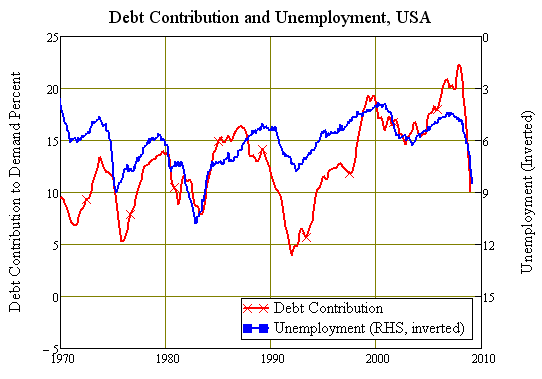
The dramatic deterioration in the economy comes as a surprise to conventional “neoclassical” economists because they exclude debt (and money) from their model of how the economy works. This failed model of the operations of a market economy is why they are incapable of explaining the economy’s behaviour today.
With the debt contribution to demand now plummeting, unemployment will rise to levels that are unprecedented in the post WWII period–and they may even rival the Great Depression.
Attempts to inflate our way out of this via either government spending or quantitative easing will also fail.
The sheer scale of private debt de-leveraging swamps the government’s pump priming, while there is so much debt relative to government created money that the latter will have to be increased by astronomical amounts–and given to those in debt, rather than to the banks–to counter the collapse in demand caused by private deleveraging.
To labour a comparison I’ve made numerous times, Rudd’s stimulus package will inject $42 billion into the economy, but a 5% reduction in debt by the private sector will remove $100 billion from it.
Even the slowdown in debt accumulation will swamp the government’s stimulus. In 2007-08, the last year of our debt bubble, private debt rose by $259 billion–adding 20% to aggregate demand. The fall of this to zero–a simple stabilisation of private debt–will remove 20% of demand from the economy. This is what is causing unemployment to explode now.
On the monetary front, Bernanke has literally doubled government-created money in the USA in a matter of months, but even so the ratio of private debt to this is close to 30 to 1. He’d need to create twenty times as much (and give it to the debtors to cancel their debts, rather than to the banks in a futile attempt to maintain their facade of solvency) before there would be any chance of a monetary stimulus working. I simply can’t see him trying it.
Even if he did (and our local RBA followed suit), and even if governments maintained the scale of fiscal stimulus they are now imparting, there would still be the reality (for the USA, the UK and Australia, and some European nations) that, courtesy of the globalisation of production, they no longer have the productive capacity to employ those who are going to be thrown into unemployment via this debt-driven collapse.
The problems caused by the neoclassical economic philosophy of the last 40 years were papered over by debt. To steal a phrase from Warren Buffett, now that debt is collapsing–and debt-finance can no longer be used to purchase cheap Asian goods–the nakedness of that philosophy will be exposed by the outgoing tide.
Australia, which has for some time deluded itself that it is different to the rest of the world, and will therefore come through this crisis relatively unscathed, may in fact be the most naked of all.
http://www.debtdeflation.com/blogs/2009/04/09/whod-a-thought-it-unemployment-leaps-05-in-a-month/
This was right in line with what I was expecting from a non-orthodox, “Hyman Minsky” point of view. As I have argued in numerous blogs, aggregate demand is the sum of GDP plus the change in debt. Now that our economy is utterly debt-dependent, the debt-financed asset-price bubbles have burst, and debt de-leveraging has begun in earnest, the economy will tank and unemployment will explode as debt-financed spending evaporates.
The key chart I’ve published on this a number of times is the following: it shows the correlation between the contribution the change in private debt makes to aggregate demand and the unemployment rate (the red line is the change in debt, divided by the sum of the change in debt plus GDP; the blue line is unemployment, inverted and plotted on the right hand axis).
As the economy has become more and more debt-dependent–as the ratio of Debt to GDP has risen–this correlation has gone from being trivial to explaining 95% of the level of unemployment.
For those who believe that “Australia is different”, here’s the matching chart for the USA. The only difference is one of time: they began their decline in this Depression about a year before we did. But we are rapidly catching up.
The dramatic deterioration in the economy comes as a surprise to conventional “neoclassical” economists because they exclude debt (and money) from their model of how the economy works. This failed model of the operations of a market economy is why they are incapable of explaining the economy’s behaviour today.
With the debt contribution to demand now plummeting, unemployment will rise to levels that are unprecedented in the post WWII period–and they may even rival the Great Depression.
Attempts to inflate our way out of this via either government spending or quantitative easing will also fail.
The sheer scale of private debt de-leveraging swamps the government’s pump priming, while there is so much debt relative to government created money that the latter will have to be increased by astronomical amounts–and given to those in debt, rather than to the banks–to counter the collapse in demand caused by private deleveraging.
To labour a comparison I’ve made numerous times, Rudd’s stimulus package will inject $42 billion into the economy, but a 5% reduction in debt by the private sector will remove $100 billion from it.
Even the slowdown in debt accumulation will swamp the government’s stimulus. In 2007-08, the last year of our debt bubble, private debt rose by $259 billion–adding 20% to aggregate demand. The fall of this to zero–a simple stabilisation of private debt–will remove 20% of demand from the economy. This is what is causing unemployment to explode now.
On the monetary front, Bernanke has literally doubled government-created money in the USA in a matter of months, but even so the ratio of private debt to this is close to 30 to 1. He’d need to create twenty times as much (and give it to the debtors to cancel their debts, rather than to the banks in a futile attempt to maintain their facade of solvency) before there would be any chance of a monetary stimulus working. I simply can’t see him trying it.
Even if he did (and our local RBA followed suit), and even if governments maintained the scale of fiscal stimulus they are now imparting, there would still be the reality (for the USA, the UK and Australia, and some European nations) that, courtesy of the globalisation of production, they no longer have the productive capacity to employ those who are going to be thrown into unemployment via this debt-driven collapse.
The problems caused by the neoclassical economic philosophy of the last 40 years were papered over by debt. To steal a phrase from Warren Buffett, now that debt is collapsing–and debt-finance can no longer be used to purchase cheap Asian goods–the nakedness of that philosophy will be exposed by the outgoing tide.
Australia, which has for some time deluded itself that it is different to the rest of the world, and will therefore come through this crisis relatively unscathed, may in fact be the most naked of all.
http://www.debtdeflation.com/blogs/2009/04/09/whod-a-thought-it-unemployment-leaps-05-in-a-month/
6 March 2009
After the Economic Dunkirk
http://www.debtdeflation.com/blogs/2009/03/05/after-our-economic-dunkirk/
Not well. Rudd’s stimulus is a whopping $42 billion–a big number. But our private debt is now over $2 trillion. If the private sector de-levers by as little as 5% of its current debt level, that will withdraw $100 billion from spending. In the new economic Rock vs Scissors game, Deleveraging trumps Government Stimulus every time.
This is why Japan is still mired in a Depression, 19 years after its bubble economy burst. You can’t solve a problem caused by too much debt by going into more debt. Ultimately, the only solution is to reduce debt.
There Australia is in a quandary. We don’t yet have insolvent banks–the USA on the other hand has nothing else. So drastic means of attacking the problem are possible in America, once the Yankees get over their usual pussy-footing about nationalisation. But we can’t follow that path while it still appears that our banks are solvent.
So all we can do is brace ourselves for a massive increase in unemployment, and do what we can to ameliorate the pain. Several policies are obvious there: remove the waiting period for receiving the dole, eliminate (or drastically prune) the requirements that unemployed persons exhaust their savings before they receive the dole, get rid of the punitive job application requirements, and take the stigma away from being a victim of a global financial crisis that is well beyond the control of those whose jobs will be destroyed by it.
That will necessitate a massive increase in the government deficit, but that is justified in making sure that the pain of a Depression is shared more equitably. It is also a far more sensible way of going into deficit than throwing a fistful of money at soon to be unemployed consumers.
We can also change the rules on mortgage defaults, so that a failed borrower becomes a renter from the bank or lender that extended the money, and pays a rent based on a proportion of their income. That might mean a lot less revenue for banks, but it will also mean a lot less mortgagee sales–and there will be a tsunami of those coming our way if the economy continues to shrink by 0.5% or more every quarter.
On that front, the most recent figure was a drop in the bucket compared to what we’ve already seen overseas, and what we are likely to see here as deleveraging reduces debt-financed spending, our terms of trade collapse, and our export voumes plummet. It seems that the days of Kangaroo Economics–”We won’t suffer a recession because we have marsupials”–are over. Bye Bye, Boom Boom.
Not well. Rudd’s stimulus is a whopping $42 billion–a big number. But our private debt is now over $2 trillion. If the private sector de-levers by as little as 5% of its current debt level, that will withdraw $100 billion from spending. In the new economic Rock vs Scissors game, Deleveraging trumps Government Stimulus every time.
This is why Japan is still mired in a Depression, 19 years after its bubble economy burst. You can’t solve a problem caused by too much debt by going into more debt. Ultimately, the only solution is to reduce debt.
There Australia is in a quandary. We don’t yet have insolvent banks–the USA on the other hand has nothing else. So drastic means of attacking the problem are possible in America, once the Yankees get over their usual pussy-footing about nationalisation. But we can’t follow that path while it still appears that our banks are solvent.
So all we can do is brace ourselves for a massive increase in unemployment, and do what we can to ameliorate the pain. Several policies are obvious there: remove the waiting period for receiving the dole, eliminate (or drastically prune) the requirements that unemployed persons exhaust their savings before they receive the dole, get rid of the punitive job application requirements, and take the stigma away from being a victim of a global financial crisis that is well beyond the control of those whose jobs will be destroyed by it.
That will necessitate a massive increase in the government deficit, but that is justified in making sure that the pain of a Depression is shared more equitably. It is also a far more sensible way of going into deficit than throwing a fistful of money at soon to be unemployed consumers.
We can also change the rules on mortgage defaults, so that a failed borrower becomes a renter from the bank or lender that extended the money, and pays a rent based on a proportion of their income. That might mean a lot less revenue for banks, but it will also mean a lot less mortgagee sales–and there will be a tsunami of those coming our way if the economy continues to shrink by 0.5% or more every quarter.
On that front, the most recent figure was a drop in the bucket compared to what we’ve already seen overseas, and what we are likely to see here as deleveraging reduces debt-financed spending, our terms of trade collapse, and our export voumes plummet. It seems that the days of Kangaroo Economics–”We won’t suffer a recession because we have marsupials”–are over. Bye Bye, Boom Boom.
27 January 2009
70,000 jobs axed as global financial crisis deepens ~ABC Sydney
Companies around the world have slashed more than 70,000 jobs in a single day as the global economic slump deepens.
No sector has been immune from the new wave of job losses.
Construction equipment maker Caterpillar, which has operations in Australia, is cutting 20,000 jobs worldwide.
Drug manufacturer Pfizer will shed 19,000 workers when it completes a takeover of a rival drug giant Wyeth.
Also axing jobs is car maker General Motors, banking and insurance group ING and electronics firm Philips.
Telecommunications company Sprint Nextel is shedding 8,000 staff or 14 per cent of its workforce.
Home improvement retailer Home Depot is axing 7,000 positions.
All of these jobs cuts were announced within the space of couple of hours.
They follow deep cuts last week at computer firms Microsoft and Intel and at United Airlines.
A sombre US President Barack Obama fronted the cameras at the White House to sympathise with those workers affected.
"These are working men and women whose families have been disrupted and whose dreams have been put on hold," he said.
Mr Obama used the shocking news to step up pressure on the US Congress to quickly pass his proposed $1.2 trillion economic stimulus package.
And a grim report by the National Association of Business Economics says nearly half of those companies surveyed expected to make what they described as "significant" job cuts over the next six months.
The survey says America is facing its worst business conditions in nearly 30 years.
Japanese cuts
Japan's top car makers say they are planning to cut 25,000 jobs by the end of March.
Despite being in better shape than the big three US car makers, Japan's auto manufacturers are taking drastic measures to weather the global financial storm.
A survey of Japanese car makers has found they expect to slash 25,000 jobs by the end of the Japanese financial year in March.
The survey says the leading 12 auto manufacturers also plan to cut their combined production by at least 3 million cars from their original output targets.
No sector has been immune from the new wave of job losses.
Construction equipment maker Caterpillar, which has operations in Australia, is cutting 20,000 jobs worldwide.
Drug manufacturer Pfizer will shed 19,000 workers when it completes a takeover of a rival drug giant Wyeth.
Also axing jobs is car maker General Motors, banking and insurance group ING and electronics firm Philips.
Telecommunications company Sprint Nextel is shedding 8,000 staff or 14 per cent of its workforce.
Home improvement retailer Home Depot is axing 7,000 positions.
All of these jobs cuts were announced within the space of couple of hours.
They follow deep cuts last week at computer firms Microsoft and Intel and at United Airlines.
A sombre US President Barack Obama fronted the cameras at the White House to sympathise with those workers affected.
"These are working men and women whose families have been disrupted and whose dreams have been put on hold," he said.
Mr Obama used the shocking news to step up pressure on the US Congress to quickly pass his proposed $1.2 trillion economic stimulus package.
And a grim report by the National Association of Business Economics says nearly half of those companies surveyed expected to make what they described as "significant" job cuts over the next six months.
The survey says America is facing its worst business conditions in nearly 30 years.
Japanese cuts
Japan's top car makers say they are planning to cut 25,000 jobs by the end of March.
Despite being in better shape than the big three US car makers, Japan's auto manufacturers are taking drastic measures to weather the global financial storm.
A survey of Japanese car makers has found they expect to slash 25,000 jobs by the end of the Japanese financial year in March.
The survey says the leading 12 auto manufacturers also plan to cut their combined production by at least 3 million cars from their original output targets.
9 December 2008
Coming soon to U.S., 1 million jobs lost every month: Report
London-based GFC Economics is making a frightening prediction: By spring 2009, the United States could be facing more than 1 million layoffs every successive month.
Expenses related to corporate debt, and muddy credit markets consumed by fear, are driving a fast-approaching "hard landing," claims a Sunday report in UK's Guardian.
"Corporate bond yields have rocketed since the credit crisis began as investors flee risky assets in search of safe havens such as US Treasuries. That effectively means many firms are being forced to pay eye-watering interest rates to borrow funds," the paper reported.
"November's jobs figures were so much worse than analysts had expected that the Dow Jones share index actually rallied by 259 points, more than 3 per cent, as investors bet that Washington would have to launch a major new rescue package for the economy even before President-elect Barack Obama takes over the White House in January."
Sunday morning, during an appearance on Meet the Press, President-elect Obama cautioned Americans that the crisis would only get worse before it begins to ease. He also outlined a new stimulus package some senior Democrats have said could cost as much as $1 trillion.
"Mr. Obama refused to put a cost on the plan, but senior Democrats are talking about $700 billion, with others urging up to $1 trillion," reported the Times Online. "When he met the nation’s governors last week he was told that on the state level there was $136 billion worth of building projects ready to go if federal money was made available."
David Frost, director-general of the British Chamber of Commerce, paints a grim deadline.
"The worry is that next year the job losses will be just horrendous," he said. "All sectors are taking the hit. In the middle of the year it was construction and estate agencies. Now it is services, the automotive industry, retailers. Firms are waiting for Christmas and if they can't see any improvement they will cut their payrolls."
Expenses related to corporate debt, and muddy credit markets consumed by fear, are driving a fast-approaching "hard landing," claims a Sunday report in UK's Guardian.
"Corporate bond yields have rocketed since the credit crisis began as investors flee risky assets in search of safe havens such as US Treasuries. That effectively means many firms are being forced to pay eye-watering interest rates to borrow funds," the paper reported.
"November's jobs figures were so much worse than analysts had expected that the Dow Jones share index actually rallied by 259 points, more than 3 per cent, as investors bet that Washington would have to launch a major new rescue package for the economy even before President-elect Barack Obama takes over the White House in January."
Sunday morning, during an appearance on Meet the Press, President-elect Obama cautioned Americans that the crisis would only get worse before it begins to ease. He also outlined a new stimulus package some senior Democrats have said could cost as much as $1 trillion.
"Mr. Obama refused to put a cost on the plan, but senior Democrats are talking about $700 billion, with others urging up to $1 trillion," reported the Times Online. "When he met the nation’s governors last week he was told that on the state level there was $136 billion worth of building projects ready to go if federal money was made available."
David Frost, director-general of the British Chamber of Commerce, paints a grim deadline.
"The worry is that next year the job losses will be just horrendous," he said. "All sectors are taking the hit. In the middle of the year it was construction and estate agencies. Now it is services, the automotive industry, retailers. Firms are waiting for Christmas and if they can't see any improvement they will cut their payrolls."
Subscribe to:
Posts (Atom)