Jesse nails it.
After thinking it over, and listening carefully to the discussion on financial television and the news today in reaction to the proposal for a special bank tax, I can come to no other conclusion. Wall Street thinks that the American people, who came to their aid after the collapse of a monumental and most likely fraudulent bubble, are jealous little malcontents.
They believe that the public wants to limit the bonuses paid by Wall Street because they are just jealous. Or stupid and petty. At least they wish to leave their viewers and readers with that impression.
That's the long and short of it. You, average working stiff and retiree, are just a jealous little malcontent who envies the great success of the financial sector, much like some foreign agitator who attacks the West because they envy its freedoms.
And you are seeking retribution, revenge. That is what this bank tax is all about, retribution.
An economics professor just admitted that he too feels a need for retribution at times, as an emotional response, but being a more educated fellow he sees how negative that is. Instead he proposes that if we must have some bank tax that we divert the funds received into a bank holding fund, a kind of a TARP II, to pay for future financial disasters. Forget about reform. The banks are too smart for it.
I would not call it jealousy or a need for retribution.
I would say that the people as a whole have a sense of right and wrong, a sense of fairness and balance, a sense of outrage that is being held in check by patience, a remarkable forebearance, but wish to see justice done for themselves and their children, because it is the right thing, the only practical thing, to do.
But I can also understand why the Wall Street Bankers and the financial elite would see this as jealousy and envy.
Sociopath: (so⋅ci⋅o⋅path) a person, as a psychopathic personality, whose behavior is antisocial and who lacks a sense of moral responsibility or social conscience.
The most amoral, pathological son of a bitch I ever worked with, who by the way was enormously charismatic and charming when on public display, was a big tech entrepreneur from the Boston area. When his grandiose schemes started to fall apart, as much from the impracticality of his ego as from the fact that no one would trust him any longer, having senselessly betrayed everyone including his closest friends, he said to me in all the sincerity he could muster, "I am failing because people want to drag me down to their level."
And I can assure you, the halls of too many corporations and big government are infested with such power needing, neurotically driven personality types.
This is what renders any notion of self-regulation and efficient markets the romantic fantasy that they are. People are not uniformly rational and moderate in their behaviour. All people are not possessed of a natural goodness and a self-effacing moderation.
This is what makes the rule of law, the Constitution, so indispensable.
This is not to say that their enablers, the financial demimonde, are sociopaths. They are doing what enablers too often do; go along to get along, say and do whatever is required for pay. Camp followers, as they used to be called.
And as for what happened, well, as one well-heeled, successful young manager advised, "Older people are easy to handle. You just scare them. Then they do whatever they are told."
In his mind 'older' was anyone over 40. And as for the rest of the people, well, you just play on their other emotions like hatred and greed and prejudice. He saw absolutely nothing wrong with this, and was so straightfoward and unabashed in this view that it made my blood run cold, because it was clear that he was not alone in this perspective. And it is obvious that Tim, Ben, and Hank did exactly this, and it worked.
And so now they hit the theme that if the banks are taxed, they will just find ways around the restrictions, and keep doing what they wish to do with bonuses and speculation, but may stop lending to the people for their commercial and personal needs, to punish them.
So there you have it. You are a jealous, envious, little nobody desiring retribution from your betters in the land that your fathers fought and died for.
And not only that, but many of your middle class fellows would agree. They would not think this about themselves of course, but about you, the other. The lazy stupid one. There is no easier way to elevate yourself in your own mind than to just put down, impoverish, the other.
And the banks and their enablers in the government will use this, and shape your thinking with it.
You cannot say that you have not been warned. Many times. Money is power, and in a free republic power must be restrained with checks and balances, with a continuing effort and vigilance.
"Banks have done more injury to the religion, morality, tranquility, prosperity, and even wealth of the nation than they can have done or ever will do good." John Adams
There can be no easy truce, no peaceful resolution of the current crisis, until the banks are restrained, and the political and financial systems are reformed, and balance is restored to the economy.
"I believe that it is better to tell the truth than to lie. I believe that it is better to be free than to be a slave. And I believe that it is better to know than be ignorant." H. L. Mencken
Never allow yourself to succumb to hatred and a desire for retribution rather than justice. It is always wrong to hate, because the ultimate tragedy is that we become what we hate, we take the shape of that which possesses our passions, thoughts and attention, we adopt its methods and distortions, even if as in a mirror, until we too are misshapen and lost. And that is the real tragedy, how the whole world can descend into a whirlpool of madness, and become blind. So let us appeal to the law, and to justice, at every turn.
Mr. Obama. Reform these banks.
http://jessescrossroadscafe.blogspot.com/2010/01/wall-street-thinks-you-are-envious-and.html
Showing posts with label banks. Show all posts
Showing posts with label banks. Show all posts
17 January 2010


1 December 2009
Liquidity vs. Solvency: Interview with Bob Eisenbeis and David Kotok
The current issue of Institutional Risk Analytics features an interview with Bob and David Kotok of Cumberland Advisors. To me it is a must read, literally packed with insightful analysis about the dismal situation as concerns our fiscal and monetary affairs.
In essence, “the wounded banking sector of the US is here for a very long time”. Twenty-four hundred plus banks are now rated "F" by the IRA Bank Monitor, which is a quarter of the whole industry. Something like half of the "F" banks are expected to fail. At the same time, it appears we have a situation wherein “Washington has largely destroyed confidence in the United States of America among global investors... “
“On the way back from Tokyo last week, I sat next to a guy who is running the agency desk at one of the largest primary dealers. He described to me the road show he was on to sell US agency paper to Asian financial institutions. We talked about this approach. He said very bluntly that the Asian banks are not buying it. He told me that "we have destroyed confidence and they do not trust us." My response to this was "do you blame them?"
The failed auction has not happened yet. It may not happen. But it would not surprise any of us if it eventually does happen. I expect a VAT to be introduced. I expect it to be introduced during the lame duck session of Congress in 2012.
The IRA: You think we can hold it off for that long?
(Whalen and company were on Bloomberg Radio with Josh Rosner on Tuesday when Josh leaned over during a break and predicted that the Obama Administration was preparing to impose a VAT on the US, using the supposed pressure from our aggrieved allies and global investors as the pretext. We later spoke to our friends in the conservative movement and it turns out that Brookings Institution has been working night and day on a study that will be the road map for implementing a VAT. This is to be a nation-wide sales tax on the American people to pay for the bank bailout. Apparently Bob Rubin and Larry Summers are the proponents of the VAT and they are planning to use the apparent pressure from our foreign creditors as the justification for a large, permanent increase in taxes. And David (of Cumberland Advisors), just described the failure of an auction of agency debt that could provide the pretext for just such a move.)
Liquidity vs. Solvency
The final Q3 2009 data from the FDIC is loaded into The IRA Bank Monitor and, as we reported several weeks ago with our preliminary results stress in the banking industry is up from Q2 2009 and by a significant margin.
The number of FDIC-insured bank units rated "F" rose from 2,256 at the end of June to 2,337 as of Q3 2009. Even with the heavily subsidized money center banks added back into the equation, the Stress Index results suggest that the US financial services sector is still sinking bow down under the weight of the highest loss rate experience in the post-WW II period.
Whereas 2008 was about fear, 2009 has been about buying time. But now dwindling cash positions inside some of the largest financial institutions and investors seem to suggest that 2010 will be about resolution, whether we like it or not.
This suggests that the economy will muddle along through next year and that the 2010 US mid-term elections could be problematic for all incumbents.
us
With the apparent default by the leading government-owned holding company in Dubai, investors have been reminded that solvency remains a core problem in the global economy despite ample official liquidity.
While the Fed and other central banks have thrown a great deal of fiat paper money at the solvency problem, many obligors still have piles of liabilities that were predicated on price levels and volumes in many markets that no longer pertain. Ponder why the government of China might publicly state that its banks need more capital and the next leg of the proverbial systemic risk stool may come into sharper focus.
"The bottom line is that the policies that we see including this new instrument and the other, what I call "wiz kid" ideas like the $1 trillion PPIP which is a fizzle, they do not create confidence. These polices inspire distrust and undermine confidence number two. And thirdly they are not solving basic issues with banks and markets that Bob has been describing in our comments over the past many months, chiefly the difference between solvency and liquidity. Some people in the Treasury do not understand the difference or they do not want to."
http://us1.institutionalriskanalytics.com/pub/IRAMain.asp
GEAB quote – As early as January 2009, LEAP/E2020 warned its subscribers of risks of Dubai collapse in 2009
Fourteen subjects lose momentum along the year 2009 - 1. Financial services, central economic activities: In 2009, as the collapse of Wall Street and the City will deepen (and that of financial centres of secondary importance, such as Singapore and Dubai), the demonstration will be completed that a national economy cannot be based on financial services. The only financial centers to survive will be those based on a sound real economy (that will save Hong-Kong) and representing only one component, among others, of a country’s economy. On the one hand, financial services are reducing even faster than the rest of the economy when a recession occurs due to a financial crisis (they are attacked on every front); and, on the other hand, since financial services are so easy to relocate at the time of Internet (a lot easier than industrial labor-forces), they cannot be the mainstay of anything durable in fact. In 2009, everything that depends on the vitality of these financial centers will sink into the crisis at an even faster pace than the rest of the economy.
But Minack says equities will not roll over until next year..as is sanguine on Dubai.
Finally, sovereign stress has jangled nerves. We're not convinced that what's happened in Dubai is, by itself, of broad consequence. The sums involved are, relative to the global financial losses seen in this cycle, small change. Neither Jonathan Garner, our EM equity strategist, nor Rashique Rahman, our EM credit strategist, sees an end to the rally in their asset classes. (See Jonathan Garner, China/Dubai Newsflow - China More Important and Rashique Rahman, Credit (Dis)location - The Market Will Recover, 27 November.)
However, policy makers' response to the Great Recession has been the Great Swap, and one of the things swapped was the tail risk: a year ago that was private balance sheet implosion; looking ahead, the tail risk is the sovereign equivalent. While Dubai was unexpected, the simple point is that we have seen concerns rising in a number of places, notably Japan and southern Europe.
These factors may sound good reason to call the end of the rally. We know the risks in over-finessing market timing, but on balance we think there's one more leg higher. Our sense is that the current setback has been exacerbated by year-end profit-taking and thinning market conditions. Our hunch is that investors will again see this as a buy the dip opportunity and that the New Year could start reasonably strong, particularly if investors anticipate a continuation of recovery and low rates.
Consequently, we're sticking to our view that stocks can make new rally highs over the next couple of months, although we have lower conviction than in the prior corrections. We are taking last week's events as serious warning. What we are starting to see is a hint of the forces - developed world growth threatening to roll over, and heightened concern about public sector finances - that we think will at some stage lead to a significant fall in developed-world risk assets in 2010.
22 November 2009
Banks drift toward being part of the problem and not the solution
Repudiating the architects of the faux boom is a necessary but not sufficient condition for world economic recovery.
From Liberal Krugman, "Government officials, perhaps influenced by spending too much time with bankers, forgot that if you want to govern effectively you have retain the trust of the people. And by treating the financial industry — which got us into this mess in the first place — with kid gloves, they have squandered that trust."
http://www.nytimes.com/2009/11/20/opinion/20krugman.html?_r=1&sq=%22The%20Big%20Squander%22&st=cse&adxnnl=1&scp=1&adxnnlx=1258773939-FKsmEbG/NnGjwtcOXVjkfg
To conservative Wolf, FT, "Over the past half century, UK bank capital has remained at between 3 per cent and 5 per cent of assets, these assets have risen tenfold, relative to GDP, and returns on equity have averaged 20 per cent. Such high returns, in an established industry, must mean either high barriers to entry or excessive risk-taking. The former are undesirable and the latter terrifying, particularly in view of the huge rise in the state’s exposure to the risks."
http://www.ft.com/cms/s/0/f9d3132c-d55b-11de-81ee-00144feabdc0.html
Buiter, FT, proposing auditing the ECB,
"A comprehensive independent audit of the Fed’s use of what is, in the final analysis, public money and therefore tax payers’ money is long overdue. This is a major victory for democracy and the public’s right to know what those to whom certain public functions have been delegated and entrusted have been doing with the taxpayers’ money.
What’s good for the Fed and for American democracy is equally important for the European Central Bank and European democracy or for the Bank of England and British democracy. It is time for a detailed and comprehensive independent audit of the ECB’s financial transactions since the beginning of the crisis. This should include a close examination of the precise terms and conditions, including valuations of illiquid collateral, on which liquidity support, including enhanced (credit) liquidity support has been made available to the Euro Area banks by the NCBs of the Eurosystem."
http://blogs.ft.com/maverecon/2009/11/auditing-the-central-bank-a-jolly-good-thing/#more-7751
From Liberal Krugman, "Government officials, perhaps influenced by spending too much time with bankers, forgot that if you want to govern effectively you have retain the trust of the people. And by treating the financial industry — which got us into this mess in the first place — with kid gloves, they have squandered that trust."
http://www.nytimes.com/2009/11/20/opinion/20krugman.html?_r=1&sq=%22The%20Big%20Squander%22&st=cse&adxnnl=1&scp=1&adxnnlx=1258773939-FKsmEbG/NnGjwtcOXVjkfg
To conservative Wolf, FT, "Over the past half century, UK bank capital has remained at between 3 per cent and 5 per cent of assets, these assets have risen tenfold, relative to GDP, and returns on equity have averaged 20 per cent. Such high returns, in an established industry, must mean either high barriers to entry or excessive risk-taking. The former are undesirable and the latter terrifying, particularly in view of the huge rise in the state’s exposure to the risks."
http://www.ft.com/cms/s/0/f9d3132c-d55b-11de-81ee-00144feabdc0.html
Buiter, FT, proposing auditing the ECB,
"A comprehensive independent audit of the Fed’s use of what is, in the final analysis, public money and therefore tax payers’ money is long overdue. This is a major victory for democracy and the public’s right to know what those to whom certain public functions have been delegated and entrusted have been doing with the taxpayers’ money.
What’s good for the Fed and for American democracy is equally important for the European Central Bank and European democracy or for the Bank of England and British democracy. It is time for a detailed and comprehensive independent audit of the ECB’s financial transactions since the beginning of the crisis. This should include a close examination of the precise terms and conditions, including valuations of illiquid collateral, on which liquidity support, including enhanced (credit) liquidity support has been made available to the Euro Area banks by the NCBs of the Eurosystem."
http://blogs.ft.com/maverecon/2009/11/auditing-the-central-bank-a-jolly-good-thing/#more-7751
8 November 2009
Gold suppression is public policy and public record, not 'conspiracy theory' ~ GATA
Gold suppression is public policy and public record, not 'conspiracy theory'
Submitted by cpowell on Sat, 2009-11-07 18:16. Section: Essays
Remarks by Chris Powell, Secretary/Treasurer
Gold Anti-Trust Action Committee Inc.
International Precious Metals and Commodities Show
Olympia Park, Munich, Germany
Saturday, November 7, 2009
Thank you for coming to listen to me today. Please forgive my inability to speak German. I'll be discussing many documents, some of them fairly complicated, but don't worry if you miss something about them. They'll be posted at GATA's Internet site with these remarks.
On Friday, September 25, Jim Rickards, director of market intelligence for the Omnis consulting firm in McLean, Virginia., was interviewed on the cable television network CNBC in the United States. Talking about the currency markets, Rickards remarked: "When you own gold you're fighting every central bank in the world."
That's because gold is a currency that competes with government currencies and has a powerful influence on interest rates and the price of government bonds. And that's why central banks long have tried to suppress the price of gold. Gold is the ticket out of the central banking system, the escape from coercive central bank and government power.
As an independent currency, a currency to which investors can resort when they are dissatisfied with government currencies, gold carries the enormous power to discipline governments, to call them to account for their inflation of the money supply and to warn the world against it. Because gold is the vehicle of escape from the central bank system, the manipulation of the gold market is the manipulation that makes possible all other market manipulation by government.
Of course what Jim Rickards said about gold was no surprise to my organization, the Gold Anti-Trust Action Committee. To the contrary, what Rickards said has been our premise for most of our 10 years, and we have documented it extensively. Rickards' assertion was spectacular simply because he was allowed to make it in the mainstream financial news media and was allowed to keep talking. While the gold price suppression scheme is a hard fact of history, it is seldom mentioned in polite company in the financial world. I have been asked to talk about it here. I am grateful for this invitation and I will try to be polite.
How have central banks tried to suppress the price of gold?
The gold price suppression scheme was undertaken openly by governments for a long time prior to 1971.
That's what the gold standard was about -- governments fixing the price of gold to a precise value in their currencies, a price at which governments would exchange their currencies for gold, currencies that were backed by gold.
Though the gold standard was abandoned during World War I, restored briefly in the 1920s, and then abandoned again during the Great Depression, that was not the end of government efforts to control the gold price. Throughout the 1960s the United States and Great Britain attempted to hold the price at $35 in a public arrangement of the dishoarding of U.S. gold reserves. This arrangement came to be known as the London Gold Pool.
As monetary inflation rose sharply, the London Gold Pool was overwhelmed by demand and was shut down abruptly in April 1968. Three years later, in 1971, the United States repudiated the remaining convertibility of the dollar into gold -- convertibility for government treasuries that wanted to exchange dollars for gold. At that moment currencies began to float against each other and against gold -- or so the world was told.
For since 1971 the gold price suppression scheme has been undertaken largely surreptitiously, seldom acknowledged officially. But sometimes it has been acknowledged officially, and with a little detective work, more about it can be discovered.
You may have heard GATA derided as a "conspiracy theory" organization. We are not that at all. To the contrary, we examine the public record, produce documentation, question public officials, and publicize their most interesting answers, or their most interesting refusals to answer. I'd like to review some of the public record with you.
The gold price suppression scheme became a matter of public record in January 1995, when the general counsel of the U.S. Federal Reserve Board, J. Virgil Mattingly, told the Federal Open Market Committee, according to the committee's minutes, that the U.S. Treasury Department's Exchange Stabilization Fund had undertaken gold swaps. Gold swaps are exchanges of gold allowing one central bank to intervene in the gold market on behalf of another central bank, potentially giving anonymity to the central bank that wants to undertake the intervention. The 1995 Federal Open Market Committee minutes in which Mattingly acknowledges gold swaps are still posted at the Fed's Internet site:
http://www.federalreserve.gov/monetarypolicy/files/FOMC19950201meeting.p...
The gold price suppression scheme was a matter of public record in July 1998, six months before GATA was formed, when Federal Reserve Chairman Alan Greenspan told Congress: "Central banks stand ready to lease gold in increasing quantities should the price rise." That is, Greenspan himself, supposedly the greatest among the central bankers, contradicted the usual central bank explanation for leasing gold -- which was supposedly to earn a little interest on a dead asset -- and admitted that gold leasing is all about suppressing the price. Greenspan's admission is still posted at the Fed's Internet site:
http://www.federalreserve.gov/boarddocs/testimony/1998/19980724.htm
Incidentally, while we gold bugs love to cite Greenspan's testimony from 1998 because of its reference to gold leasing, that testimony was mainly about something else, for which it is far more important today. For with that testimony Greenspan persuaded Congress not to regulate the sort of financial derivatives that lately have devastated the world financial system.
The Washington Agreement on Gold, made by the European central banks in 1999, was another admission -- no, a proclamation that central banks were working together to control the gold price. The central banks making the Washington Agreement claimed that, by restricting their gold sales and leasing, they meant to prevent the gold price from falling too hard. But even if you believed that explanation, it was still collusive intervention in the gold market. You can find the Washington Agreement at the World Gold Council's Internet site:
http://www.reserveasset.gold.org/central_bank_agreements/cbga1/
Barrick Gold, then the largest gold-mining company in the world, confessed to the gold price suppression scheme in U.S. District Court in New Orleans on February 28, 2003. That is when Barrick filed a motion to dismiss Blanchard & Co.'s anti-trust lawsuit against Barrick and its bullion banker, JPMorganChase, for rigging the gold market.
Barrick's motion claimed that in borrowing gold from central banks and selling it, the mining company had become the agent of the central banks in the gold market, and, as the agent of the central banks, Barrick should share their sovereign immunity and be exempt from suit. Barrick's confession to the gold price suppression scheme is posted at GATA's Internet site:
http://www.gata.org/files/BarrickConfessionMotionToDismiss.pdf
The Reserve Bank of Australia confessed to the gold price suppression scheme in its annual report for 2003. "Foreign currency reserve assets and gold," the Reserve Bank's report said, "are held primarily to support intervention in the foreign exchange market." The bank's report is still posted at its Internet site:
http://www.rba.gov.au/PublicationsAndResearch/RBAAnnualReports/2003/Pdf/...
Maybe the most brazen admission of the Western central bank scheme to suppress the gold price was made by the head of the monetary and economic department of the Bank for International Settlements, William S. White, in a speech to a BIS conference in Basel, Switzerland, in June 2005.
There are five main purposes of central bank cooperation, White announced, and one of them is "the provision of international credits and joint efforts to influence asset prices (especially gold and foreign exchange) in circumstances where this might be thought useful." White's speech is posted at GATA's Internet site:
http://www.gata.org/node/4279
In January this year a remarkable 16-page memorandum was discovered in the archive of the late Federal Reserve Chairman William McChesney Martin. The memorandum is dated April 5, 1961, and is titled "U.S. Foreign Exchange Operations: Needs and Methods." It is a detailed plan of surreptitious intervention to rig the currency and gold markets to support the dollar and to conceal, obscure, or falsify U.S. government records and reports so that the rigging might not be discovered. This document remains on the Internet site of the Federal Reserve Bank of St. Louis:
http://fraser.stlouisfed.org/docs/historical/martin/23_06_19610405.pdf
In August this year the international journalist Max Keiser reported an interview he had with the Bundesbank, Germany's central bank, in which he was told that all of Germany's gold reserves were held in New York. That interview is posted at the YouTube Internet site:
http://www.youtube.com/watch?v=EzVhzoAqMhU
Some people saw the Bundesbank's admission as a suggestion that Germany's gold had become the tool of the U.S. government. GATA consultant Rob Kirby of Kirby Analytics in Toronto then pressed the Bundesbank for clarification. On August 24 the Bundesbank replied to Kirby by e-mail with a denial of Keiser's report, but the denial was actually pretty much a confirmation:
http://www.gata.org/node/7713
"The Deutsche Bundesbank," the reply said, "keeps a large part of its gold holdings in its own vaults in Germany, while some of its gold is also stored with the central banks located at major gold trading centers. This," the Bundesbank continued, "has historical and market-related reasons, the gold having been transferred to the Bundesbank at these trading centers. Moreover, the Bundesbank needs to hold gold at the various trading centers in order to conduct its gold activities."
The Bundesbank did not specify those "gold activities" and those "trading centers." But those "activities" can mean only that the Bundesbank is or recently has been surreptitiously active in the gold market, perhaps at the behest of others -- like the United States, the custodian of German gold.
In September this year a New York financial market professional and student of history named Geoffrey Batt posted at the Zero Hedge Internet site three declassified U.S. government documents involving the gold market.
The first was a long cable dated March 6, 1968, from someone named Deming at the U.S. Embassy in Paris to the State Department in Washington. It is posted at the Zero Hedge Internet site:
http://www.zerohedge.com/article/declassified-state-dept-data-highlights...
The cable described the strains on the London Gold Pool, the
gold-dishoarding mechanism established by the U.S. Treasury and the Bank of England to hold the gold price to the official price of $35 per ounce. The London Gold Pool was to last only six months longer.
The cable is a detailed speculation on what would have to be done to control the gold price and particularly to convince investors "that there is no point any more in speculating on an increase in the price of gold" and "to establish beyond doubt" that the world financial system "is immune to gold losses" by central banks.
The cable recommends creation of a "new reserve asset" with "gold-like qualities" to replace gold and prevent gold from gaining value. To accomplish this, the cable proposes "monthly or quarterly reshuffles" of gold reserves among central banks -- what the cable calls a "reshuffle club" that would apply gold where market intervention seemed most necessary.
These "reshuffles" sound like the central bank gold swaps of recent years.
The idea, the cable says, is for the central banks "to remain the masters of gold."
Also in September this year Zero Hedge's Geoffrey Batt disclosed a memorandum from the Central Intelligence Agency dated December 4, 1968, several months after the collapse of the London Gold Pool. This too is posted at the Zero Hedge Internet site:
http://www.zerohedge.com/article/cia-chimes-gold-control-highlights-hist...
The CIA memo said that to keep the dollar strong and prevent "a major outflow of gold," U.S. strategy would be:
" -- To isolate official from private gold markets by obtaining a pledge from central banks that they will neither buy nor sell gold except to each other."
And:
"-- To bring South Africa to sell its current production of gold in the private market, and thus keep the private price down."
The third declassified U.S. government document published by Geoffrey Batt at Zero Hedge, also in September this year, may be the most interesting, because it was written on June 3, 1975, four years after the last bit of official fixed convertibility of the dollar and gold had been eliminated and the world had been told that currencies henceforth would float against each other and gold and gold would be free trading.
The document is a seven-page memorandum from Federal Reserve Board Chairman Arthur Burns to President Gerald Ford. It is all about controlling the gold price through foreign policy and defeating any free market for gold. It is posted at the Zero Hedge Internet site as well:
http://www.zerohedge.com/article/smoking-gun-fed-controlling-gold
Burns tells the president: "I have a secret understanding in writing with the Bundesbank, concurred in by Mr. Schmidt" -- that's Helmut Schmidt, West Germany's chancellor at the time -- "that Germany will not buy gold, either from the market or from another government, at a price above the official price of $42.22 per ounce."
Burns adds, "I am convinced that by far the best position for us to take at this time is to resist arrangements that provide wide latitude for central banks and governments to purchase gold at a market-related price."
While the Burns memo is consistent with the long-established interest of central banks in controlling the gold price, it was still 34 years ago. But now at last there has been a contemporaneous admission of U.S. government intervention in the gold market. It has come out of GATA's long Freedom of Information Act struggle with the U.S. Treasury Department and Federal Reserve for information about the U.S. gold reserves and gold swaps, information that has been denied to GATA on the grounds that it would compromise certain private proprietary interests. (Of course such a
denial, a denial based on proprietary interests, is in itself a suggestion that the U.S. gold reserve has been placed, at least partly, in private hands.)
Responding to President Obama's declaration, soon after his inauguration, that the federal government would be more open, GATA renewed its informational requests to the Fed and the Treasury. These requests concentrated on gold swaps. Of course both requests were denied again. But through its Washington lawyer, William J. Olson --
http://www.lawandfreedom.com -- GATA brought an appeal of the Fed's denial, and this appeal was directed to a full member of the Fed's Board of Governors, Kevin M. Warsh, formerly a member of the President's Working Group on Financial Markets, nicknamed the Plunge Protection Team. Warsh denied GATA's appeal but in his letter to our lawyer he let slip some stunning information:
http://www.gata.org/files/GATAFedResponse-09-17-2009.pdf
Warsh wrote: "In connection with your appeal, I have confirmed that the information withheld under Exemption 4" -- that's Exemption 4 of the Freedom of Information Act -- "consists of confidential commercial or financial information relating to the operations of the Federal Reserve Banks that was obtained within the meaning of Exemption 4. This includes information relating to swap arrangements with foreign banks on behalf of the Federal Reserve System and is not the type of information that is customarily disclosed to the public. This information was properly withheld from you."
So there it is: The Federal Reserve today -- right now -- has gold swap arrangements with "foreign banks."
Eight years ago Fed Chairman Alan Greenspan and the general counsel of the Federal Open Market Committee, Virgil Mattingly, vigorously denied to GATA, through two U.S. senators who had inquired of the Fed on our behalf, that the Fed had gold swap arrangements, even though FOMC minutes from 1995 quote Mattingly as saying the U.S. has engaged in gold swaps:
http://www.gata.org/node/1181
But now the Fed admits such arrangements.
Of course Fed Governor Warsh did not say that the Fed has actually swapped any gold lately, only that it has arrangements to do so -- and, just as important, that the Fed does not want the public and the markets to know about those arrangements, does not want the public and the markets to know about the disposition of United States gold reserves.
GATA is preparing to sue the Fed in federal court to compel disclosure of these gold swap arrangements.
There is a reason for the Fed's insistence that the public and the markets must not know what the Fed is doing in the gold market.
It is because, as the documents compiled and publicized by GATA suggest, suppressing the gold price is part of the general surreptitious rigging of the currency, bond, and commodity markets by the U.S. and allied governments, because this market rigging is the foremost objective of U.S. foreign and economic policy, and because this rigging cannot work if it is exposed and the markets realize that they are not really markets at all.
And the rigging increasingly is being exposed and understood.
In complaining about the manipulation of the gold market, GATA has not been called "conspiracy nuts" by everyone. We have gained a good deal of institutional support over the years.
First came Sprott Asset Management in Toronto, which in 2004 issued a
comprehensive report supporting GATA. The report was written by Sprott's chief investment strategist, John Embry, and his assistant, Andrew Hepburn, and was titled "Not Free, Not Fair -- the Long-Term Manipulation of the Gold Price." It remains available at the Sprott Internet site:
http://www.sprott.com/docs/PressReleases/20_not_free_not_fair.pdf
Then in 2006 the Cheuvreux brokerage house of Credit Agricole, the major French bank, issued its own report confirming GATA's findings of manipulation in the gold market. The Cheuvreux report was titled "Remonetization of Gold: Start Hoarding," and you can find it at GATA's Internet site:
http://www.gata.org/files/CheuvreuxGoldReport.pdf
And in 2007 Citigroup -- yes, Citigroup, a pillar of the American financial establishment -- joined the supposed conspiracy nuts. It published a report titled "Gold: Riding the Reflationary Rescue," written by its analysts John H. Hill and Graham Wark, declaring: "Gold undoubtedly faced headwinds this year from resurgent central bank selling, which was clearly timed to cap the gold price." You can find the Citigroup report at GATA's Internet site:
http://www.gata.org/files/CitigroupGoldReport092107.pdf
Even those authorities who do not want to run afoul of government institutions that with a few computer keystrokes can create virtually infinite amounts of money may have to admit the opportunity for central banks to manipulate the gold market. For it is widely acknowledged that annual world gold production is about 2,400 tonnes, that annual net world gold demand is about 3,400 tonnes, that gold production has been falling as demand has been rising, and that the thousand-tonne gap between production and net demand has been filled mainly by central bank dishoarding and leasing.
What do you suppose the gold price would be if central banks were not supplying more than a quarter of annual demand?
That dishoarding was not all innocent management of a foreign exchange reserve portfolio. Much of it was meant as market intervention -- and after all, market intervention is exactly why central banking was invented.
Intervening in markets is what central banks do. They have no other purpose.
Central banks admit intervening often in the currency markets, buying and selling their own currencies and those of other governments to maintain exchange rates at what they consider politically desirable levels. Central banks admit doing the same in the government bond markets. There is even evidence that the Federal Reserve and Treasury Department have been intervening frequently in the U.S. stock markets since the crash of 1987.
You do not have to settle for rumors about the "Plunge Protection Team," also known as the President's Working Group on Financial Markets. Again you can just look at the public record.
The Federal Reserve injects billions of dollars into the stock and bond markets every week, on the public record, through the major New York financial houses, its so-called primary dealers in federal government bonds, using what are called repurchase agreements and the Fed's Primary Dealer Credit Facility. The financial houses thus have become the Fed's agents in directing that money into the markets. The recent rise in the U.S. stock market matches almost exactly the money funneled by the Fed to the New York financial houses through repurchase agreements and the Primary Dealer Credit Facility.
Meanwhile, for years the International Monetary Fund, the central bank of the central banks, has been openly intervening in the gold market by threatening to sell gold. The IMF said its intent in selling gold was to raise money to lend to poor nations. This explanation was ridiculous on its face, though the IMF has never been challenged about it in the financial press. No, the financial press has been happy to tell the world that central banks that lately have effortlessly conjured into existence fantastic amounts of money in many currencies could find a little money to help poor countries only by selling gold.
Of course the intent of the IMF and its member central banks was not to help poor countries but to intimidate the gold market and control the gold price.
That the IMF intimidated the gold market so long with this threat of gold sales was all the more remarkable because the IMF probably has never had any gold to sell in the first place.
In April 2008 I wrote to the managing director of the IMF, Dominque Strauss-Kahn, with five questions about the IMF's gold. I copied the letter to the IMF's press office by e-mail, and quickly began to get some answers from one of its press officers, Conny Lotze.
My first question to the IMF was: "Your Internet site says the IMF holds 3,217 metric tons of gold 'at designated depositories.' Which depositories are these?"
Conny Lotze of the IMF replied, but not specifically. She wrote: "The fund's gold is distributed across a number of official depositories." She noted that the IMF's rules designate the United States, Britain, France, and India as IMF depositories.
My second question was: "If you would prefer not to identify the depositories for security reasons, could you at least identify the national and private custodians of the IMF's gold and the amounts of IMF gold held by each?"
Conny Lotze replied, again not very specifically: "All of the designated depositories are official."
My third question was: "Is the IMF's gold at these depositories allocated -- that is, specifically identified as belonging to the IMF -- or is it merged with other gold in storage at these depositories?"
Conny Lotze replied, still not very specifically: "The fund's gold is properly accounted for at all its depositories."
My fourth question was: "Do the IMF's member countries count the IMF's gold as part of their own national reserves, or do they count and identify the IMF's gold separately?"
Conny Lotze replied a bit ambiguously: "Members do not include IMF gold within their reserves because it is an asset of the IMF. Members include their reserve position in the fund in their international reserves."
This sounded to me as if the IMF members were still counting as their own the gold that supposedly belongs to the IMF -- that the IMF members were just listing the gold assets in another column on their own books.
My fifth question to the IMF was: "Does the IMF have assurances from the depositories that its gold is not leased or swapped or otherwise encumbered? If so, what are these assurances?"
Conny Lotze replied: "Under the fund's Articles of Agreement it is not authorized to engage in these transactions in gold."
But I had not asked if the IMF itself was swapping or leasing gold. I had asked whether the custodians of the IMF's gold were swapping or leasing it.
This prompted me to raise one more question for Conny Lotze. I wrote her: "Is there any audit of the IMF's gold that is available to the public? I ask because, if the amount of IMF gold held by each depository nation is not public information, there does not seem to be much documentation for the IMF's gold, nor any documentation for the assurance that its custody is just fine. Without any details or documentation, the IMF's answer seems to be simply that it should be trusted -- that it has the gold it says it has, somewhere."
And that was the last I heard from Conny Lotze. She didn't answer me again. I had spoken a word that is increasingly unspeakable in the gold section of central banking: audit.
This week the IMF at last announced the disposal of some of the 400 tonnes of gold it long had been threatening to sell. Two hundred tonnes have been purchased by the Reserve Bank of India. This may or may not be a real transaction, a real transfer of gold from an IMF vault to a vault of the Reserve Bank of India. More likely this transaction is only a bookkeeping entry among IMF member central banks. But in any case it seems likely that the gold with which the IMF has been threatening the market for years is never going to hit the market, if it even exists. Rather, this gold will remain in the mysterious possession of central banks.
Lately central bankers often have complained about what they call "imbalances" in the world financial system. That is, certain countries, particularly in Asia, run big trade surpluses, while other countries, especially the United States, run big trade deficits and consume far more than they produce, living off the rest of the world. These complaints by the central bankers about "imbalances" are brazenly hypocritical, since these imbalances have been caused by the central banks themselves, caused by their constant interventions in the currency, bond, and commodity markets to prevent those markets from coming into balance through ordinary market action lest certain political interests be disturbed.
Yes, when markets balance themselves they often do it brutally, causing great damage to many of their participants. The United States enacted a central banking system in 1913 because for the almost 150 years before then the country went through a catastrophic deflation every decade or so. Central banking was created in the name of preventing those catastrophic deflations.
The problem with central banking has been mainly the old problem of power --- it corrupts.
Central bankers are supposed to be more capable of restraint than ordinary politicians, and maybe some are, but they are not always or even often capable of the necessary restraint. One market intervention encourages another and another and increases the political pressure to keep intervening to benefit special interests rather than the general interest -- to benefit especially the financial interests, the banking and investment banking industries. These interventions, subsidies to special interests, increasingly are needed to prevent the previous imbalances from imploding.
And so we have come to an era of daily market interventions by central banks -- so much so that the main purpose of central banking now is to prevent ordinary markets from happening at all.
By manipulating the value of money, central banking controls the value of all labor, services, and real goods, and yet it is conducted almost entirely in secret -- because, in choosing winners and losers in the economy, advancing infinite amounts of money to some participants in the markets but not to others, administering the ultimate patronage, central banking cannot survive scrutiny.
Yet the secrecy of central banking now is taken for granted even in nominally democratic countries.
Maybe the Federal Reserve's intervention to rescue Bear Stearns through the Fed's de-facto subsidiary, JPMorganChase, will cause some devastating public inquiries by Congress and the news media. But what a hundred years ago in the United States was called the Money Power is so ascendant today that it sometimes even boasts of its privilege. What other agency of a democratic government could get away with the principle that was articulated on national television in the United States in 1994 by the vice chairman of the Federal Reserve, Alan Blinder? Blinder declared: "The last duty of a central banker is to tell the public the truth."
The truth as GATA sees it is this:
First, gold is the secret knowledge of the financial universe, but it is becoming an open secret. That is GATA's work -- to break the secret open, to show how the gold price has been suppressed by central bank creation of imaginary gold in amounts to match and thus help conceal the vast inflation of the world's money supply. We will continue to use freedom-of-information law against the Fed and the Treasury Department about their policies toward gold and the disposition of the U.S. gold reserve. Of course central banks can no more afford to account fully for their gold reserves than the Fed and JPMorganChase can afford to disclose details of their negotiations for the rescue of Bear Stearns. Indeed, as my correspondence with the IMF suggests, the disposition of Western central bank gold reserves is a secret more closely guarded than the blueprints for the manufacture of nuclear weapons.
Why can't the public and the markets be permitted to know exactly where central bank gold reserves are? Because in the hands of governments gold is a deadly weapon -- as the Reserve Bank of Australia acknowledges, the main weapon of currency market intervention.
Second, all technical analysis of markets now is faulty if it fails to account for pervasive government intervention.
And third, the intervention against gold is failing because of overuse, exposure, exhaustion of Western central bank gold reserves -- we estimate that the Western central banks have in their vaults only about half the 32,000 tonnes they claim to have -- and the resentment of the developing world, which is starting to figure out how it has been expropriated by the dollar system, a system in which people do real work and create real goods and send them to the United States in exchange for mere colored paper and electrons.
For years now the Western central banks have been attempting a controlled retreat with gold, bleeding out their reserves with sales, leases, and derivatives so that gold's ascent and the dollar's inevitable decline may be less shocking. Central bankers often convey part of this strategy in code; they warn against what they call a "disorderly decline" in the dollar, as if an "orderly" decline is all right.
The rise in the gold price over the last decade is just the other side of that coin -- an "orderly" rise, 15 percent or so per year, a rise carefully modulated by surreptitious central bank intervention.
But GATA believes that the central banks may have to retreat farther with gold than anyone dreams, and far more abruptly than they have retreated so far. We believe that when the central banks are overrun in the gold market, as they were overrun in 1968, and the market begins to reflect the ratio between, on one hand, the supply of real gold, actual metal, not the voluminous paper promises of metal, and, on the other hand, the explosion of the world money supply of the last few decades -- as the market begins to perceive the difference between the real and the unreal -- there may not be enough zeroes to put behind the gold price.
A century ago Rudyard Kipling wrote a poem that foresaw the decline of the empire of his country, Great Britain. Kipling's poem attributed this decline to the loss of the old virtues, the virtues that were listed at the top of the pages in the special notebooks, called "copybooks," that were given to British schoolchildren at that time -- virtues like honesty, fair dealing, Ten Commandments stuff. The title of Kipling's poem is "The Gods of the Copybook Headings," and its conclusion is a warning to the empire that succeeded the one he was living in:
Then the Gods of the Market tumbled,
And their smooth-tongued wizards withdrew
And the hearts of the meanest were humbled
And began to believe it was true
That All is not Gold that Glitters,
And Two and Two make Four,
And the Gods of the Copybook Headings
Limped up to explain it once more.
As it will be in the future,
It was at the birth of Man.
There are only four things certain
Since Social Progress began:
That the Dog returns to his Vomit
And the Sow returns to her Mire,
And the burnt Fool's bandaged finger
Goes wabbling back to the Fire;
And that after this is accomplished,
And the brave new world begins,
When all men are paid for existing
And no man must pay for his sins,
As surely as Water will wet us,
As surely as Fire will burn,
The Gods of the Copybook Headings
With terror and slaughter return.
The gold price suppression story is important despite this week's dramatic rise in the gold price. For even as the price of gold has been rising, we really don't yet know what a fair price, a free-market price, for gold is, since gold has not traded in a free market for many years and is not trading in a free market now.
Indeed, since central bank intervention in the currency, bond, equities, and commodity markets has exploded over the last year, we don't really know what the market price of anything is anymore. Thus the gold price suppression story is a story about the valuation of all capital and labor in the world -- and whether those values will be set openly in free markets, the democratic way, or secretly by governments, the totalitarian way.
The specifics of the gold price suppression operation are complicated, but you don't have to remember them all if you know what they mean.
They mean that there is a currency war going on between countries and their central banks. There has been such a war for many years, only the victims were not really fighting back. Now some of them are. Signs of this war are now everywhere -- like the story published a month ago by the British newspaper The Independent that described an international plan to replace the dollar in oil trading:
http://www.independent.co.uk/news/business/news/the-demise-of-the-dollar...
Gold and silver have been and remain currencies and will be remonetized by markets eventually if not by central banks as well, because gold and silver are the only neutral currencies, the only currencies that are not the liabilities of any particular country.
But when you invest in currencies like gold and silver, you risk getting caught in the crossfire of the currency war. As in any war, truth is the first casualty in the currency war, even as secrecy is always the first principle of central banking.
http://www.gata.org/node/7997
Submitted by cpowell on Sat, 2009-11-07 18:16. Section: Essays
Remarks by Chris Powell, Secretary/Treasurer
Gold Anti-Trust Action Committee Inc.
International Precious Metals and Commodities Show
Olympia Park, Munich, Germany
Saturday, November 7, 2009
Thank you for coming to listen to me today. Please forgive my inability to speak German. I'll be discussing many documents, some of them fairly complicated, but don't worry if you miss something about them. They'll be posted at GATA's Internet site with these remarks.
On Friday, September 25, Jim Rickards, director of market intelligence for the Omnis consulting firm in McLean, Virginia., was interviewed on the cable television network CNBC in the United States. Talking about the currency markets, Rickards remarked: "When you own gold you're fighting every central bank in the world."
That's because gold is a currency that competes with government currencies and has a powerful influence on interest rates and the price of government bonds. And that's why central banks long have tried to suppress the price of gold. Gold is the ticket out of the central banking system, the escape from coercive central bank and government power.
As an independent currency, a currency to which investors can resort when they are dissatisfied with government currencies, gold carries the enormous power to discipline governments, to call them to account for their inflation of the money supply and to warn the world against it. Because gold is the vehicle of escape from the central bank system, the manipulation of the gold market is the manipulation that makes possible all other market manipulation by government.
Of course what Jim Rickards said about gold was no surprise to my organization, the Gold Anti-Trust Action Committee. To the contrary, what Rickards said has been our premise for most of our 10 years, and we have documented it extensively. Rickards' assertion was spectacular simply because he was allowed to make it in the mainstream financial news media and was allowed to keep talking. While the gold price suppression scheme is a hard fact of history, it is seldom mentioned in polite company in the financial world. I have been asked to talk about it here. I am grateful for this invitation and I will try to be polite.
How have central banks tried to suppress the price of gold?
The gold price suppression scheme was undertaken openly by governments for a long time prior to 1971.
That's what the gold standard was about -- governments fixing the price of gold to a precise value in their currencies, a price at which governments would exchange their currencies for gold, currencies that were backed by gold.
Though the gold standard was abandoned during World War I, restored briefly in the 1920s, and then abandoned again during the Great Depression, that was not the end of government efforts to control the gold price. Throughout the 1960s the United States and Great Britain attempted to hold the price at $35 in a public arrangement of the dishoarding of U.S. gold reserves. This arrangement came to be known as the London Gold Pool.
As monetary inflation rose sharply, the London Gold Pool was overwhelmed by demand and was shut down abruptly in April 1968. Three years later, in 1971, the United States repudiated the remaining convertibility of the dollar into gold -- convertibility for government treasuries that wanted to exchange dollars for gold. At that moment currencies began to float against each other and against gold -- or so the world was told.
For since 1971 the gold price suppression scheme has been undertaken largely surreptitiously, seldom acknowledged officially. But sometimes it has been acknowledged officially, and with a little detective work, more about it can be discovered.
You may have heard GATA derided as a "conspiracy theory" organization. We are not that at all. To the contrary, we examine the public record, produce documentation, question public officials, and publicize their most interesting answers, or their most interesting refusals to answer. I'd like to review some of the public record with you.
The gold price suppression scheme became a matter of public record in January 1995, when the general counsel of the U.S. Federal Reserve Board, J. Virgil Mattingly, told the Federal Open Market Committee, according to the committee's minutes, that the U.S. Treasury Department's Exchange Stabilization Fund had undertaken gold swaps. Gold swaps are exchanges of gold allowing one central bank to intervene in the gold market on behalf of another central bank, potentially giving anonymity to the central bank that wants to undertake the intervention. The 1995 Federal Open Market Committee minutes in which Mattingly acknowledges gold swaps are still posted at the Fed's Internet site:
http://www.federalreserve.gov/monetarypolicy/files/FOMC19950201meeting.p...
The gold price suppression scheme was a matter of public record in July 1998, six months before GATA was formed, when Federal Reserve Chairman Alan Greenspan told Congress: "Central banks stand ready to lease gold in increasing quantities should the price rise." That is, Greenspan himself, supposedly the greatest among the central bankers, contradicted the usual central bank explanation for leasing gold -- which was supposedly to earn a little interest on a dead asset -- and admitted that gold leasing is all about suppressing the price. Greenspan's admission is still posted at the Fed's Internet site:
http://www.federalreserve.gov/boarddocs/testimony/1998/19980724.htm
Incidentally, while we gold bugs love to cite Greenspan's testimony from 1998 because of its reference to gold leasing, that testimony was mainly about something else, for which it is far more important today. For with that testimony Greenspan persuaded Congress not to regulate the sort of financial derivatives that lately have devastated the world financial system.
The Washington Agreement on Gold, made by the European central banks in 1999, was another admission -- no, a proclamation that central banks were working together to control the gold price. The central banks making the Washington Agreement claimed that, by restricting their gold sales and leasing, they meant to prevent the gold price from falling too hard. But even if you believed that explanation, it was still collusive intervention in the gold market. You can find the Washington Agreement at the World Gold Council's Internet site:
http://www.reserveasset.gold.org/central_bank_agreements/cbga1/
Barrick Gold, then the largest gold-mining company in the world, confessed to the gold price suppression scheme in U.S. District Court in New Orleans on February 28, 2003. That is when Barrick filed a motion to dismiss Blanchard & Co.'s anti-trust lawsuit against Barrick and its bullion banker, JPMorganChase, for rigging the gold market.
Barrick's motion claimed that in borrowing gold from central banks and selling it, the mining company had become the agent of the central banks in the gold market, and, as the agent of the central banks, Barrick should share their sovereign immunity and be exempt from suit. Barrick's confession to the gold price suppression scheme is posted at GATA's Internet site:
http://www.gata.org/files/BarrickConfessionMotionToDismiss.pdf
The Reserve Bank of Australia confessed to the gold price suppression scheme in its annual report for 2003. "Foreign currency reserve assets and gold," the Reserve Bank's report said, "are held primarily to support intervention in the foreign exchange market." The bank's report is still posted at its Internet site:
http://www.rba.gov.au/PublicationsAndResearch/RBAAnnualReports/2003/Pdf/...
Maybe the most brazen admission of the Western central bank scheme to suppress the gold price was made by the head of the monetary and economic department of the Bank for International Settlements, William S. White, in a speech to a BIS conference in Basel, Switzerland, in June 2005.
There are five main purposes of central bank cooperation, White announced, and one of them is "the provision of international credits and joint efforts to influence asset prices (especially gold and foreign exchange) in circumstances where this might be thought useful." White's speech is posted at GATA's Internet site:
http://www.gata.org/node/4279
In January this year a remarkable 16-page memorandum was discovered in the archive of the late Federal Reserve Chairman William McChesney Martin. The memorandum is dated April 5, 1961, and is titled "U.S. Foreign Exchange Operations: Needs and Methods." It is a detailed plan of surreptitious intervention to rig the currency and gold markets to support the dollar and to conceal, obscure, or falsify U.S. government records and reports so that the rigging might not be discovered. This document remains on the Internet site of the Federal Reserve Bank of St. Louis:
http://fraser.stlouisfed.org/docs/historical/martin/23_06_19610405.pdf
In August this year the international journalist Max Keiser reported an interview he had with the Bundesbank, Germany's central bank, in which he was told that all of Germany's gold reserves were held in New York. That interview is posted at the YouTube Internet site:
http://www.youtube.com/watch?v=EzVhzoAqMhU
Some people saw the Bundesbank's admission as a suggestion that Germany's gold had become the tool of the U.S. government. GATA consultant Rob Kirby of Kirby Analytics in Toronto then pressed the Bundesbank for clarification. On August 24 the Bundesbank replied to Kirby by e-mail with a denial of Keiser's report, but the denial was actually pretty much a confirmation:
http://www.gata.org/node/7713
"The Deutsche Bundesbank," the reply said, "keeps a large part of its gold holdings in its own vaults in Germany, while some of its gold is also stored with the central banks located at major gold trading centers. This," the Bundesbank continued, "has historical and market-related reasons, the gold having been transferred to the Bundesbank at these trading centers. Moreover, the Bundesbank needs to hold gold at the various trading centers in order to conduct its gold activities."
The Bundesbank did not specify those "gold activities" and those "trading centers." But those "activities" can mean only that the Bundesbank is or recently has been surreptitiously active in the gold market, perhaps at the behest of others -- like the United States, the custodian of German gold.
In September this year a New York financial market professional and student of history named Geoffrey Batt posted at the Zero Hedge Internet site three declassified U.S. government documents involving the gold market.
The first was a long cable dated March 6, 1968, from someone named Deming at the U.S. Embassy in Paris to the State Department in Washington. It is posted at the Zero Hedge Internet site:
http://www.zerohedge.com/article/declassified-state-dept-data-highlights...
The cable described the strains on the London Gold Pool, the
gold-dishoarding mechanism established by the U.S. Treasury and the Bank of England to hold the gold price to the official price of $35 per ounce. The London Gold Pool was to last only six months longer.
The cable is a detailed speculation on what would have to be done to control the gold price and particularly to convince investors "that there is no point any more in speculating on an increase in the price of gold" and "to establish beyond doubt" that the world financial system "is immune to gold losses" by central banks.
The cable recommends creation of a "new reserve asset" with "gold-like qualities" to replace gold and prevent gold from gaining value. To accomplish this, the cable proposes "monthly or quarterly reshuffles" of gold reserves among central banks -- what the cable calls a "reshuffle club" that would apply gold where market intervention seemed most necessary.
These "reshuffles" sound like the central bank gold swaps of recent years.
The idea, the cable says, is for the central banks "to remain the masters of gold."
Also in September this year Zero Hedge's Geoffrey Batt disclosed a memorandum from the Central Intelligence Agency dated December 4, 1968, several months after the collapse of the London Gold Pool. This too is posted at the Zero Hedge Internet site:
http://www.zerohedge.com/article/cia-chimes-gold-control-highlights-hist...
The CIA memo said that to keep the dollar strong and prevent "a major outflow of gold," U.S. strategy would be:
" -- To isolate official from private gold markets by obtaining a pledge from central banks that they will neither buy nor sell gold except to each other."
And:
"-- To bring South Africa to sell its current production of gold in the private market, and thus keep the private price down."
The third declassified U.S. government document published by Geoffrey Batt at Zero Hedge, also in September this year, may be the most interesting, because it was written on June 3, 1975, four years after the last bit of official fixed convertibility of the dollar and gold had been eliminated and the world had been told that currencies henceforth would float against each other and gold and gold would be free trading.
The document is a seven-page memorandum from Federal Reserve Board Chairman Arthur Burns to President Gerald Ford. It is all about controlling the gold price through foreign policy and defeating any free market for gold. It is posted at the Zero Hedge Internet site as well:
http://www.zerohedge.com/article/smoking-gun-fed-controlling-gold
Burns tells the president: "I have a secret understanding in writing with the Bundesbank, concurred in by Mr. Schmidt" -- that's Helmut Schmidt, West Germany's chancellor at the time -- "that Germany will not buy gold, either from the market or from another government, at a price above the official price of $42.22 per ounce."
Burns adds, "I am convinced that by far the best position for us to take at this time is to resist arrangements that provide wide latitude for central banks and governments to purchase gold at a market-related price."
While the Burns memo is consistent with the long-established interest of central banks in controlling the gold price, it was still 34 years ago. But now at last there has been a contemporaneous admission of U.S. government intervention in the gold market. It has come out of GATA's long Freedom of Information Act struggle with the U.S. Treasury Department and Federal Reserve for information about the U.S. gold reserves and gold swaps, information that has been denied to GATA on the grounds that it would compromise certain private proprietary interests. (Of course such a
denial, a denial based on proprietary interests, is in itself a suggestion that the U.S. gold reserve has been placed, at least partly, in private hands.)
Responding to President Obama's declaration, soon after his inauguration, that the federal government would be more open, GATA renewed its informational requests to the Fed and the Treasury. These requests concentrated on gold swaps. Of course both requests were denied again. But through its Washington lawyer, William J. Olson --
http://www.lawandfreedom.com -- GATA brought an appeal of the Fed's denial, and this appeal was directed to a full member of the Fed's Board of Governors, Kevin M. Warsh, formerly a member of the President's Working Group on Financial Markets, nicknamed the Plunge Protection Team. Warsh denied GATA's appeal but in his letter to our lawyer he let slip some stunning information:
http://www.gata.org/files/GATAFedResponse-09-17-2009.pdf
Warsh wrote: "In connection with your appeal, I have confirmed that the information withheld under Exemption 4" -- that's Exemption 4 of the Freedom of Information Act -- "consists of confidential commercial or financial information relating to the operations of the Federal Reserve Banks that was obtained within the meaning of Exemption 4. This includes information relating to swap arrangements with foreign banks on behalf of the Federal Reserve System and is not the type of information that is customarily disclosed to the public. This information was properly withheld from you."
So there it is: The Federal Reserve today -- right now -- has gold swap arrangements with "foreign banks."
Eight years ago Fed Chairman Alan Greenspan and the general counsel of the Federal Open Market Committee, Virgil Mattingly, vigorously denied to GATA, through two U.S. senators who had inquired of the Fed on our behalf, that the Fed had gold swap arrangements, even though FOMC minutes from 1995 quote Mattingly as saying the U.S. has engaged in gold swaps:
http://www.gata.org/node/1181
But now the Fed admits such arrangements.
Of course Fed Governor Warsh did not say that the Fed has actually swapped any gold lately, only that it has arrangements to do so -- and, just as important, that the Fed does not want the public and the markets to know about those arrangements, does not want the public and the markets to know about the disposition of United States gold reserves.
GATA is preparing to sue the Fed in federal court to compel disclosure of these gold swap arrangements.
There is a reason for the Fed's insistence that the public and the markets must not know what the Fed is doing in the gold market.
It is because, as the documents compiled and publicized by GATA suggest, suppressing the gold price is part of the general surreptitious rigging of the currency, bond, and commodity markets by the U.S. and allied governments, because this market rigging is the foremost objective of U.S. foreign and economic policy, and because this rigging cannot work if it is exposed and the markets realize that they are not really markets at all.
And the rigging increasingly is being exposed and understood.
In complaining about the manipulation of the gold market, GATA has not been called "conspiracy nuts" by everyone. We have gained a good deal of institutional support over the years.
First came Sprott Asset Management in Toronto, which in 2004 issued a
comprehensive report supporting GATA. The report was written by Sprott's chief investment strategist, John Embry, and his assistant, Andrew Hepburn, and was titled "Not Free, Not Fair -- the Long-Term Manipulation of the Gold Price." It remains available at the Sprott Internet site:
http://www.sprott.com/docs/PressReleases/20_not_free_not_fair.pdf
Then in 2006 the Cheuvreux brokerage house of Credit Agricole, the major French bank, issued its own report confirming GATA's findings of manipulation in the gold market. The Cheuvreux report was titled "Remonetization of Gold: Start Hoarding," and you can find it at GATA's Internet site:
http://www.gata.org/files/CheuvreuxGoldReport.pdf
And in 2007 Citigroup -- yes, Citigroup, a pillar of the American financial establishment -- joined the supposed conspiracy nuts. It published a report titled "Gold: Riding the Reflationary Rescue," written by its analysts John H. Hill and Graham Wark, declaring: "Gold undoubtedly faced headwinds this year from resurgent central bank selling, which was clearly timed to cap the gold price." You can find the Citigroup report at GATA's Internet site:
http://www.gata.org/files/CitigroupGoldReport092107.pdf
Even those authorities who do not want to run afoul of government institutions that with a few computer keystrokes can create virtually infinite amounts of money may have to admit the opportunity for central banks to manipulate the gold market. For it is widely acknowledged that annual world gold production is about 2,400 tonnes, that annual net world gold demand is about 3,400 tonnes, that gold production has been falling as demand has been rising, and that the thousand-tonne gap between production and net demand has been filled mainly by central bank dishoarding and leasing.
What do you suppose the gold price would be if central banks were not supplying more than a quarter of annual demand?
That dishoarding was not all innocent management of a foreign exchange reserve portfolio. Much of it was meant as market intervention -- and after all, market intervention is exactly why central banking was invented.
Intervening in markets is what central banks do. They have no other purpose.
Central banks admit intervening often in the currency markets, buying and selling their own currencies and those of other governments to maintain exchange rates at what they consider politically desirable levels. Central banks admit doing the same in the government bond markets. There is even evidence that the Federal Reserve and Treasury Department have been intervening frequently in the U.S. stock markets since the crash of 1987.
You do not have to settle for rumors about the "Plunge Protection Team," also known as the President's Working Group on Financial Markets. Again you can just look at the public record.
The Federal Reserve injects billions of dollars into the stock and bond markets every week, on the public record, through the major New York financial houses, its so-called primary dealers in federal government bonds, using what are called repurchase agreements and the Fed's Primary Dealer Credit Facility. The financial houses thus have become the Fed's agents in directing that money into the markets. The recent rise in the U.S. stock market matches almost exactly the money funneled by the Fed to the New York financial houses through repurchase agreements and the Primary Dealer Credit Facility.
Meanwhile, for years the International Monetary Fund, the central bank of the central banks, has been openly intervening in the gold market by threatening to sell gold. The IMF said its intent in selling gold was to raise money to lend to poor nations. This explanation was ridiculous on its face, though the IMF has never been challenged about it in the financial press. No, the financial press has been happy to tell the world that central banks that lately have effortlessly conjured into existence fantastic amounts of money in many currencies could find a little money to help poor countries only by selling gold.
Of course the intent of the IMF and its member central banks was not to help poor countries but to intimidate the gold market and control the gold price.
That the IMF intimidated the gold market so long with this threat of gold sales was all the more remarkable because the IMF probably has never had any gold to sell in the first place.
In April 2008 I wrote to the managing director of the IMF, Dominque Strauss-Kahn, with five questions about the IMF's gold. I copied the letter to the IMF's press office by e-mail, and quickly began to get some answers from one of its press officers, Conny Lotze.
My first question to the IMF was: "Your Internet site says the IMF holds 3,217 metric tons of gold 'at designated depositories.' Which depositories are these?"
Conny Lotze of the IMF replied, but not specifically. She wrote: "The fund's gold is distributed across a number of official depositories." She noted that the IMF's rules designate the United States, Britain, France, and India as IMF depositories.
My second question was: "If you would prefer not to identify the depositories for security reasons, could you at least identify the national and private custodians of the IMF's gold and the amounts of IMF gold held by each?"
Conny Lotze replied, again not very specifically: "All of the designated depositories are official."
My third question was: "Is the IMF's gold at these depositories allocated -- that is, specifically identified as belonging to the IMF -- or is it merged with other gold in storage at these depositories?"
Conny Lotze replied, still not very specifically: "The fund's gold is properly accounted for at all its depositories."
My fourth question was: "Do the IMF's member countries count the IMF's gold as part of their own national reserves, or do they count and identify the IMF's gold separately?"
Conny Lotze replied a bit ambiguously: "Members do not include IMF gold within their reserves because it is an asset of the IMF. Members include their reserve position in the fund in their international reserves."
This sounded to me as if the IMF members were still counting as their own the gold that supposedly belongs to the IMF -- that the IMF members were just listing the gold assets in another column on their own books.
My fifth question to the IMF was: "Does the IMF have assurances from the depositories that its gold is not leased or swapped or otherwise encumbered? If so, what are these assurances?"
Conny Lotze replied: "Under the fund's Articles of Agreement it is not authorized to engage in these transactions in gold."
But I had not asked if the IMF itself was swapping or leasing gold. I had asked whether the custodians of the IMF's gold were swapping or leasing it.
This prompted me to raise one more question for Conny Lotze. I wrote her: "Is there any audit of the IMF's gold that is available to the public? I ask because, if the amount of IMF gold held by each depository nation is not public information, there does not seem to be much documentation for the IMF's gold, nor any documentation for the assurance that its custody is just fine. Without any details or documentation, the IMF's answer seems to be simply that it should be trusted -- that it has the gold it says it has, somewhere."
And that was the last I heard from Conny Lotze. She didn't answer me again. I had spoken a word that is increasingly unspeakable in the gold section of central banking: audit.
This week the IMF at last announced the disposal of some of the 400 tonnes of gold it long had been threatening to sell. Two hundred tonnes have been purchased by the Reserve Bank of India. This may or may not be a real transaction, a real transfer of gold from an IMF vault to a vault of the Reserve Bank of India. More likely this transaction is only a bookkeeping entry among IMF member central banks. But in any case it seems likely that the gold with which the IMF has been threatening the market for years is never going to hit the market, if it even exists. Rather, this gold will remain in the mysterious possession of central banks.
Lately central bankers often have complained about what they call "imbalances" in the world financial system. That is, certain countries, particularly in Asia, run big trade surpluses, while other countries, especially the United States, run big trade deficits and consume far more than they produce, living off the rest of the world. These complaints by the central bankers about "imbalances" are brazenly hypocritical, since these imbalances have been caused by the central banks themselves, caused by their constant interventions in the currency, bond, and commodity markets to prevent those markets from coming into balance through ordinary market action lest certain political interests be disturbed.
Yes, when markets balance themselves they often do it brutally, causing great damage to many of their participants. The United States enacted a central banking system in 1913 because for the almost 150 years before then the country went through a catastrophic deflation every decade or so. Central banking was created in the name of preventing those catastrophic deflations.
The problem with central banking has been mainly the old problem of power --- it corrupts.
Central bankers are supposed to be more capable of restraint than ordinary politicians, and maybe some are, but they are not always or even often capable of the necessary restraint. One market intervention encourages another and another and increases the political pressure to keep intervening to benefit special interests rather than the general interest -- to benefit especially the financial interests, the banking and investment banking industries. These interventions, subsidies to special interests, increasingly are needed to prevent the previous imbalances from imploding.
And so we have come to an era of daily market interventions by central banks -- so much so that the main purpose of central banking now is to prevent ordinary markets from happening at all.
By manipulating the value of money, central banking controls the value of all labor, services, and real goods, and yet it is conducted almost entirely in secret -- because, in choosing winners and losers in the economy, advancing infinite amounts of money to some participants in the markets but not to others, administering the ultimate patronage, central banking cannot survive scrutiny.
Yet the secrecy of central banking now is taken for granted even in nominally democratic countries.
Maybe the Federal Reserve's intervention to rescue Bear Stearns through the Fed's de-facto subsidiary, JPMorganChase, will cause some devastating public inquiries by Congress and the news media. But what a hundred years ago in the United States was called the Money Power is so ascendant today that it sometimes even boasts of its privilege. What other agency of a democratic government could get away with the principle that was articulated on national television in the United States in 1994 by the vice chairman of the Federal Reserve, Alan Blinder? Blinder declared: "The last duty of a central banker is to tell the public the truth."
The truth as GATA sees it is this:
First, gold is the secret knowledge of the financial universe, but it is becoming an open secret. That is GATA's work -- to break the secret open, to show how the gold price has been suppressed by central bank creation of imaginary gold in amounts to match and thus help conceal the vast inflation of the world's money supply. We will continue to use freedom-of-information law against the Fed and the Treasury Department about their policies toward gold and the disposition of the U.S. gold reserve. Of course central banks can no more afford to account fully for their gold reserves than the Fed and JPMorganChase can afford to disclose details of their negotiations for the rescue of Bear Stearns. Indeed, as my correspondence with the IMF suggests, the disposition of Western central bank gold reserves is a secret more closely guarded than the blueprints for the manufacture of nuclear weapons.
Why can't the public and the markets be permitted to know exactly where central bank gold reserves are? Because in the hands of governments gold is a deadly weapon -- as the Reserve Bank of Australia acknowledges, the main weapon of currency market intervention.
Second, all technical analysis of markets now is faulty if it fails to account for pervasive government intervention.
And third, the intervention against gold is failing because of overuse, exposure, exhaustion of Western central bank gold reserves -- we estimate that the Western central banks have in their vaults only about half the 32,000 tonnes they claim to have -- and the resentment of the developing world, which is starting to figure out how it has been expropriated by the dollar system, a system in which people do real work and create real goods and send them to the United States in exchange for mere colored paper and electrons.
For years now the Western central banks have been attempting a controlled retreat with gold, bleeding out their reserves with sales, leases, and derivatives so that gold's ascent and the dollar's inevitable decline may be less shocking. Central bankers often convey part of this strategy in code; they warn against what they call a "disorderly decline" in the dollar, as if an "orderly" decline is all right.
The rise in the gold price over the last decade is just the other side of that coin -- an "orderly" rise, 15 percent or so per year, a rise carefully modulated by surreptitious central bank intervention.
But GATA believes that the central banks may have to retreat farther with gold than anyone dreams, and far more abruptly than they have retreated so far. We believe that when the central banks are overrun in the gold market, as they were overrun in 1968, and the market begins to reflect the ratio between, on one hand, the supply of real gold, actual metal, not the voluminous paper promises of metal, and, on the other hand, the explosion of the world money supply of the last few decades -- as the market begins to perceive the difference between the real and the unreal -- there may not be enough zeroes to put behind the gold price.
A century ago Rudyard Kipling wrote a poem that foresaw the decline of the empire of his country, Great Britain. Kipling's poem attributed this decline to the loss of the old virtues, the virtues that were listed at the top of the pages in the special notebooks, called "copybooks," that were given to British schoolchildren at that time -- virtues like honesty, fair dealing, Ten Commandments stuff. The title of Kipling's poem is "The Gods of the Copybook Headings," and its conclusion is a warning to the empire that succeeded the one he was living in:
Then the Gods of the Market tumbled,
And their smooth-tongued wizards withdrew
And the hearts of the meanest were humbled
And began to believe it was true
That All is not Gold that Glitters,
And Two and Two make Four,
And the Gods of the Copybook Headings
Limped up to explain it once more.
As it will be in the future,
It was at the birth of Man.
There are only four things certain
Since Social Progress began:
That the Dog returns to his Vomit
And the Sow returns to her Mire,
And the burnt Fool's bandaged finger
Goes wabbling back to the Fire;
And that after this is accomplished,
And the brave new world begins,
When all men are paid for existing
And no man must pay for his sins,
As surely as Water will wet us,
As surely as Fire will burn,
The Gods of the Copybook Headings
With terror and slaughter return.
The gold price suppression story is important despite this week's dramatic rise in the gold price. For even as the price of gold has been rising, we really don't yet know what a fair price, a free-market price, for gold is, since gold has not traded in a free market for many years and is not trading in a free market now.
Indeed, since central bank intervention in the currency, bond, equities, and commodity markets has exploded over the last year, we don't really know what the market price of anything is anymore. Thus the gold price suppression story is a story about the valuation of all capital and labor in the world -- and whether those values will be set openly in free markets, the democratic way, or secretly by governments, the totalitarian way.
The specifics of the gold price suppression operation are complicated, but you don't have to remember them all if you know what they mean.
They mean that there is a currency war going on between countries and their central banks. There has been such a war for many years, only the victims were not really fighting back. Now some of them are. Signs of this war are now everywhere -- like the story published a month ago by the British newspaper The Independent that described an international plan to replace the dollar in oil trading:
http://www.independent.co.uk/news/business/news/the-demise-of-the-dollar...
Gold and silver have been and remain currencies and will be remonetized by markets eventually if not by central banks as well, because gold and silver are the only neutral currencies, the only currencies that are not the liabilities of any particular country.
But when you invest in currencies like gold and silver, you risk getting caught in the crossfire of the currency war. As in any war, truth is the first casualty in the currency war, even as secrecy is always the first principle of central banking.
http://www.gata.org/node/7997
15 October 2009
1 October 2009
Plenty More Bank Losses Expected Globally Additional $1.5 Trillion in Write-Downs Forecast by End of 2010 Despite Rising Securities Prices
Hat tip to C H Powell, who added....here you go, Kevin; everything I've been braying about for the last eight months:we're about 45% done (writedowns)....
ISTANBUL -- Rising global securities prices reduced the International Monetary Fund's estimate of bank losses, but banks around the world -- especially in Europe -- still are likely to face additional write-downs of $1.5 trillion by the end of next year, the IMF said.
Overall, the IMF calculates that the global financial crisis will produce $3.4 trillion in losses for financial institutions, between 2007 and 2010, a chunk of which already has been recognized. That estimate is $600 billion less than the IMF forecast in April, largely reflecting an increase in the prices of securities held by financial institutions since then.
AFP/Getty Images
The IMF projected total losses in the banking sector specifically will reach $2.8 trillion. That is the same as in April, but the figures aren't directly comparable because the IMF reworked its methodology, in part to track potential losses in European banks. Of that amount, the IMF said, banks globally have written down $1.3 trillion and have additional potential losses of $1.5 trillion facing them.
As in past estimates, the IMF said that banks in the U.S. are further ahead in dealing with potential losses than those in Europe. Banks in the U.S. have recognized about 60% of anticipated write-downs, the IMF calculated. Banks in the Britain and continental Europe have recognized only about 40% of their potential losses.
The IMF said that U.S. banks' portfolios rely more on securities, and thus have benefited from the recent gains in stock markets. Banks in Europe, however, are more dependent on loans to Eastern Europe and other beleaguered markets, whose economies remain vulnerable.
"Financial markets have rebounded, emerging-market risks have eased, banks have raised capital and wholesale funding markets have reopened," the IMF said. "Even so, credit channels are still impaired and the economic recovery is likely to be slow."
More
Full IMF Report
The IMF urged governments to continue pressing financial institutions to dispose of toxic assets and build capital cushions.
The fund estimated that bank losses in the U.S. and Europe over the coming year or so were likely to outpace the banks' retained earnings over that time, reducing their equity. By several measures of capital, banks in the U.S. and the U.K. were in better shape than their counterparts in continental Europe, the IMF found.
Private-sector demand for credit is likely to remain "anemic," the IMF said. But vastly increased public borrowing could put upward pressure on interest rates and undermine what is likely to be a tepid recovery.
Historical evidence suggests that a 1 percentage point increase in the fiscal deficit, if long lasting, helps produce an increase in long-term interest rates of between 0.1 and 0.6 percentage point. Picking the middle of that range, the IMF said increase in the budget deficits by sums equal to between 5 and 6 percentage points of gross domestic product -- well within the range of possibility in the U.S. and Europe -- could boost long-term interest rates by 1.5 to 2.0 percentage points. That, the IMF warned, would have "very adverse growth consequences."
The IMF urged global governments to start planning to reduce the extraordinary fiscal and monetary stimulus that has been used to fight the global recession, though it didn't urge that such a withdrawal begin yet.
The fund also counseled nations to adopt policies to reduce the threats posed by financial institutions deemed "too big to fail" -- meaning the government needs to bail them out or face a systemic meltdown. Among the possible policies the IMF suggested: requiring such institutions to carry additional capital and liquidity requirements to encourage them to reduce their size and complexity. Risk-based charges to "prefinance a bailout fund" are another possibility, the IMF said.
Write to Bob Davis at bob.davis@wsj.com
ISTANBUL -- Rising global securities prices reduced the International Monetary Fund's estimate of bank losses, but banks around the world -- especially in Europe -- still are likely to face additional write-downs of $1.5 trillion by the end of next year, the IMF said.
Overall, the IMF calculates that the global financial crisis will produce $3.4 trillion in losses for financial institutions, between 2007 and 2010, a chunk of which already has been recognized. That estimate is $600 billion less than the IMF forecast in April, largely reflecting an increase in the prices of securities held by financial institutions since then.
AFP/Getty Images
The IMF projected total losses in the banking sector specifically will reach $2.8 trillion. That is the same as in April, but the figures aren't directly comparable because the IMF reworked its methodology, in part to track potential losses in European banks. Of that amount, the IMF said, banks globally have written down $1.3 trillion and have additional potential losses of $1.5 trillion facing them.
As in past estimates, the IMF said that banks in the U.S. are further ahead in dealing with potential losses than those in Europe. Banks in the U.S. have recognized about 60% of anticipated write-downs, the IMF calculated. Banks in the Britain and continental Europe have recognized only about 40% of their potential losses.
The IMF said that U.S. banks' portfolios rely more on securities, and thus have benefited from the recent gains in stock markets. Banks in Europe, however, are more dependent on loans to Eastern Europe and other beleaguered markets, whose economies remain vulnerable.
"Financial markets have rebounded, emerging-market risks have eased, banks have raised capital and wholesale funding markets have reopened," the IMF said. "Even so, credit channels are still impaired and the economic recovery is likely to be slow."
More
Full IMF Report
The IMF urged governments to continue pressing financial institutions to dispose of toxic assets and build capital cushions.
The fund estimated that bank losses in the U.S. and Europe over the coming year or so were likely to outpace the banks' retained earnings over that time, reducing their equity. By several measures of capital, banks in the U.S. and the U.K. were in better shape than their counterparts in continental Europe, the IMF found.
Private-sector demand for credit is likely to remain "anemic," the IMF said. But vastly increased public borrowing could put upward pressure on interest rates and undermine what is likely to be a tepid recovery.
Historical evidence suggests that a 1 percentage point increase in the fiscal deficit, if long lasting, helps produce an increase in long-term interest rates of between 0.1 and 0.6 percentage point. Picking the middle of that range, the IMF said increase in the budget deficits by sums equal to between 5 and 6 percentage points of gross domestic product -- well within the range of possibility in the U.S. and Europe -- could boost long-term interest rates by 1.5 to 2.0 percentage points. That, the IMF warned, would have "very adverse growth consequences."
The IMF urged global governments to start planning to reduce the extraordinary fiscal and monetary stimulus that has been used to fight the global recession, though it didn't urge that such a withdrawal begin yet.
The fund also counseled nations to adopt policies to reduce the threats posed by financial institutions deemed "too big to fail" -- meaning the government needs to bail them out or face a systemic meltdown. Among the possible policies the IMF suggested: requiring such institutions to carry additional capital and liquidity requirements to encourage them to reduce their size and complexity. Risk-based charges to "prefinance a bailout fund" are another possibility, the IMF said.
Write to Bob Davis at bob.davis@wsj.com
24 August 2009
why money is collapsing and why central banks need adult supervision
Hat Tip Taichi
Introduction: Ellen Brown developed her research skills as an attorney practicing civil litigation in Los Angeles. In Web of Debt, her latest book, she turns those skills to an analysis of the Federal Reserve and "the money trust." She shows how this private cartel has usurped the power to create money from the people themselves, and how we the people can get it back. Brown developed an interest in the developing world and its problems while living abroad for eleven years in Kenya, Honduras, Guatemala and Nicaragua. She returned to practicing law when she was asked to join the legal team of a popular Tijuana healer with an innovative cancer therapy, who was targeted by the chemotherapy industry in the 1990s. That experience produced her book Forbidden Medicine, which traces the suppression of natural health treatments to the same corrupting influences that have captured the money system. Brown's eleven books include the bestselling Nature's Pharmacy, co-authored with Dr. Lynne Walker, which has sold 285,000 copies.
Daily Bell: Nice to meet you.
Brown: My pleasure!
Daily Bell: Nice to meet you.
Brown: My pleasure!
Daily Bell: Can you tell us your book's thesis in a nutshell?
Brown: Our money is an illusion. Except for coins, which compose only one ten-thousandth of the money supply, all of our money today consists of debt to private banks. Banks always take back more money in principal and interest than they put into the money supply as principal, making the system basically a pyramid scheme. After 300 years, this scheme has spread around the world and has now reached its mathematical limits. The whole world has been captured in the debt trap of a private international banking monopoly.
Daily Bell: These are clearheaded deductions about economics. How did you get interested?
Brown: In my earlier books, which were on health and the politics of health, I saw the pharmaceutical industry as the force to be reckoned with and exposed. I was on the legal team of a Tijuana cancer therapist named Jimmy Keller, who showed Ed Griffin's documentary "World Without Cancer" to all his patients. I read Griffin's book of the same name and realized that the banking, drug and oil cartels were basically the same entities, and that their power came from the power to create money that they had usurped from the people themselves. This was such a mind-boggling insight that I felt I had to write about it.
Daily Bell: How did you make the jump from nutrition to finance?
Brown: My first book was on nutrition but my later books focused on the politics of health and what is wrong with our health care system. I feel we have been misled about drugs and healing, and I wanted to expose that and set it right. After reading "World Without Cancer," I read Ed Griffin's book "The Creature from Jekyll Island," which I thought was great right up to the end; but I felt his solution would not work. I then read other books on the subject and got my grounding in it. I actually got interested in writing on economics and the Federal Reserve in the seventies, but that was before the Internet, and I wasn't able to follow my hunches to the end. When that remarkable tool became available, the missing puzzle pieces fell into place and I could see the larger picture and had to write about it.
Daily Bell: Tell us some more about your background, where you grew up and when you traveled.
Brown: I was born in California, grew up in the Detroit and Denver suburbs, graduated from UC Berkeley in English and then from UCLA Law School. I met my husband Cliff in law school, and we worked as attorneys in L.A. for 10 years (11 for him), until he burned out on Beverly Hills law and decided to join the U.S. Agency for International Development. He always wanted to go abroad, and it gave me a chance to write and have more time with the kids (we have two). From 1989 to 2000, we lived in Kenya, Honduras, Guatemala and Nicaragua. Then I got divorced and returned to the States, where I discovered this most interesting of writing subjects. I'm still good friends with my ex; I just ran out of topics overseas! There was more to it than that, of course, but I do feel I had to come back to the States to find this topic du jour. My daughter now works for a U.N. N.G.O. and my son is a graduate student in economics in Michigan.
Daily Bell: What's been the reaction to your book?
Brown: Remarkably good. I get flooded with email, which is great. With my other books, I didn't have much contact with readers and felt like a ghostwriter. With this one, I feel like a lightning rod, attracting ideas from everywhere. I credit it to the Internet, an amazing historical development that has changed the game worldwide.
Daily Bell: Are you familiar with Austrian finance? What do you think of it?
Brown: I am, and I enjoyed reading Murray Rothbard; but I don't think the Quantity Theory of Money is correct. Prices do not benignly adjust to a contraction in the money supply; this has been shown historically. When the money supply contracts, workers get laid off, businesses shut down, and the economy goes into a recession or a depression. It's a fallacy to think you can control prices by controlling the money supply - or even that you can control the money supply ("you" meaning, of course, the central bank). In the 1970s and 1980s, when Milton Friedman's monetarism was popular, attempts were made to regulate prices by regulating the money supply, and they didn't work. Some major recessions resulted, and Third World countries got locked hopelessly in debt from a radical increase in interest rates, but the money supply couldn't be controlled.
The Federal Reserve doesn't create money; banks do. The Federal Reserve just responds by providing the reserves they need after the fact if they come up short. And adding money to the system doesn't raise prices - not if workers and materials are available to make goods. If you add money to the system, the money will go looking for goods, and merchants will respond by making more. Supply and demand will go up together and prices will remain stable. An increase in interest rates is more likely to raise prices. Merchants raise their prices to cover their costs, and interest is a major cost.
Daily Bell: Are you a free-market economist or something else?
Brown: I believe in free markets, but I don't believe we have them today. Virtually every market now is manipulated and controlled. We lost our free markets when we gave away the power to create money to a private banking elite. They got their power through sleight of hand, and it can be reversed only by reversing the sleight of hand. Ironically, to get back our free markets, we need some government intervention. The economy has been captured by thieves, and we need some rules and regulations to put the genie back in the bottle.
Daily Bell: What's wrong with a gold or silver monetary system?
Brown: To answer that question properly will take more than a few sentences, but I'll try to be succinct. There are three ways a precious metal system could be set up: (1) a "gold-backed" fiat currency, of the sort we had until 1933 domestically and until 1971 internationally; (2) 100% gold coins, as Ed Griffin recommends; or (3) gold, silver and anything else trading freely with dollars, as recommended by Ron Paul.
The first alternative failed historically and doesn't work mathematically. Nixon had to take the dollar off the gold standard internationally after DeGaulle traded in his dollars for gold and the British then tried to trade in theirs, and the U.S. was about to run out of gold. In a "fractional reserve" system, only a fraction of the gold necessary to cash in all the dollars "backed" by gold is actually held in the banks' vaults. When people figure that out, you get runs on the banks and the banks have to close their doors. Roosevelt was faced with the same problem. People had panicked and were trading in their dollars for gold at the banks. The dollar was then 40% backed by gold, so whenever anyone cashed in $2 in paper money, $3 in loans had to be called in. The result was a radical collapse in the money supply.
Option #2, an all-gold currency, won't work for a number of reasons, but I'll just mention one: where are you going to get the gold? To be fair, the government would have to swap all the dollars in the money supply for gold. Assume a $13 trillion money supply (M3) and that there is $4 trillion worth of gold in the world (per the last report I saw). Even if you could acquire every penny's worth of gold, you'd have to revalue the gold so that it was worth $3000/ounce. Goldbugs say that's doable, but here's my question: how are you going to get the gold? What are you going to buy it with? Your paper dollars are going to be worthless. What Indian woman wearing that gold around her neck is going to be foolish enough to trade it for your paper dollars?
Ed Griffin would just divide the outstanding money supply by the gold in Fort Knox, but we don't know if there's any gold left in Fort Knox, and even assuming there is, the dollar value per ounce is going to be so far from anything resembling the real market value of gold that tying the dollar to gold will lose all meaning. If you want a fixed money supply, why not just have Congress order up X number of dollars, forbid any more to be issued, and make it illegal for banks to create credit on their books? Let them lend what they have and no more. Even that won't work though; you'll quickly degenerate into recession or depression, because there won't be enough money for innovation, development and the like. The ability to create and extend credit is a good thing and is necessary to a thriving economy. It's just a question of who gets to create it, private banks (which then proceed to charge interest on it that they siphon off the top as profits) or public banks, drawing on the "full faith and credit of the United States" because they are the United States and can return the profits to the United States, maintaining a mathematically sound system?
The third idea - allowing people to trade in any currency they want - doesn't solve anything and just creates new problems. What's the exchange rate going to be between these various domestic currencies, and who is going to set it? Are you going to allow shortselling between currencies, derivative bets, etc.? If you have silver and gold coins trading together, what happens if gold goes up in value relative to silver? Will you have to change the face value of the coins? They could be left unstamped, but then you won't really have coins; you'll just have round gold bars. Then why not just keep your gold bars and sell them for paper dollars as needed? If the paper dollars lose value, as goldbugs are sure they will, the gold bars will fetch more dollars when sold, so value will have been preserved just as it would have been if the gold were actually turned into gold coins.
Daily Bell: You are somewhat cynical about government, yet your solutions feature government involvement. Can government really be trusted to do the right thing?
Brown: I have faith in the sort of government "of the people, by the people, for the people" described by Abraham Lincoln; but we don't have that now. What we have is government controlled by a few giant corporations, and they got their power by acquiring the power to create the national money supply. "Allow me to issue and control a nation's currency," Amschel Mayer Rothschild allegedly said in the 18th century, "and I care not who makes its laws." That statement may be apocryphal, but that is how they did it, and that is the power we have to get back if we want a just and trustworthy government that represents people rather than wealthy corporations.
Daily Bell: Do you believe in a business cycle - and that central banks aggravate it by printing too much money?
Brown: We had obvious business cycles in the 19th century when we were on the gold standard. Banks would issue banknotes that were many multiples of the gold they held in their vaults, until the paper money supply so far outstripped its backing that people realized the banks could not make good on all their gold-backed notes and there would be runs on the banks. "Fiat money" was not the problem though. The whole system was a ruse. The gold backing allowed private bankers to create paper money on a printing press and lend it at interest, pretending it represented gold the bankers did not really have in their vaults. Privately-issued paper money that is only partially backed by precious metals is a form of counterfeiting whether the sums are prudently managed or not.
Daily Bell: Was central banking over-printing of money the proximate cause of the economic crisis?
Brown: No. Alan Greenspan did lower interest rates to ridiculously low levels in 2001, precipitating the housing bubble that precipitated the current crisis; and he gave his blessing to derivatives, which allowed banks to move loans off their books, package them up, and sell them to investors, making room on their books for more loans and fanning the housing bubble. But it wasn't the central bank that over-printed money. It was the commercial banks, and of course they don't actually "print" it. They just create it as accounting entries on their books. The "crisis" came when there was a sudden shift in accounting rules, from "mark to fantasy" to "mark to market". The idea was to rein in the over exuberance\ of the banks; but the banks were just doing what they had to do to keep the Ponzi scheme going: create ever more loans. The real cause of the crisis was the Ponzi scheme itself: it just ran out of its food source.
Daily Bell: What are the best investments to make throughout the business cycle, and do they change over time?
Brown: They change over time, and because markets are so heavily manipulated, you can't really know what they are unless you're an insider. The rest of us just have to pay very close attention and ride the roller coaster. A case in point was a year ago, when gold was about to break through $1000, oil was hovering near $150/barrel, bank stocks were plummeting, and so was the dollar. Suddenly in July, everything miraculously reversed - the dollar and bank stocks shot up, and gold and oil plunged. What happened? The Japanese central bank later admitted in its local paper that the central banks had colluded to manipulate the markets.
Daily Bell: What do you think of the current economic crisis. Are Western countries handling it well?
Brown: Yes and no. The credit system has collapsed and Western central banks are trying to pump it back up with "quantitative easing," which is a better approach than President Hoover took when he tried to tighten the government's belt and "balance the budget" in the early 1930s. But bailing out the banks is the wrong approach. Governments should be using quantitative easing (essentially money-printing) to build infrastructure and pay the government's bills rather than trying to clean up the toxic books of failed banks. The problem is that the central banks are there to serve the banking system, not the people. We need truly national central banks. England and Canada technically own their central banks, but their governments still borrow from private banks. They don't use their central banks as if they owned them. China, Malaysia, and South Korea do; and they're faring quite well these days.
Daily Bell: Do you believe in the bailouts taking place in America?
Brown: No. We've been extorted into them. We've been made to believe the only way we can save our credit system is to spend our hard-earned taxpayer money to save the banks that got us into the mess, but that's not true. We can set up our own public credit system and let the private parasitic cartel fend for itself. They made billions in the free market; let them go down in the free market.
Daily Bell: Can you explain the genesis of the financial crisis?
Brown: Taking the long view, it's the end of a 300 year Ponzi scheme. Virtually all of our money is created by banks as loans; but banks create only the principal, not the interest necessary to pay their loans back. More is always owed back than is created in the first place, and new borrowers must continually be found to take out new loans to create the money to pay this extra interest. After 300 years, the whole world has been locked in debt, and the parasitic pyramid has run out of its food source.
All sorts of scams and schemes were devised to plunder the last dollar out of borrowers - securitization of subprime mortgages to move them off the banks' books and make room for more, derivatives to supposedly eliminate the risk of subprime default and induce investors to buy, etc. But the schemes have been exposed, and the "shadow lenders" - the investors induced to buy these bundles of subprime debt - have gone away and they aren't coming back any time soon.
The shadow lenders made up $10 trillion worth of the mortgage market. Virtually all of our money consists of credit (or debt), and a big chunk of this credit has disappeared. The money supply is collapsing, and that is what has caused the financial crisis. The solution is to put money back into the system; but the banks can't do it, because the Bank for International Settlements has imposed a tourniquet on lending with the Basel Accords.
We need to set up our own public banks, which cannot run short of "the full faith and credit of the United States" because they ARE the United States (or whatever local government is setting them up). In the U.S., we should nationalize the Federal Reserve and let it operate like a real government-owned bank, issuing money and credit on behalf of the public for infrastructure and other government expenditures. States could also set up their own credit mechanisms by setting up their own banks.
Daily Bell: Do you believe that some of your ideas will be taken up officially?
Brown: I keep trying, knocking at any doors I see; but it's a slow-moving machine. The first step is mass education and popular understanding.
Daily Bell: Have you heard from Wall Street about your ideas?
Brown: No.
Daily Bell: Are you at all worried about the reaction to your ideas?
Brown: I try to suggest solutions that are good for everyone. I think the private banking business has actually come to the end of the line. They're scrambling desperately to hold it all together, but there's not much more they can do. The whole multi-trillion dollar derivatives edifice was constructed in an attempt to bring business back that the banks were losing to their competitor non-bank institutions, but it didn't work in the end. I think the bankers might be relieved to pass the baton. Not that they want to lose their existing fortunes, but they might be ready to retire to their favorite islands and let the next generation tackle the problem; or to take jobs exercising their expertise in a new public banking arrangement with the stable backing of the government.
Daily Bell: You do a great deal of public speaking. What do you emphasize most in your talks?
Brown: Solutions, solutions, solutions. This nut can be cracked. We've been looking at the problem wrong. When we step outside the box and look again, it's all quite simple. Truth is simple.
Daily Bell: What are the most important - seminal -- articles of yours that you would encourage everyone to read? Where can they be found?
Brown: My articles can all be found on my website at WebofDebt.com. I try to write one every week or two, and they're quite topical, but the most popular (per the OpEdNews ratings) have been "It's the Derivatives, Stupid!", written in September 2008 after the Lehman/AIG collapse; "Borrowing from Peter to Pay Paul: The Wall Street Ponzi Scheme Called Fractional Reserve Banking" (December 29, 2008); and "Toward a Solution to the Debt Crisis in California" (July 13, 2009). My latest article is "The Public Option in Banking: How We Can Beat Wall Street at Its Own Game" (August 8, 2009), posted on the Huffington Post among other places.
Daily Bell: On behalf of all of our readers we thank you for sharing your views with us - and for your courageous and important work.
Brown: You're welcome. I don't feel courageous; I just write. I live with my 90-year-old mother in a senior village. I need the excitement!
http://www.thedailybell.com/496/Ellen-Brown-Web-of-Debt.html
Introduction: Ellen Brown developed her research skills as an attorney practicing civil litigation in Los Angeles. In Web of Debt, her latest book, she turns those skills to an analysis of the Federal Reserve and "the money trust." She shows how this private cartel has usurped the power to create money from the people themselves, and how we the people can get it back. Brown developed an interest in the developing world and its problems while living abroad for eleven years in Kenya, Honduras, Guatemala and Nicaragua. She returned to practicing law when she was asked to join the legal team of a popular Tijuana healer with an innovative cancer therapy, who was targeted by the chemotherapy industry in the 1990s. That experience produced her book Forbidden Medicine, which traces the suppression of natural health treatments to the same corrupting influences that have captured the money system. Brown's eleven books include the bestselling Nature's Pharmacy, co-authored with Dr. Lynne Walker, which has sold 285,000 copies.
Daily Bell: Nice to meet you.
Brown: My pleasure!
Daily Bell: Nice to meet you.
Brown: My pleasure!
Daily Bell: Can you tell us your book's thesis in a nutshell?
Brown: Our money is an illusion. Except for coins, which compose only one ten-thousandth of the money supply, all of our money today consists of debt to private banks. Banks always take back more money in principal and interest than they put into the money supply as principal, making the system basically a pyramid scheme. After 300 years, this scheme has spread around the world and has now reached its mathematical limits. The whole world has been captured in the debt trap of a private international banking monopoly.
Daily Bell: These are clearheaded deductions about economics. How did you get interested?
Brown: In my earlier books, which were on health and the politics of health, I saw the pharmaceutical industry as the force to be reckoned with and exposed. I was on the legal team of a Tijuana cancer therapist named Jimmy Keller, who showed Ed Griffin's documentary "World Without Cancer" to all his patients. I read Griffin's book of the same name and realized that the banking, drug and oil cartels were basically the same entities, and that their power came from the power to create money that they had usurped from the people themselves. This was such a mind-boggling insight that I felt I had to write about it.
Daily Bell: How did you make the jump from nutrition to finance?
Brown: My first book was on nutrition but my later books focused on the politics of health and what is wrong with our health care system. I feel we have been misled about drugs and healing, and I wanted to expose that and set it right. After reading "World Without Cancer," I read Ed Griffin's book "The Creature from Jekyll Island," which I thought was great right up to the end; but I felt his solution would not work. I then read other books on the subject and got my grounding in it. I actually got interested in writing on economics and the Federal Reserve in the seventies, but that was before the Internet, and I wasn't able to follow my hunches to the end. When that remarkable tool became available, the missing puzzle pieces fell into place and I could see the larger picture and had to write about it.
Daily Bell: Tell us some more about your background, where you grew up and when you traveled.
Brown: I was born in California, grew up in the Detroit and Denver suburbs, graduated from UC Berkeley in English and then from UCLA Law School. I met my husband Cliff in law school, and we worked as attorneys in L.A. for 10 years (11 for him), until he burned out on Beverly Hills law and decided to join the U.S. Agency for International Development. He always wanted to go abroad, and it gave me a chance to write and have more time with the kids (we have two). From 1989 to 2000, we lived in Kenya, Honduras, Guatemala and Nicaragua. Then I got divorced and returned to the States, where I discovered this most interesting of writing subjects. I'm still good friends with my ex; I just ran out of topics overseas! There was more to it than that, of course, but I do feel I had to come back to the States to find this topic du jour. My daughter now works for a U.N. N.G.O. and my son is a graduate student in economics in Michigan.
Daily Bell: What's been the reaction to your book?
Brown: Remarkably good. I get flooded with email, which is great. With my other books, I didn't have much contact with readers and felt like a ghostwriter. With this one, I feel like a lightning rod, attracting ideas from everywhere. I credit it to the Internet, an amazing historical development that has changed the game worldwide.
Daily Bell: Are you familiar with Austrian finance? What do you think of it?
Brown: I am, and I enjoyed reading Murray Rothbard; but I don't think the Quantity Theory of Money is correct. Prices do not benignly adjust to a contraction in the money supply; this has been shown historically. When the money supply contracts, workers get laid off, businesses shut down, and the economy goes into a recession or a depression. It's a fallacy to think you can control prices by controlling the money supply - or even that you can control the money supply ("you" meaning, of course, the central bank). In the 1970s and 1980s, when Milton Friedman's monetarism was popular, attempts were made to regulate prices by regulating the money supply, and they didn't work. Some major recessions resulted, and Third World countries got locked hopelessly in debt from a radical increase in interest rates, but the money supply couldn't be controlled.
The Federal Reserve doesn't create money; banks do. The Federal Reserve just responds by providing the reserves they need after the fact if they come up short. And adding money to the system doesn't raise prices - not if workers and materials are available to make goods. If you add money to the system, the money will go looking for goods, and merchants will respond by making more. Supply and demand will go up together and prices will remain stable. An increase in interest rates is more likely to raise prices. Merchants raise their prices to cover their costs, and interest is a major cost.
Daily Bell: Are you a free-market economist or something else?
Brown: I believe in free markets, but I don't believe we have them today. Virtually every market now is manipulated and controlled. We lost our free markets when we gave away the power to create money to a private banking elite. They got their power through sleight of hand, and it can be reversed only by reversing the sleight of hand. Ironically, to get back our free markets, we need some government intervention. The economy has been captured by thieves, and we need some rules and regulations to put the genie back in the bottle.
Daily Bell: What's wrong with a gold or silver monetary system?
Brown: To answer that question properly will take more than a few sentences, but I'll try to be succinct. There are three ways a precious metal system could be set up: (1) a "gold-backed" fiat currency, of the sort we had until 1933 domestically and until 1971 internationally; (2) 100% gold coins, as Ed Griffin recommends; or (3) gold, silver and anything else trading freely with dollars, as recommended by Ron Paul.
The first alternative failed historically and doesn't work mathematically. Nixon had to take the dollar off the gold standard internationally after DeGaulle traded in his dollars for gold and the British then tried to trade in theirs, and the U.S. was about to run out of gold. In a "fractional reserve" system, only a fraction of the gold necessary to cash in all the dollars "backed" by gold is actually held in the banks' vaults. When people figure that out, you get runs on the banks and the banks have to close their doors. Roosevelt was faced with the same problem. People had panicked and were trading in their dollars for gold at the banks. The dollar was then 40% backed by gold, so whenever anyone cashed in $2 in paper money, $3 in loans had to be called in. The result was a radical collapse in the money supply.
Option #2, an all-gold currency, won't work for a number of reasons, but I'll just mention one: where are you going to get the gold? To be fair, the government would have to swap all the dollars in the money supply for gold. Assume a $13 trillion money supply (M3) and that there is $4 trillion worth of gold in the world (per the last report I saw). Even if you could acquire every penny's worth of gold, you'd have to revalue the gold so that it was worth $3000/ounce. Goldbugs say that's doable, but here's my question: how are you going to get the gold? What are you going to buy it with? Your paper dollars are going to be worthless. What Indian woman wearing that gold around her neck is going to be foolish enough to trade it for your paper dollars?
Ed Griffin would just divide the outstanding money supply by the gold in Fort Knox, but we don't know if there's any gold left in Fort Knox, and even assuming there is, the dollar value per ounce is going to be so far from anything resembling the real market value of gold that tying the dollar to gold will lose all meaning. If you want a fixed money supply, why not just have Congress order up X number of dollars, forbid any more to be issued, and make it illegal for banks to create credit on their books? Let them lend what they have and no more. Even that won't work though; you'll quickly degenerate into recession or depression, because there won't be enough money for innovation, development and the like. The ability to create and extend credit is a good thing and is necessary to a thriving economy. It's just a question of who gets to create it, private banks (which then proceed to charge interest on it that they siphon off the top as profits) or public banks, drawing on the "full faith and credit of the United States" because they are the United States and can return the profits to the United States, maintaining a mathematically sound system?
The third idea - allowing people to trade in any currency they want - doesn't solve anything and just creates new problems. What's the exchange rate going to be between these various domestic currencies, and who is going to set it? Are you going to allow shortselling between currencies, derivative bets, etc.? If you have silver and gold coins trading together, what happens if gold goes up in value relative to silver? Will you have to change the face value of the coins? They could be left unstamped, but then you won't really have coins; you'll just have round gold bars. Then why not just keep your gold bars and sell them for paper dollars as needed? If the paper dollars lose value, as goldbugs are sure they will, the gold bars will fetch more dollars when sold, so value will have been preserved just as it would have been if the gold were actually turned into gold coins.
Daily Bell: You are somewhat cynical about government, yet your solutions feature government involvement. Can government really be trusted to do the right thing?
Brown: I have faith in the sort of government "of the people, by the people, for the people" described by Abraham Lincoln; but we don't have that now. What we have is government controlled by a few giant corporations, and they got their power by acquiring the power to create the national money supply. "Allow me to issue and control a nation's currency," Amschel Mayer Rothschild allegedly said in the 18th century, "and I care not who makes its laws." That statement may be apocryphal, but that is how they did it, and that is the power we have to get back if we want a just and trustworthy government that represents people rather than wealthy corporations.
Daily Bell: Do you believe in a business cycle - and that central banks aggravate it by printing too much money?
Brown: We had obvious business cycles in the 19th century when we were on the gold standard. Banks would issue banknotes that were many multiples of the gold they held in their vaults, until the paper money supply so far outstripped its backing that people realized the banks could not make good on all their gold-backed notes and there would be runs on the banks. "Fiat money" was not the problem though. The whole system was a ruse. The gold backing allowed private bankers to create paper money on a printing press and lend it at interest, pretending it represented gold the bankers did not really have in their vaults. Privately-issued paper money that is only partially backed by precious metals is a form of counterfeiting whether the sums are prudently managed or not.
Daily Bell: Was central banking over-printing of money the proximate cause of the economic crisis?
Brown: No. Alan Greenspan did lower interest rates to ridiculously low levels in 2001, precipitating the housing bubble that precipitated the current crisis; and he gave his blessing to derivatives, which allowed banks to move loans off their books, package them up, and sell them to investors, making room on their books for more loans and fanning the housing bubble. But it wasn't the central bank that over-printed money. It was the commercial banks, and of course they don't actually "print" it. They just create it as accounting entries on their books. The "crisis" came when there was a sudden shift in accounting rules, from "mark to fantasy" to "mark to market". The idea was to rein in the over exuberance\ of the banks; but the banks were just doing what they had to do to keep the Ponzi scheme going: create ever more loans. The real cause of the crisis was the Ponzi scheme itself: it just ran out of its food source.
Daily Bell: What are the best investments to make throughout the business cycle, and do they change over time?
Brown: They change over time, and because markets are so heavily manipulated, you can't really know what they are unless you're an insider. The rest of us just have to pay very close attention and ride the roller coaster. A case in point was a year ago, when gold was about to break through $1000, oil was hovering near $150/barrel, bank stocks were plummeting, and so was the dollar. Suddenly in July, everything miraculously reversed - the dollar and bank stocks shot up, and gold and oil plunged. What happened? The Japanese central bank later admitted in its local paper that the central banks had colluded to manipulate the markets.
Daily Bell: What do you think of the current economic crisis. Are Western countries handling it well?
Brown: Yes and no. The credit system has collapsed and Western central banks are trying to pump it back up with "quantitative easing," which is a better approach than President Hoover took when he tried to tighten the government's belt and "balance the budget" in the early 1930s. But bailing out the banks is the wrong approach. Governments should be using quantitative easing (essentially money-printing) to build infrastructure and pay the government's bills rather than trying to clean up the toxic books of failed banks. The problem is that the central banks are there to serve the banking system, not the people. We need truly national central banks. England and Canada technically own their central banks, but their governments still borrow from private banks. They don't use their central banks as if they owned them. China, Malaysia, and South Korea do; and they're faring quite well these days.
Daily Bell: Do you believe in the bailouts taking place in America?
Brown: No. We've been extorted into them. We've been made to believe the only way we can save our credit system is to spend our hard-earned taxpayer money to save the banks that got us into the mess, but that's not true. We can set up our own public credit system and let the private parasitic cartel fend for itself. They made billions in the free market; let them go down in the free market.
Daily Bell: Can you explain the genesis of the financial crisis?
Brown: Taking the long view, it's the end of a 300 year Ponzi scheme. Virtually all of our money is created by banks as loans; but banks create only the principal, not the interest necessary to pay their loans back. More is always owed back than is created in the first place, and new borrowers must continually be found to take out new loans to create the money to pay this extra interest. After 300 years, the whole world has been locked in debt, and the parasitic pyramid has run out of its food source.
All sorts of scams and schemes were devised to plunder the last dollar out of borrowers - securitization of subprime mortgages to move them off the banks' books and make room for more, derivatives to supposedly eliminate the risk of subprime default and induce investors to buy, etc. But the schemes have been exposed, and the "shadow lenders" - the investors induced to buy these bundles of subprime debt - have gone away and they aren't coming back any time soon.
The shadow lenders made up $10 trillion worth of the mortgage market. Virtually all of our money consists of credit (or debt), and a big chunk of this credit has disappeared. The money supply is collapsing, and that is what has caused the financial crisis. The solution is to put money back into the system; but the banks can't do it, because the Bank for International Settlements has imposed a tourniquet on lending with the Basel Accords.
We need to set up our own public banks, which cannot run short of "the full faith and credit of the United States" because they ARE the United States (or whatever local government is setting them up). In the U.S., we should nationalize the Federal Reserve and let it operate like a real government-owned bank, issuing money and credit on behalf of the public for infrastructure and other government expenditures. States could also set up their own credit mechanisms by setting up their own banks.
Daily Bell: Do you believe that some of your ideas will be taken up officially?
Brown: I keep trying, knocking at any doors I see; but it's a slow-moving machine. The first step is mass education and popular understanding.
Daily Bell: Have you heard from Wall Street about your ideas?
Brown: No.
Daily Bell: Are you at all worried about the reaction to your ideas?
Brown: I try to suggest solutions that are good for everyone. I think the private banking business has actually come to the end of the line. They're scrambling desperately to hold it all together, but there's not much more they can do. The whole multi-trillion dollar derivatives edifice was constructed in an attempt to bring business back that the banks were losing to their competitor non-bank institutions, but it didn't work in the end. I think the bankers might be relieved to pass the baton. Not that they want to lose their existing fortunes, but they might be ready to retire to their favorite islands and let the next generation tackle the problem; or to take jobs exercising their expertise in a new public banking arrangement with the stable backing of the government.
Daily Bell: You do a great deal of public speaking. What do you emphasize most in your talks?
Brown: Solutions, solutions, solutions. This nut can be cracked. We've been looking at the problem wrong. When we step outside the box and look again, it's all quite simple. Truth is simple.
Daily Bell: What are the most important - seminal -- articles of yours that you would encourage everyone to read? Where can they be found?
Brown: My articles can all be found on my website at WebofDebt.com. I try to write one every week or two, and they're quite topical, but the most popular (per the OpEdNews ratings) have been "It's the Derivatives, Stupid!", written in September 2008 after the Lehman/AIG collapse; "Borrowing from Peter to Pay Paul: The Wall Street Ponzi Scheme Called Fractional Reserve Banking" (December 29, 2008); and "Toward a Solution to the Debt Crisis in California" (July 13, 2009). My latest article is "The Public Option in Banking: How We Can Beat Wall Street at Its Own Game" (August 8, 2009), posted on the Huffington Post among other places.
Daily Bell: On behalf of all of our readers we thank you for sharing your views with us - and for your courageous and important work.
Brown: You're welcome. I don't feel courageous; I just write. I live with my 90-year-old mother in a senior village. I need the excitement!
http://www.thedailybell.com/496/Ellen-Brown-Web-of-Debt.html
11 July 2009
Tame the big four before they suck us dry
The big four are on government life support and highly dependant on imported capital also guaranteed. Basically, with an economy thats income driven and not asset price driven we can't afford the big four. As for private banks, they privatise the profits of the good times and go bludging in the bad and for a whole bunch of reasons are done as profit centers. Commmunity banks, credit unions and State banks are the future. Australian economists have doen good work on the economic rationale for public ownership. The bottom line is that if irresponsible lending, rising household debt, and unaffordable house prices have caused a financial crisis in the USA we’re in for a bigger one here.
Since the financial crisis began the Big Four have increased their share of the mortgage market from 80 per cent to 92 per cent and taken over non-bank lenders such as RAMS and second-order banks including St George and BankWest.
The open letter expresses concern at how the banks are using their privileged access to government guarantees, saying they are "rushing offshore" to expand even though Australians are "repeatedly told that our banks were lucky not to have had substantial overseas exposures".
The banks have been under fire for failing to pass on to mortgage holders the full cuts made by the Reserve Bank. Yesterday the Reserve left its official cash rate unchanged at 3 per cent.
The open letter is signed by economists who have advised both sides of politics, including Christopher Joye, chairman of the former prime minister John Howard's 2003 Home Ownership Task Force, and Nicholas Gruen, chairman of the Government 2.0 Task Force for the Finance Minister, Lindsay Tanner.
The letter was delivered to the office of the Treasurer, Wayne Swan, late yesterday, and gained support from the ACTU president, Sharan Burrow, and the shadow treasurer, Joe Hockey.
But a spokesman for Mr Swan appeared to reject it, saying Australia's financial system had performed "very well" during the crisis compared with others and the Government was "not contemplating" a systemic review.
Dr Joye, who runs the research and investment firm Rismark, said Mr Swan's response was an example of the complacency the open letter warned against.
"Everybody knows that providence has played a part in Australia's ability to skate through this crisis. When a coalition of top academic economists calls for a review to evaluate improvements to Australia's decades-old regulatory system, politicians should listen," he said.
The letter says Australia would "do well not to discount the possibility that a roll of the dice left us without more significant system failures" and adds that "in future, we may not be so lucky".
It was also signed by Joshua Gans, a professor at Melbourne Business School, Stephen King, a Monash University professor and former ACCC commissioner, John Quiggin, a professor at Queensland University, and Sam Wylie, a management consultant.
The letter refers to two inquiries into Australia's financial system - the Wallis inquiry of 1997 and the Campbell inquiry of 1981 - and says much of what they brought in is now out of date. It says a new inquiry would examine whether the banks should pay a "systemic capital charge" to account for risks in their business and whether they should have to accumulate capital in good times.
http://business.theage.com.au/business/peoples-bank-to-break-the-big-four-20090707-dbtx.html
Since the financial crisis began the Big Four have increased their share of the mortgage market from 80 per cent to 92 per cent and taken over non-bank lenders such as RAMS and second-order banks including St George and BankWest.
The open letter expresses concern at how the banks are using their privileged access to government guarantees, saying they are "rushing offshore" to expand even though Australians are "repeatedly told that our banks were lucky not to have had substantial overseas exposures".
The banks have been under fire for failing to pass on to mortgage holders the full cuts made by the Reserve Bank. Yesterday the Reserve left its official cash rate unchanged at 3 per cent.
The open letter is signed by economists who have advised both sides of politics, including Christopher Joye, chairman of the former prime minister John Howard's 2003 Home Ownership Task Force, and Nicholas Gruen, chairman of the Government 2.0 Task Force for the Finance Minister, Lindsay Tanner.
The letter was delivered to the office of the Treasurer, Wayne Swan, late yesterday, and gained support from the ACTU president, Sharan Burrow, and the shadow treasurer, Joe Hockey.
But a spokesman for Mr Swan appeared to reject it, saying Australia's financial system had performed "very well" during the crisis compared with others and the Government was "not contemplating" a systemic review.
Dr Joye, who runs the research and investment firm Rismark, said Mr Swan's response was an example of the complacency the open letter warned against.
"Everybody knows that providence has played a part in Australia's ability to skate through this crisis. When a coalition of top academic economists calls for a review to evaluate improvements to Australia's decades-old regulatory system, politicians should listen," he said.
The letter says Australia would "do well not to discount the possibility that a roll of the dice left us without more significant system failures" and adds that "in future, we may not be so lucky".
It was also signed by Joshua Gans, a professor at Melbourne Business School, Stephen King, a Monash University professor and former ACCC commissioner, John Quiggin, a professor at Queensland University, and Sam Wylie, a management consultant.
The letter refers to two inquiries into Australia's financial system - the Wallis inquiry of 1997 and the Campbell inquiry of 1981 - and says much of what they brought in is now out of date. It says a new inquiry would examine whether the banks should pay a "systemic capital charge" to account for risks in their business and whether they should have to accumulate capital in good times.
http://business.theage.com.au/business/peoples-bank-to-break-the-big-four-20090707-dbtx.html
3 July 2009
The late "greatest banking bubble ever" ends
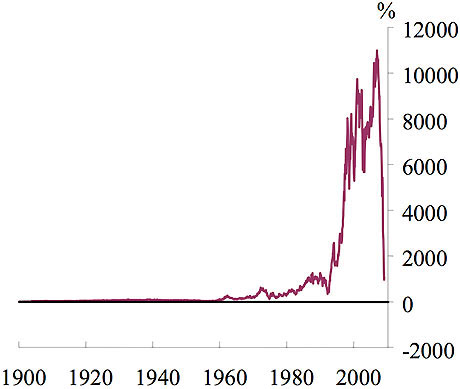
Over the last 20 years to the South Sea bubble of the early 18th century and said bankers had merely "resorted to the roulette wheel" to keep up with each other.
The Bank's executive director for financial stability, Andy Haldane, said in a speech in Chicago that having been stable over much of the 20th century, returns in the banking system relative to the wider stockmarket shot up after 1986 until 2006.
"Banking became the goose laying the golden eggs. There is no period in recent UK financial history which bears comparison," he said.
He said bankers and policymakers became seduced by the excess returns available: "Banks appeared to have discovered a money machine, albeit one whose workings were sometimes impossible to understand.
"One of the South Sea stocks was memorably 'a company for carrying out an undertaking of great advantage, but nobody to know what it is'. Banking became the 21st-century equivalent."
He said banking returns over the period were magnified by leverage as banks borrowed excessively, he said.
21 June 2009
Gulf states central banks "aggressive" in hunt for gold
The WGC did not publish data regarding the UAE Central Bank's gold reserve apparently because the country has not disclosed its gold reserve to the IMF in the past six months. Two GCC countries – Saudi Arabia and Qatar – were shown were as having 11.9 and 3.1 per cent of their reserves in gold. The figure stood at 12.4 per cent and 3.7 per cent respectively for the two hydrocarbon rich countries in March 2009.
WGC CEO Aram Shishmanian had recently told Emirates Business that the GCC central banks are looking forward to improving their gold reserves. "Central banks with low reserves of gold are looking forward to increasing their reserves. They are trying to analyse what the right balance should be. They are getting aggressive," he had said.
http://www.business24-7.ae/Articles/2009/6/Pages/20062009/06212009_c0e95058f0ab435fae8c789e39688011.aspx
WGC CEO Aram Shishmanian had recently told Emirates Business that the GCC central banks are looking forward to improving their gold reserves. "Central banks with low reserves of gold are looking forward to increasing their reserves. They are trying to analyse what the right balance should be. They are getting aggressive," he had said.
http://www.business24-7.ae/Articles/2009/6/Pages/20062009/06212009_c0e95058f0ab435fae8c789e39688011.aspx
1 June 2009
The Core to Periphery Dynamic: ~ Nolan
A very usefull paradigm for the ebb and flow of empires. For a country where "free enterprise" is the dominant justification for the status quo the extent to which the dollar system and financial innovation centered credit creation in the US investment banks and focused investments on what would pay commisions rather that real yeilds or even the actual needs of the real economy is a question worth asking. Capital was allocated on a command economy model chasing asset prices or arbitrage or whatever could be fit into guaranteed by a mortgage checkboxes.
Finance will be more small scale and local when this ends...
This week provided ample confirmation for the global reflation thesis. The dollar index dropped another 0.9%. Gold surged $22 to $979. Crude oil jumped $4.67 to a six-month high, posting the largest one-month percentage gain since 1999 (according to Bloomberg). The Goldman Sachs Commodities index rallied 5.5% to an almost 7-month high (up 27% y-t-d). Emerging markets remain on fire. And the Baltic Dry Index rose gain today, increasing its streak of consecutive gains to 19.
Leading the “bric” sweepstakes, Russia's RTS equities index jumped 7.3% this week, while India’s Sensex rose 5.3%. Russian stocks are now up 72% y-t-d, followed by India’s 52%, China’s 45%, and Brazil’s 42%. Elsewhere, stocks in Taiwan are up 50%, South Korea 24%, Argentina 47%, and Hungary 22%. The “commodity” currencies led the charge again this week. The South African rand gained 4.1%, the New Zealand dollar 3.3%, the Brazilian real 3.0%, the Australian dollar 2.4%, and the Canadian dollar 2.7%.
It was quite a week in U.S. interest rate markets. Ten-year Treasury yields jumped 29 basis points during the shortened week’s first two trading sessions (to 3.74%), before backing off to end the week up only 2 bps to 3.47%. The mortgage marketplace turned rather tumultuous, with benchmark Fannie MBS yields spiking 55 bps from last Friday’s close before ending the week 19 bps higher at 4.33%. Some interest-rate hedging markets seemed in disarray, with the dollar swaps market demonstrating price discontinuity. After closing last week at 14.4 bps, the 10-year dollar swap spread traded as high as 38.25 before ending the week at 19.50.
Importantly, at least for the week, mortgage-related market tumult didn’t broaden to other risk markets. Corporate Credit spreads were mostly narrower on the week, even as the company debt issuance boom ran unabated. The junk bond market enjoyed another week of strong fund inflows more than matched by huge issuance. It is also worth noting the resilience of the “emerging” debt markets. Brazilian benchmark dollar bond yields were down 14 bps to 5.86%. Mexican dollar bond yields fell 14 bps to 5.74%. Brazil’s Credit default swap (CDS) prices declined to the lowest level since early October (197 bps, down from the October high of 600 bps). It is no longer the case that when the Treasury market catches a cold others get really sick.
At this point, the markets’ sanguine attitude toward dollar and Treasury/MBS weakness is understandable. From a global perspective, a weaker dollar bolsters the inflationary bias that had prior to the Credit meltdown been driving robust economic performance throughout the energy and commodities-based economies. Dollar devaluation also works to reinforce already heady financial flows to “emerging” markets and non-dollar assets more generally. There are facets of inflation that seductively salve recovery.
The dramatic loosening of financial conditions globally is supporting an improvement in economic conditions. The optimists are looking for Asia and the developing world to lead a global recovery, and a sinking dollar on a short-term basis would seem to support such a scenario. Our weak currency also empowers the Global Government Finance Bubble. Amazingly, most countries today have unprecedented flexibility to issue debt without fear of negative market reaction or a run against their currencies.
I again want to emphasize the dramatic change in circumstances that is increasingly in view throughout global markets and economies. During the nineties – and stretching through the “King Dollar” period earlier this decade – there was an overarching inflationary bias that worked to direct flows TO the “Core” (the U.S. Credit system and securities markets). Whether it was a crisis that initially erupted in Mexico, SE Asia, Russia, Argentine or Brazil, the immediate market response was an abrupt reversal of financial flows from the developing countries to U.S. dollar securities. While there was an ongoing acceleration in speculative flows meandering about the globe in search of big returns, the first sign of trouble would incite a panic straight to the dollar.
The “Core” absolutely dominated the system, providing our policymakers (especially the Fed) extraordinary latitude. The Periphery to Core bias fostered financial crises, along with general Periphery financial and economic instability. This dynamic worked to keep global inflationary pressures in check. Or, better said, the nature of the inflationary flow of finance kept inflation pressures directed to U.S. dollar securities markets - as opposed to energy, commodities and more traditional inflation.
The global financial and economic backdrop has changed profoundly. Today, there exists a powerful inflationary bias working to direct flows away from the Core out to the Periphery. This dynamic helps to explain the dramatic change in the cost and availability of finance for the developed world over the past several years – the virtually unlimited cheap finance that funded historic booms in China and Asia.
Granted, this flow was abruptly interrupted by last year’s global Credit crisis. It is, however, my view that the dynamic of powerful Core to Periphery flows has resumed. Moreover, it is the nature of this type of dynamic that if such a trend recovers it will likely resume stronger-than-ever (think tech stock post-LTCM reflation or mortgages post-tech Bubble reflation). This analysis is supported by the Periphery’s recent dramatic economic and market outperformance relative to the Core.
So, is this bullish or bearish? Well, I believe The Core to Periphery Dynamic is supportive of a more rapid than expected global economic recovery. I definitely expect global inflation to surprise on the upside. Adherents to the global deflationary spiral thesis may be left wondering what the heck happened. The backdrop seems to be set for surprising revival in energy and commodities markets. And I would not be surprised if the global equities rally has some legs.
Yet I view The Core to Periphery Dynamic as profoundly bearish for the U.S. At its core, this historic redirection of global flows and inflationary pressures is the consequence of a breakdown in the dollar standard. Failed policies, a resulting deeply impaired economic structure, and massive ongoing devaluation have ended the dollar’s reign as the globe’s premier reserve currency and perceived stable store of value. There is today no sound currency to replace the dollar, so the global financial system operates rudderless and with great uncertainties.
It is more certain, however, that the great benefits commanded to our economy and markets over the decades from governing the world’s reserve currency are drawing to an end. Our policymakers still believe they can inflate Credit and manipulate interest rates - and not have to pay a price for it. But the new global reality may be that currency markets protest massive U.S. fiscal deficits and activist monetary policy, while global markets come to dictate U.S. market yields. Over the past two weeks we have seen the dollar and U.S. Treasuries/MBS come under significant pressure. Is this the beginning of global markets disciplining Washington?
A robust Core to Periphery Dynamic and the re-emergence of dollar vulnerability are a potent combination. U.S. markets to this point remain sanguine with the prospect of an expanding Federal Reserve balance sheet rectifying any spike in interest rates. But currency markets are no doubt increasingly fixated on our propensity to monetize current and prospective stimulus. At some point, increasingly unwieldy flows out of our currency may force the Fed’s hand. The scenario where the Fed is forced to choose between loose monetary policy and currency crisis sits out there as a potential big negative surprise for U.S. markets.
http://www.prudentbear.com/index.php/creditbubblebulletinview?art_id=10234
Finance will be more small scale and local when this ends...
This week provided ample confirmation for the global reflation thesis. The dollar index dropped another 0.9%. Gold surged $22 to $979. Crude oil jumped $4.67 to a six-month high, posting the largest one-month percentage gain since 1999 (according to Bloomberg). The Goldman Sachs Commodities index rallied 5.5% to an almost 7-month high (up 27% y-t-d). Emerging markets remain on fire. And the Baltic Dry Index rose gain today, increasing its streak of consecutive gains to 19.
Leading the “bric” sweepstakes, Russia's RTS equities index jumped 7.3% this week, while India’s Sensex rose 5.3%. Russian stocks are now up 72% y-t-d, followed by India’s 52%, China’s 45%, and Brazil’s 42%. Elsewhere, stocks in Taiwan are up 50%, South Korea 24%, Argentina 47%, and Hungary 22%. The “commodity” currencies led the charge again this week. The South African rand gained 4.1%, the New Zealand dollar 3.3%, the Brazilian real 3.0%, the Australian dollar 2.4%, and the Canadian dollar 2.7%.
It was quite a week in U.S. interest rate markets. Ten-year Treasury yields jumped 29 basis points during the shortened week’s first two trading sessions (to 3.74%), before backing off to end the week up only 2 bps to 3.47%. The mortgage marketplace turned rather tumultuous, with benchmark Fannie MBS yields spiking 55 bps from last Friday’s close before ending the week 19 bps higher at 4.33%. Some interest-rate hedging markets seemed in disarray, with the dollar swaps market demonstrating price discontinuity. After closing last week at 14.4 bps, the 10-year dollar swap spread traded as high as 38.25 before ending the week at 19.50.
Importantly, at least for the week, mortgage-related market tumult didn’t broaden to other risk markets. Corporate Credit spreads were mostly narrower on the week, even as the company debt issuance boom ran unabated. The junk bond market enjoyed another week of strong fund inflows more than matched by huge issuance. It is also worth noting the resilience of the “emerging” debt markets. Brazilian benchmark dollar bond yields were down 14 bps to 5.86%. Mexican dollar bond yields fell 14 bps to 5.74%. Brazil’s Credit default swap (CDS) prices declined to the lowest level since early October (197 bps, down from the October high of 600 bps). It is no longer the case that when the Treasury market catches a cold others get really sick.
At this point, the markets’ sanguine attitude toward dollar and Treasury/MBS weakness is understandable. From a global perspective, a weaker dollar bolsters the inflationary bias that had prior to the Credit meltdown been driving robust economic performance throughout the energy and commodities-based economies. Dollar devaluation also works to reinforce already heady financial flows to “emerging” markets and non-dollar assets more generally. There are facets of inflation that seductively salve recovery.
The dramatic loosening of financial conditions globally is supporting an improvement in economic conditions. The optimists are looking for Asia and the developing world to lead a global recovery, and a sinking dollar on a short-term basis would seem to support such a scenario. Our weak currency also empowers the Global Government Finance Bubble. Amazingly, most countries today have unprecedented flexibility to issue debt without fear of negative market reaction or a run against their currencies.
I again want to emphasize the dramatic change in circumstances that is increasingly in view throughout global markets and economies. During the nineties – and stretching through the “King Dollar” period earlier this decade – there was an overarching inflationary bias that worked to direct flows TO the “Core” (the U.S. Credit system and securities markets). Whether it was a crisis that initially erupted in Mexico, SE Asia, Russia, Argentine or Brazil, the immediate market response was an abrupt reversal of financial flows from the developing countries to U.S. dollar securities. While there was an ongoing acceleration in speculative flows meandering about the globe in search of big returns, the first sign of trouble would incite a panic straight to the dollar.
The “Core” absolutely dominated the system, providing our policymakers (especially the Fed) extraordinary latitude. The Periphery to Core bias fostered financial crises, along with general Periphery financial and economic instability. This dynamic worked to keep global inflationary pressures in check. Or, better said, the nature of the inflationary flow of finance kept inflation pressures directed to U.S. dollar securities markets - as opposed to energy, commodities and more traditional inflation.
The global financial and economic backdrop has changed profoundly. Today, there exists a powerful inflationary bias working to direct flows away from the Core out to the Periphery. This dynamic helps to explain the dramatic change in the cost and availability of finance for the developed world over the past several years – the virtually unlimited cheap finance that funded historic booms in China and Asia.
Granted, this flow was abruptly interrupted by last year’s global Credit crisis. It is, however, my view that the dynamic of powerful Core to Periphery flows has resumed. Moreover, it is the nature of this type of dynamic that if such a trend recovers it will likely resume stronger-than-ever (think tech stock post-LTCM reflation or mortgages post-tech Bubble reflation). This analysis is supported by the Periphery’s recent dramatic economic and market outperformance relative to the Core.
So, is this bullish or bearish? Well, I believe The Core to Periphery Dynamic is supportive of a more rapid than expected global economic recovery. I definitely expect global inflation to surprise on the upside. Adherents to the global deflationary spiral thesis may be left wondering what the heck happened. The backdrop seems to be set for surprising revival in energy and commodities markets. And I would not be surprised if the global equities rally has some legs.
Yet I view The Core to Periphery Dynamic as profoundly bearish for the U.S. At its core, this historic redirection of global flows and inflationary pressures is the consequence of a breakdown in the dollar standard. Failed policies, a resulting deeply impaired economic structure, and massive ongoing devaluation have ended the dollar’s reign as the globe’s premier reserve currency and perceived stable store of value. There is today no sound currency to replace the dollar, so the global financial system operates rudderless and with great uncertainties.
It is more certain, however, that the great benefits commanded to our economy and markets over the decades from governing the world’s reserve currency are drawing to an end. Our policymakers still believe they can inflate Credit and manipulate interest rates - and not have to pay a price for it. But the new global reality may be that currency markets protest massive U.S. fiscal deficits and activist monetary policy, while global markets come to dictate U.S. market yields. Over the past two weeks we have seen the dollar and U.S. Treasuries/MBS come under significant pressure. Is this the beginning of global markets disciplining Washington?
A robust Core to Periphery Dynamic and the re-emergence of dollar vulnerability are a potent combination. U.S. markets to this point remain sanguine with the prospect of an expanding Federal Reserve balance sheet rectifying any spike in interest rates. But currency markets are no doubt increasingly fixated on our propensity to monetize current and prospective stimulus. At some point, increasingly unwieldy flows out of our currency may force the Fed’s hand. The scenario where the Fed is forced to choose between loose monetary policy and currency crisis sits out there as a potential big negative surprise for U.S. markets.
http://www.prudentbear.com/index.php/creditbubblebulletinview?art_id=10234
25 May 2009
On Europe and European Banks vis a vis US Banks
A mate of mine Charles Powell, and I, have been having a minor dissagreement with the prospects for Europe going forward vis a vis the United States.
I have looked at the terms of trade and the energy efficiency of GNP and the unleveraged households as very positive for Europe and that notion extended to the banks, the assumption being that no one could be worse off than the yanks. I excude UK, Spain and emerging Europe, but I assumed French and German Banks would be solid.
I still think Europe has a future, but it appears that Charles was far more correct about the banks.... thanks for the forward and the debate, Charles.
"As we have repeatedly said, Spain is set for a long, painful deflation that will manifest itself via a spectacularly high unemployment level, a real estate collapse and general banking insolvencies. Consider this: the value of outstanding loans to Spanish developers has gone from just €33.5 billion in 2000 to €318 billion in 2008, a rise of 850% in 8 years. If you add in construction sector debts, the overall value of outstanding loans to developers and construction companies rises to €470 billion. That's almost 50% of Spanish GDP. Most of these loans will go bad.
"Spanish banks are now facing a very bleak outlook. Spain's unemployment rate reached over 17% last month; there are now four million unemployed Spaniards and over one million families with not a single person employed in the family. Spain and Ireland had the worst housing bubbles in the world and now Spain has as many unsold homes as the US, even though the US is about six times bigger.
"Why are Spanish banks not insolvent? Spanish banks are not marking their real estate loans to market. We've often wondered how it is that our thesis for Spanish real estate and industrial collapse has not created more victims. The answer is simple according to an article in Expansion, the Spanish equivalent of the Financial Times, from the 19th of April titled 'Spanish banks control half of all real estate appraisals.' You can't make this stuff up. We haven't even begun to see the worst in Spain yet."
European banks are in far worse shape than their US counterparts. That is because they utilize far more leverage, on an average about 30 times leverage. How can that be, in what is supposed to be a conservative industry?
"European banks were only restricted on the basis of risk-weighted assets, unlike the US where it is the total leverage ratio that matters, so most European banks bought assets that were rated by Moody's and S&P, who couldn't rate their way out of a paper bag, and for anything that wasn't highly rated, they bought credit default swaps or guarantees from AIG and MBIA. Because of that European banks were able to lever up a lot more than their US counterparties. Given the much higher leverage levels and general worsening of collateral values, we think that all the shoes in Europe have not dropped."
European banks have assets of about 330% of their GDP, compared to US banking assets, which are about 50%. They have over $700 billion in loans to Asian businesses (which are watching their exports collapse) and $1.3 trillion in loans to Eastern Europe, which is in a very serious recession, and so many of those loans are simply not going to be worth anything. Simply put, there is going to be a need for massive amounts of money to bail out European banks, or we'll watch their economies simply implode.
Where is the money for the bailouts going to come from? Germany? That will be a tough sell politically in a country that is in a much worse recession than the US. How do you tell your citizens you need to bail out banks in other countries with their tax dollars? Italian and Austrian banks are going to need a lot of capital, more than their governments can pay. It is going to be a very tough problem.
Governments around the world are responding to the global recession by running massive deficits. In addition to the US, the UK, Japan, Russia, Spain, and Ireland are all running deficits of over 10%.
And, as in the case of the US, these are not going to be one-time deficits. The IMF predicts that England will shrink again next year and the recovery in the US will be modest at best. The US economy is expected to grow by 0.2% (far from the optimistic projections of various US government agencies), the 16-nation eurozone will eke out a modest gain of 0.1%, and the Group of Seven (G7) leading industrial economies will, as a whole, only grow by 0.2 percent. They project that Japan's economy will stagnate next year.
Where Will the Money Come From?
And now let's look at what is bumping in my worry closet. The world is going to have to fund multiple trillions in debt over the next several years. Pick a number. I think $5 trillion sounds about right. $3 trillion is in the cards for the US alone, if current projections are right.
Just exactly where is that money going to come from? The US trade deficit is now down to under $350 billion a year. The Fed can monetize a trillion. Maybe. Look at the yield curve on US government debt below (Bloomberg). US savings are going to go up, but where is the incentive to buy ten-year debt at 3.5%? Four-year debt under 2% doesn't do much for your savings growth. Even with monetization and the Chinese buying our debt with the dollars we send them, that still leaves the bond market about $1.5 trillion short, give or take $100 billion.
http://www.highyieldblog.com/2009/05/european-banks.html
I have looked at the terms of trade and the energy efficiency of GNP and the unleveraged households as very positive for Europe and that notion extended to the banks, the assumption being that no one could be worse off than the yanks. I excude UK, Spain and emerging Europe, but I assumed French and German Banks would be solid.
I still think Europe has a future, but it appears that Charles was far more correct about the banks.... thanks for the forward and the debate, Charles.
"As we have repeatedly said, Spain is set for a long, painful deflation that will manifest itself via a spectacularly high unemployment level, a real estate collapse and general banking insolvencies. Consider this: the value of outstanding loans to Spanish developers has gone from just €33.5 billion in 2000 to €318 billion in 2008, a rise of 850% in 8 years. If you add in construction sector debts, the overall value of outstanding loans to developers and construction companies rises to €470 billion. That's almost 50% of Spanish GDP. Most of these loans will go bad.
"Spanish banks are now facing a very bleak outlook. Spain's unemployment rate reached over 17% last month; there are now four million unemployed Spaniards and over one million families with not a single person employed in the family. Spain and Ireland had the worst housing bubbles in the world and now Spain has as many unsold homes as the US, even though the US is about six times bigger.
"Why are Spanish banks not insolvent? Spanish banks are not marking their real estate loans to market. We've often wondered how it is that our thesis for Spanish real estate and industrial collapse has not created more victims. The answer is simple according to an article in Expansion, the Spanish equivalent of the Financial Times, from the 19th of April titled 'Spanish banks control half of all real estate appraisals.' You can't make this stuff up. We haven't even begun to see the worst in Spain yet."
European banks are in far worse shape than their US counterparts. That is because they utilize far more leverage, on an average about 30 times leverage. How can that be, in what is supposed to be a conservative industry?
"European banks were only restricted on the basis of risk-weighted assets, unlike the US where it is the total leverage ratio that matters, so most European banks bought assets that were rated by Moody's and S&P, who couldn't rate their way out of a paper bag, and for anything that wasn't highly rated, they bought credit default swaps or guarantees from AIG and MBIA. Because of that European banks were able to lever up a lot more than their US counterparties. Given the much higher leverage levels and general worsening of collateral values, we think that all the shoes in Europe have not dropped."
European banks have assets of about 330% of their GDP, compared to US banking assets, which are about 50%. They have over $700 billion in loans to Asian businesses (which are watching their exports collapse) and $1.3 trillion in loans to Eastern Europe, which is in a very serious recession, and so many of those loans are simply not going to be worth anything. Simply put, there is going to be a need for massive amounts of money to bail out European banks, or we'll watch their economies simply implode.
Where is the money for the bailouts going to come from? Germany? That will be a tough sell politically in a country that is in a much worse recession than the US. How do you tell your citizens you need to bail out banks in other countries with their tax dollars? Italian and Austrian banks are going to need a lot of capital, more than their governments can pay. It is going to be a very tough problem.
Governments around the world are responding to the global recession by running massive deficits. In addition to the US, the UK, Japan, Russia, Spain, and Ireland are all running deficits of over 10%.
And, as in the case of the US, these are not going to be one-time deficits. The IMF predicts that England will shrink again next year and the recovery in the US will be modest at best. The US economy is expected to grow by 0.2% (far from the optimistic projections of various US government agencies), the 16-nation eurozone will eke out a modest gain of 0.1%, and the Group of Seven (G7) leading industrial economies will, as a whole, only grow by 0.2 percent. They project that Japan's economy will stagnate next year.
Where Will the Money Come From?
And now let's look at what is bumping in my worry closet. The world is going to have to fund multiple trillions in debt over the next several years. Pick a number. I think $5 trillion sounds about right. $3 trillion is in the cards for the US alone, if current projections are right.
Just exactly where is that money going to come from? The US trade deficit is now down to under $350 billion a year. The Fed can monetize a trillion. Maybe. Look at the yield curve on US government debt below (Bloomberg). US savings are going to go up, but where is the incentive to buy ten-year debt at 3.5%? Four-year debt under 2% doesn't do much for your savings growth. Even with monetization and the Chinese buying our debt with the dollars we send them, that still leaves the bond market about $1.5 trillion short, give or take $100 billion.
http://www.highyieldblog.com/2009/05/european-banks.html
Subscribe to:
Posts (Atom)