The combination of massive fiscal stimulus and a monetary policy set to "full flood" did a lot of the heavy lifting but the real kicker was a flood of "hot money" driven by a carry trade by investment banks flush with bailout money looking for a yield differential and currency gains as the pound and buck dive. The Ruddster bought some time but it will end badly, imo.
Keen notes...
2010 will be a bad year for the Australian economy:
The combination of the RBA’s rate rises and the ending of the First Home Buyers Boost will in all likelihood prick the house price bubble inspired by the Boost in the first place—and lead as many as 175,000 households to be very angry that they were enticed into this speculative bubble in the first place. If this happens, there is little prospect of making the House Price Souffle rise twice by yet another foolish enticement into debt.
The political pressure on the government may lead it to unwind its stimulus, which will remove a key prop from the economy; and
Deleveraging, which has been the looming problem that government policy (especially the First Home Vendors Grant) has simply delayed, will kick in as it has in the USA. The most likely manifestation would be a decline in discretionary consumption and non-mining investment.
I therefore expect that the RBA won’t get to complete its intended program of raising interest rates, but will be forced to go into reverse in 2010 as it was in 2008. It shouldn’t be forgotten that the RBA was still raising rates in mid-2008 to fight inflation. They didn’t see the GFC coming, and I believe that they’re making a similar mistake this time—believing that it’s all behind us when the special factors that minimised the impact are terminating.
So no I don’t believe we have dodged the iceberg—we’ve merely pushed it below the surface, from where it will rise again to dent out economic hull once more. And all the while the neoclassical economists who didn’t realise they were in an ice field in the first place are busily rearranging the deckchairs on the Titanic.
http://www.debtdeflation.com/blogs/2009/11/02/debtwatch-no-40-november-2009-have-we-dodged-the-iceberg/
Showing posts with label australia. Show all posts
Showing posts with label australia. Show all posts
3 November 2009


8 September 2009
Why its all uphill from here....

Steve Keen has a grip, at least. I for one am completely confident this view is right.
When Australia began its most recent descent into debt in mid-1964, the average annual increase of 4.2% in the ratio added only a trivial amount to aggregate demand—since at the time debt was a mere 25% of GDP. But at the end of the debt bubble in 2008, when debt had become 165% of GDP, that same rate of debt growth added a huge amount to demand—the economic “car” gained speed as the slope of the debt mountain increased.
We hit the bottom of that mountain in March 2008, and now we’re starting to climb out of the valley—though not yet in absolute terms, since thanks to the First Home Vendors Boost, mortgage debt is still growing as business busily delevers (see comments on the data, below). But once deleveraging takes hold, the acceleration caused by racing down Debt Mountain will be replaced by an economic car straining up the Mount Debt Reduction. This change in the terrain will constrain private economic performance until debt has fallen significantly, as it did after the 1890s and the 1930s.
A similar, if more extreme, picture applies in the USA, where private debt is now 300% of GDP. In contrast to Australia, the USA’s debt ratio began to rise as soon as WWII ended: on average, US private debt rose 2.9% faster than GDP every year until 2008, taking the debt ratio from 45% at the end of the War to 300% now. Deleveraging from this level of debt must exert a substantial break on economic performance, by diverting income from expenditure to debt reduction.
I am therefore one of a minority of economic commentators who regard “deflation and deleveraging” as the main dangers facing the global economy in the near future (curiously, this minority might include Australian Prime Minister Kevin Rudd). From my perspective, the Global Financial Crisis marks “a change in the terrain”: for decades, rising debt has turbocharged economic performance; now falling debt will be a drag on economic activity.
The vast majority of economists who perceive the GFC as a pothole on the road that is now behind us do not consider debt and deleveraging in their analysis. Their models have neither credit nor money nor private debt in them, so from their point of view, there is no terrain at all beneath the car—merely a long flat highway of history along which the economic car drives at the speed it is underlying “real” economic performance.
7 September 2009
Australia may overtake US as world’s number-two gold producer
JOHANNESBURG (miningweekly.com) – Australia is likely to become the world’s second-largest gold producing country in the coming year, overtaking the US, industry consultant Surbiton Associates director Dr Sandra Close reported.
Australia currently shares the position of the world’s third-largest gold producer with South Africa, which, until 2007, was the world’s top gold producing country.
Australia’s gold output had increased by 4% in the June quarter to 1,8-million ounces.
“We seem to be seeing the start of a recovery in Australian gold production,” said Close.
“The ramp up of some new operations contributed to an increase in the amount of ore treated in the June quarter.”
However, despite the recent increase in quarterly output, Australian gold production for the full 2008/09 fell to 223 t, a reduction of 4% or 10 t compared with 2007/08.
“But the immediate outlook is brighter,” Close noted.
A further increase in Australian gold production should occur in the current quarter with the first contribution from Newmont’s redeveloped Boddington mine in Western Australia. The first ore was fed into the recently-completed new plant in early August. When the mine reaches full output in mid-2010, it should add some 31 t or one-million ounces annually to Australia’s gold output.
Close noted that several other new or redeveloped gold operations in Western Australia should join the list of producers in the current fiscal year. These include A1 Minerals Ltd’s Brightstar project and Range River’s Mount Morgans project, which are both expected to commence production in December 2009. Also, by the end of the year, Focus Minerals’ Three Mile Hill treatment plant should be re-commissioned, which will remove a production bottleneck and result in greater output.
Saracen Mineral Holdings’ Carosue Dam project should also start up in March 2010, followed by Catalpa Resources’ Edna May operation and Integra Mining’s Randalls project, in mid-2010.
“The modern Australian gold industry continues to make a substantial contribution to Australia’s exports, despite the market ups and downs,” Close said. “That has been the case for over 25 years now.”
She said that the gold rushes and gold boom of the 1850s were probably the best-known in Australia and they had a major impact on the country, both in social and economic terms. There was a second gold boom in the late 1890s and early 1900s, based largely on the finds in the Kalgoorlie area in Western Australia.
However, the modern gold boom, which commenced in the early 1980s, has been by far the largest in terms of output.
“Almost half of the gold ever produced in Australia has been mined since 1982,” Close said. “That amounts to around 5 800 t, or 190-million ounces – it’s a major industry.”
Close pointed to the significant contribution the gold sector had made to export earnings in the last few decades, especially with the higher gold prices over the past few years.
“For over 25 years, Australia has been riding on huge yellow haul trucks, not the sheep’s back,” Close said. “Just the 223 t of gold alone produced in 2008/09 was worth over A$8-billion.”
However, while the gold industry is making the most of higher prices and extending the life of current mines and redeveloping old mines where possible, the continuing reduction in expenditure on exploration is of great concern over the longer term.
“Throughout the 1980s and 1990s gold exploration accounted for over half of all mineral exploration expenditure but now it’s down to around 20%,” Close said.
“To ensure the long-term future of the gold sector it is vital to encourage and stimulate exploration.”
http://www.miningweekly.com/article/australia-may-overtake-us-as-worlds-number-two-gold-producer-2009-09-07
Australia currently shares the position of the world’s third-largest gold producer with South Africa, which, until 2007, was the world’s top gold producing country.
Australia’s gold output had increased by 4% in the June quarter to 1,8-million ounces.
“We seem to be seeing the start of a recovery in Australian gold production,” said Close.
“The ramp up of some new operations contributed to an increase in the amount of ore treated in the June quarter.”
However, despite the recent increase in quarterly output, Australian gold production for the full 2008/09 fell to 223 t, a reduction of 4% or 10 t compared with 2007/08.
“But the immediate outlook is brighter,” Close noted.
A further increase in Australian gold production should occur in the current quarter with the first contribution from Newmont’s redeveloped Boddington mine in Western Australia. The first ore was fed into the recently-completed new plant in early August. When the mine reaches full output in mid-2010, it should add some 31 t or one-million ounces annually to Australia’s gold output.
Close noted that several other new or redeveloped gold operations in Western Australia should join the list of producers in the current fiscal year. These include A1 Minerals Ltd’s Brightstar project and Range River’s Mount Morgans project, which are both expected to commence production in December 2009. Also, by the end of the year, Focus Minerals’ Three Mile Hill treatment plant should be re-commissioned, which will remove a production bottleneck and result in greater output.
Saracen Mineral Holdings’ Carosue Dam project should also start up in March 2010, followed by Catalpa Resources’ Edna May operation and Integra Mining’s Randalls project, in mid-2010.
“The modern Australian gold industry continues to make a substantial contribution to Australia’s exports, despite the market ups and downs,” Close said. “That has been the case for over 25 years now.”
She said that the gold rushes and gold boom of the 1850s were probably the best-known in Australia and they had a major impact on the country, both in social and economic terms. There was a second gold boom in the late 1890s and early 1900s, based largely on the finds in the Kalgoorlie area in Western Australia.
However, the modern gold boom, which commenced in the early 1980s, has been by far the largest in terms of output.
“Almost half of the gold ever produced in Australia has been mined since 1982,” Close said. “That amounts to around 5 800 t, or 190-million ounces – it’s a major industry.”
Close pointed to the significant contribution the gold sector had made to export earnings in the last few decades, especially with the higher gold prices over the past few years.
“For over 25 years, Australia has been riding on huge yellow haul trucks, not the sheep’s back,” Close said. “Just the 223 t of gold alone produced in 2008/09 was worth over A$8-billion.”
However, while the gold industry is making the most of higher prices and extending the life of current mines and redeveloping old mines where possible, the continuing reduction in expenditure on exploration is of great concern over the longer term.
“Throughout the 1980s and 1990s gold exploration accounted for over half of all mineral exploration expenditure but now it’s down to around 20%,” Close said.
“To ensure the long-term future of the gold sector it is vital to encourage and stimulate exploration.”
http://www.miningweekly.com/article/australia-may-overtake-us-as-worlds-number-two-gold-producer-2009-09-07
27 August 2009
What is patriotism?
This is the anchored and nuanced community patriotism that springs from the central paradox of human freedom, which is, according to Durant, that it can arise only out of the rule of law. Civilisation is the contract with fellow citizens that sets us free (within parameters)....
It was the Law that gave us our high estate via the idiosyncratic Brits and complete accident. The Lessons of History suggest that our soceity will thrive only to the extent that we show each other respect, are slow to judge and confine our arguments to the cool terms of our collective common good.
Clearly I related to this peice, then, which you can hear here.
A young Australian academic wants to redefine Australian patriotism and he's approached the subject from the point of view of Australia's most recent arrivals.
Tim Soutphommasane is 26. His parents were Chinese and Laotian, he was born in Paris, and he grew up in Sydney's southwest suburbs. He's just spent three years at Oxford, doing a PhD, and his book, Reclaiming Patriotism: Nation Building for Progressives, is published next week.
TIM SOUTPHOMMASANE: Patriotism doesn't have to be about cultural superiority. It doesn't have to be about racism. It can be a very positive sentiment that binds citizens together and motivates them for improving their community.
MARK COLVIN: So how do you distinguish these two types of patriotism?
TIM SOUTPHOMMASANE: Well that's the challenge I think. I think progressives or liberals in Australia in recent years have been content to sit back and allow conservatives and reactionaries to claim the language of national values and I think progressives and liberals really sold themselves short there.
They never actually tried to articulate and alternative to what I see as the two strands of patriotism that have emerged in recent years and they are 1) the narcissistic strand of patriotism that is associated for instance with tattooing your body with the southern cross or draping yourself in the national flag and 2) the neo-conservative strand of patriotism that you see for example on the right when they belief that patriotism has to involve a missionary pursuit of Judeo-Christian values.
MARK COLVIN: Why do you associate it with the right? I mean, it was Dr Johnson who was high Tory of the 18th century who said that patriotism was the last refuge of the scoundrel.
TIM SOUTPHOMMASANE: Feelings of patriotism in Australia haven't always been associated with the right. I think there's a very long left-wing tradition for instance of radical nationalism. Don't forget values of egalitarianism, mateship and the fair go have always been tinged with a very left-wing nationalistic flavour, until recently.
I think John Howard was very effective in seizing this territory from the traditional left during his prime ministership with his form of Anzac nationalism so I don't think it's always been that case, the case that patriotism has been of the right, but it certainly is the state of play at the moment.
MARK COLVIN: All right but we are a multicultural society and inevitably that means that you've got some people who call themselves Australian but who barrack for the English cricket team or still count themselves a bit Greek when it comes to the soccer or, you know, people have dual-allegiances. How are you going to ask them to suddenly be patriotic?
TIM SOUTPHOMMASANE: Well I think there is room for difference within patriotic sense of national identity and that's a nuance that hasn't always been articulated convincingly. Where I start is civic values.
I think when people think of patriotism, they think that you have to love meat pies, you have to drink VB, you have to love sport. But they're very superficial things. They're lifestyle components of Australia.
But I want to focus on civic values and I guess being Australian in my view means taking very seriously things like the fair go, egalitarianism and mateship and those values don't just exit in vacuum but exit in a context of a very discrete, national history.
I think Australians tell stories very well but we don't get our civic stories right all the time. Our civic history might not have the same flair or flamboyance as the Americans say. We weren't born of a revolution but I think there's a very distinguished and sober record of democracy as well that's worth celebrating and I want to shift the emphasis back on those aspects of the national history and the national story.
MARK COLVIN: There are some people in this country who have come here really to get away from nationalism. I think about people from the Balkans for instance. What wouldn't they be suspicious of any project that says, "let's be more nationalistic".
TIM SOUTPHOMMASANE: Well I think their suspicions are quite often very well grounded. I think the mistake is to think however, that a love of humanity or that cosmopolitanism will be enough. Stories and communities still count, not least national ones and I always say to people we don't for example see our politicians speaking to us in Esperanto but they speak to us in a national language appealing to a discrete national history in order to motivate citizens
The real challenge is really to get the balance right and I think there is a possibility of a moderate, liberal patriotism or national pride that we can celebrate. But I certainly don't want to deny that there are instances such as the Balkans where nationalistic excess have ended in bloodshed. That's not the kind of nationalism I would like to defend.
MARK COLVIN: From the peace movement to the globalisation supporters, from left to right, there is a stream of thought that says that nations themselves are, should vanish away, that we are international, that we are a world community.
TIM SOUTPHOMMASANE: What do I think of that? Well I think that yes, there has been a movement towards globalisation but that doesn't mean that the nation state has already been superseded. We still live in a world of nation states. The big decisions affecting us are made primarily by national governments. Our democracy takes a national flavour. We can't run away from that and I think there is a need for a dose of sociological realism if you will in these debates.
MARK COLVIN: So this is about civic virtue for you? Where do you start to build that in the society?
TIM SOUTPHOMMASANE: Well a lot I think depends on getting the language of leadership right. I think liberals and progressives in Australia have a great opportunity at the moment to build a new social contract for the 21st century. But that requires a consensus for reform.
I think Kevin Rudd has shown us that he's a very philosophically engaged leader but I think there's an opportunity for him here to engage in a new cultural narrative and to articulate a vision of citizenship.
MARK COLVIN: Surely you just can't do this with politics though?
TIM SOUTPHOMMASANE: Well of course not but I think...
MARK COLVIN: If you're talking about patriotism, it's got to imbue the society or it won't mean anything.
TIM SOUTPHOMMASANE: No indeed. But the starting point I think must rest in politics. Language and debates percolate from the top down I think. But I think with a dose of cultural leadership, we will see a more diffuse debate at large among Australians.
I think this really is a debate that Australians have wanted to have for a long time and it's a debate that isn't stuck I think in the old paradigm of left and right. I think we're talking really about a new generational debate here.
MARK COLVIN: Tim Soutphommasane whose book, Reclaiming Patriotism, Nation Building for Progressives is published next week.
It was the Law that gave us our high estate via the idiosyncratic Brits and complete accident. The Lessons of History suggest that our soceity will thrive only to the extent that we show each other respect, are slow to judge and confine our arguments to the cool terms of our collective common good.
Clearly I related to this peice, then, which you can hear here.
A young Australian academic wants to redefine Australian patriotism and he's approached the subject from the point of view of Australia's most recent arrivals.
Tim Soutphommasane is 26. His parents were Chinese and Laotian, he was born in Paris, and he grew up in Sydney's southwest suburbs. He's just spent three years at Oxford, doing a PhD, and his book, Reclaiming Patriotism: Nation Building for Progressives, is published next week.
TIM SOUTPHOMMASANE: Patriotism doesn't have to be about cultural superiority. It doesn't have to be about racism. It can be a very positive sentiment that binds citizens together and motivates them for improving their community.
MARK COLVIN: So how do you distinguish these two types of patriotism?
TIM SOUTPHOMMASANE: Well that's the challenge I think. I think progressives or liberals in Australia in recent years have been content to sit back and allow conservatives and reactionaries to claim the language of national values and I think progressives and liberals really sold themselves short there.
They never actually tried to articulate and alternative to what I see as the two strands of patriotism that have emerged in recent years and they are 1) the narcissistic strand of patriotism that is associated for instance with tattooing your body with the southern cross or draping yourself in the national flag and 2) the neo-conservative strand of patriotism that you see for example on the right when they belief that patriotism has to involve a missionary pursuit of Judeo-Christian values.
MARK COLVIN: Why do you associate it with the right? I mean, it was Dr Johnson who was high Tory of the 18th century who said that patriotism was the last refuge of the scoundrel.
TIM SOUTPHOMMASANE: Feelings of patriotism in Australia haven't always been associated with the right. I think there's a very long left-wing tradition for instance of radical nationalism. Don't forget values of egalitarianism, mateship and the fair go have always been tinged with a very left-wing nationalistic flavour, until recently.
I think John Howard was very effective in seizing this territory from the traditional left during his prime ministership with his form of Anzac nationalism so I don't think it's always been that case, the case that patriotism has been of the right, but it certainly is the state of play at the moment.
MARK COLVIN: All right but we are a multicultural society and inevitably that means that you've got some people who call themselves Australian but who barrack for the English cricket team or still count themselves a bit Greek when it comes to the soccer or, you know, people have dual-allegiances. How are you going to ask them to suddenly be patriotic?
TIM SOUTPHOMMASANE: Well I think there is room for difference within patriotic sense of national identity and that's a nuance that hasn't always been articulated convincingly. Where I start is civic values.
I think when people think of patriotism, they think that you have to love meat pies, you have to drink VB, you have to love sport. But they're very superficial things. They're lifestyle components of Australia.
But I want to focus on civic values and I guess being Australian in my view means taking very seriously things like the fair go, egalitarianism and mateship and those values don't just exit in vacuum but exit in a context of a very discrete, national history.
I think Australians tell stories very well but we don't get our civic stories right all the time. Our civic history might not have the same flair or flamboyance as the Americans say. We weren't born of a revolution but I think there's a very distinguished and sober record of democracy as well that's worth celebrating and I want to shift the emphasis back on those aspects of the national history and the national story.
MARK COLVIN: There are some people in this country who have come here really to get away from nationalism. I think about people from the Balkans for instance. What wouldn't they be suspicious of any project that says, "let's be more nationalistic".
TIM SOUTPHOMMASANE: Well I think their suspicions are quite often very well grounded. I think the mistake is to think however, that a love of humanity or that cosmopolitanism will be enough. Stories and communities still count, not least national ones and I always say to people we don't for example see our politicians speaking to us in Esperanto but they speak to us in a national language appealing to a discrete national history in order to motivate citizens
The real challenge is really to get the balance right and I think there is a possibility of a moderate, liberal patriotism or national pride that we can celebrate. But I certainly don't want to deny that there are instances such as the Balkans where nationalistic excess have ended in bloodshed. That's not the kind of nationalism I would like to defend.
MARK COLVIN: From the peace movement to the globalisation supporters, from left to right, there is a stream of thought that says that nations themselves are, should vanish away, that we are international, that we are a world community.
TIM SOUTPHOMMASANE: What do I think of that? Well I think that yes, there has been a movement towards globalisation but that doesn't mean that the nation state has already been superseded. We still live in a world of nation states. The big decisions affecting us are made primarily by national governments. Our democracy takes a national flavour. We can't run away from that and I think there is a need for a dose of sociological realism if you will in these debates.
MARK COLVIN: So this is about civic virtue for you? Where do you start to build that in the society?
TIM SOUTPHOMMASANE: Well a lot I think depends on getting the language of leadership right. I think liberals and progressives in Australia have a great opportunity at the moment to build a new social contract for the 21st century. But that requires a consensus for reform.
I think Kevin Rudd has shown us that he's a very philosophically engaged leader but I think there's an opportunity for him here to engage in a new cultural narrative and to articulate a vision of citizenship.
MARK COLVIN: Surely you just can't do this with politics though?
TIM SOUTPHOMMASANE: Well of course not but I think...
MARK COLVIN: If you're talking about patriotism, it's got to imbue the society or it won't mean anything.
TIM SOUTPHOMMASANE: No indeed. But the starting point I think must rest in politics. Language and debates percolate from the top down I think. But I think with a dose of cultural leadership, we will see a more diffuse debate at large among Australians.
I think this really is a debate that Australians have wanted to have for a long time and it's a debate that isn't stuck I think in the old paradigm of left and right. I think we're talking really about a new generational debate here.
MARK COLVIN: Tim Soutphommasane whose book, Reclaiming Patriotism, Nation Building for Progressives is published next week.
31 July 2009
Keen on Rudd: "On the money"
Rudd’s essay shows a stronger appreciation of the causes of this crisis, and the fragility of the economy in its wake, than I’ve yet seen from any other official source (with the sole exception of the Bank of International Settlements, where Bill White’s influence appears to remain, even though he is no longer its Economic Adviser–check this story on Bill and his forlorn attempts to raise the alarm during the Bubble).
Its one weakness is continued reliance upon neoclassical economic models to predict the future course of the economy after this crisis–when those same models ignore the role of private debt (which caused the bubble in the first place) and deleveraging (which will in fact drive the future course of the economy).
We can expect Rudd and Swann to continue with a large scale fiscal stimulus, in the hope that this will end the crisis. The next stage will come when this stimulus fails to achieve the level of growth predicted by neoclassical economic models, and as a result unemployment exceeds forecasts, public debt continues to run up, and deficit reduction strategies get pushed back in time.
So though Rudd is aware of the problem of deleveraging, he hasn’t yet taken developed policies that directly tackle it. But awareness of the problem is a necessary first step in addressing it, and Rudd has taken that first step.
http://www.debtdeflation.com/blogs/2009/07/27/rudds-essay-is-on-the-money/
Its one weakness is continued reliance upon neoclassical economic models to predict the future course of the economy after this crisis–when those same models ignore the role of private debt (which caused the bubble in the first place) and deleveraging (which will in fact drive the future course of the economy).
We can expect Rudd and Swann to continue with a large scale fiscal stimulus, in the hope that this will end the crisis. The next stage will come when this stimulus fails to achieve the level of growth predicted by neoclassical economic models, and as a result unemployment exceeds forecasts, public debt continues to run up, and deficit reduction strategies get pushed back in time.
So though Rudd is aware of the problem of deleveraging, he hasn’t yet taken developed policies that directly tackle it. But awareness of the problem is a necessary first step in addressing it, and Rudd has taken that first step.
http://www.debtdeflation.com/blogs/2009/07/27/rudds-essay-is-on-the-money/
21 July 2009
"Kill Chickens, scare Monkeys" China, Rio, Stern Hu and the new realities..
A letter from an aussie to Supkis.........
The excellent article “KGB INTERROGATION: Cheng Li” (http://www.businessspectator.com.au/bs.nsf/Article/KGB-INTERROGATION-Cheng-Li-pd20090716-TZ9D7?OpenDocument&src=sph) is the first insightful and sophisticated discussion towards understanding what is happened. We should expand the context by considering the Chinese perspective and some aspects of geopolitical realities as well. Unfortunately, our parochial political and media commentators need to be less self absorbed, partisan and shallow in their analysis.
I am a retired Australian expatriate previously employed by a major US Corporation and experience shows that major corporations do get involved in corruption to further their commercial by necessity in countries such as China.
It is unavoidable and mostly done indirectly with great care…..so why is China’s claim with regard to Rio Tinto dismissed out of hand?
.
THE AUSTRALIAN REALITIES IN CONTEXT
.
Australia’s small prosperous population was made possible by living on a huge continent using imported capital to export raw mining and agricultural commodities. In addition, we relied on US economic and military hegemony to underpin our peace of mind and manage the rise of Chinaand Asia.
.
Hence we fought with the US in the Vietnam war of independence, participated in the neo-colonial oil wars in Iraq and Afghanistan; created with Japan APEC in a vain attempt to counter ASEAN; and with US support tried to prevent Asian countries from establishing a rival institution to the IMF post Asian Crisis including the now reality currency swaps between East Asian and Asean countries.
.
Our recent Defence White Paper whilst founded on capabilities based calculus implies continued desire to contain China.
The WA state government awarded the Oakajee Port & Rail tender project to Japan at the expense of China under controversial circumstances. Now Canberra has allowed multinationals to determine our national interests by default and created a defacto RIO+BHP monopoly controlling circa 70% of global exported iron ore at the expense of China’s national interest under humiliating circumstances.
.
Kevin Rudd tries to ignore the China leader during the recent photo-op in London. Australia’s economy will be devastated should China play hardball whilst their economy only suffers marginally. Our historically high private debt per capita exceeds even depression levels and debt de-leveraging drives our slowing economy as a subset of the global economic crisis.
.
The US and UK are debtor nations with notionally insolvent financial industries hoping China will provide capital on one hand but on the other hand wish to maintain their hegemonic powers….a very delusional thought process indeed.
The Chinese and the majority of other countries outside the “international community” (code for the usual suspects US/UK/Canada/Australia) represent largely victims of centuries of western hegemony and note our behaviour referenced to their own histories.
.
China invests in energy and mining infrastructure in Latin America, Asia, Africa and Central Asia to gain access to host country mineral resources in a win-win relationship. In contrast the US and the west merely focusing on the extractive sectors – oil, gas, minerals etc.
.
Latin Americans, Asians, Africans and the Central Asians take note of the West’s exploitative instinct. Now it is beyond doubt that external forces have muddied the waters of disaffection in Xinjiang increases China’s determination to protect its national interests. We need to avoid hypocrisy and recognize the West also have blood on our hands thru war and human rights crimes the latest including supporting Israel’s colonization at the expense of Palestinians to killing civilians and colonial wars in Iraq/Afghanistan/Somalia/Pakistan etc as well as protecting the corrupt Middle East regimes.
.
We are not morally superior and it can be argued inferior….despite rampant corruption in China.
The rise of creditor nations amongst the economic debacle in the west means China’s views now have impact simply because their narrative has more economic and political weight. We as a nation need to grow up and not hide behind self serving myths.
.
We conveniently forget that China’s leadership is patently more capable and sophisticated than our own based on benchmark degree of difficulty comparisons such as sheer achievements over significant hurdles.
.
THE CHINA REALITIES IN CONTEXT
.
China has a growing USD 2 trillion surplus and underpins our nation’s prosperity. This ancient civilisation has fought western hegemony to rise to its present position in spite of internal and external obstacles by developing its own particular solutions. It has avoided the US leveraged debt and speculative capitalism free of regulation by maintaining some aspects of controlled economy mechanisms.
China will not follow in our image and will develop their version of capitalism just as Japan has. The world has become a multipolar world. China feels threatened by the monopolistic multinationals and is commercially discriminated by the US andAustralia….despite their status as the major customer in Australia.
China is a complex nation that is still developing facing serious internal and external challenges …it is not heaven on earth. This nation is in the “robber baron” era just as the US was and we were during the pre federation era. Its foreign policy in Africa, Middle East, Central Asia and littoral Asia has been pragmatic and built on mutual benefit rather than the US rabid and coercive ideology. US crony capitalism and the preferential treatment by IMF of western debtor countries in strive is noted.
THE CONNUNDRUM
The era of western dominance is ending and the multipolar world is taking shape. Australia has to come to terms with its geographic destiny and re-examine its pathway to future prosperity. China will exert greater influence on our prosperity and our nation needs to find ways to respect their needs without compromising our own sovereignty. In the past, we provided fealty to the UK then the US in return for protection… convenient because we share the same civilisation and broad cultural values.
We have tried to be the intermediary between a rising China and the US Empire in decline to protect our national interest…this strategy is reaching its use-by date. Japan may end up coming to terms with China because their US and European markets are wilting?
We need to respect reasonable China needs and develop a deeper and more mature relationship whilst protecting our sovereignty….this transferring our fealty to China is impractical. The re-assessment should include review of our economic structure that is too reliant on mining the soil and earth.
All of Asia wants to counterbalance rising China harmoniously as good economic neighbours. Modernising China is presently co-operative but history shows that when nations become hegemons they become tyrannical to their victims….read UK, US, Ottoman history.
WHAT NEEDS TO BE DONE NOW
Stop bleating about “International Community” meaning western countries not trading with China as a threat…..its rhetoric.
Block the RIO-BHP production JV and workout a pragmatic strategic frame work between Canberra-Beijing based on real-politick and mutual respect.
Educate the average Australian on today’s realities.
China just needs respect recognising its hard won status and not patronising noises.
More on China and Hu...
Alan Kohler: What we’re trying to do is understand the detention of Stern Hu. We’ve seen reports that President Hu of China signed off on that decision. We’re also hearing reports that actually it’s a lower level thing, involving the iron ore and steel negotiations. Should we see this as a big change in the way that China will deal with businesses around the world or is it something less than that?
Cheng Li: Well, the answer is yes and no. First of all I think that the most recent news from China is that the spokesperson of the Foreign Ministry said that the rumour that Hu Jintao was personally involved or sent an order to arrest, is not true. I don’t know whether you have seen that or not. Now, in terms of a bigger change, I would not say this is a turning point, but on the other hand in the broader context, yes, because the Chinese economy has been doing well. China has already emerged as an economic giant, not only in terms of the China Australia economic relations, but also virtually everywhere, including the United States, EU and Japan.
So in that context China certainly can afford to be tough and also sometimes it wants to make rules in its own way, not just as it was before when it has sometimes been too accommodating in using other leaders’ words. Now, they want to sit on the head table and in the driver’s seat and that’s the change.
AK: Don’t you think that whatever they intend this event will have a big impact on China’s business relations with the world?
CL: No. I mean, first of all this is largely Chinese/Australian economic relations. In many other parts of the world it’s not made it to the top five news items in the United States and also within China it could not even make it to the top 10 news stories. So different countries have different perspectives.
Now, to a certain extent, the industrial espionage or corruption with foreign companies and this kind of thing is happening all the time, but certainly this incident affects Australia in a direct, very strong way, so in Australia certainly many people are concerned for the right reasons. For the international communities, this is one of the many episodes.
Robert Gottliebsen: Just how much have the events in China changed the power structure at the centre? Here in Australia we’ve seen a very different face of China and now all of a sudden we’re seeing this tougher China. Does this mean we’re going back to what it used to be 10, 20 years ago?
CL: Well, it’s not so much about the conservatives, but China has reached a different economic stage. Since 1978, China has opened up. At that time, China desperately needed foreign cooperation. Particularly, they wanted foreign capital, foreign know-how, foreign technology, etc. Chinese leaders, decision-makers including Deng Xiaoping and later Premier Zhu RongJi, they said very clearly that China wants to trade its market for technology, for foreign capital. Now, that period is over.
You can say the leaders have become conservative, but I think probably ‘conservative’ is not the right word because China has been very successful. The period as a learner, as a student, is over. Now, they want to be an equal partner. They want to be in the driver’s seat, so whether you want to come to terms with that reality, it’s your problem; it’s not China’s problem. I’m not saying that they are doing the right thing, but that’s what they think. But I probably would not say it’s ‘conservative’ or ‘liberal’, but the reality is those who have power, have the resources, have the economic strength, can do what they want. Other parties maybe have to come to wear that reality.
RG: There’s a big difference between equal partners and one of the parties, in this case China, being in the driver’s seat and I think you’re really saying that rather than being equals, China wants to be in the driver’s seat.
CL: Yeah. To a certain extent, but at the moment China’s economic strength has its own limits, so therefore what I said earlier, President Hu Jintao according to China’s spokesperson, he cannot say that he personally endorsed all this. This actually leaves the door open. This is an important signal from China.
Again China also needs Australia, although you can debate which country needs the other country more, but the fact is that both need each other. At the moment, I think that China is already the largest global market and also is the leading trading partner for Australia. So again we need to put that in perspective.
I think both sides should manage this important relationship in a careful way, so both sides should cool down a little bit. China certainly sent a signal and of course these four people are still under arrest. They should do more, but at the same time the international community, particularly Australian leaders and the media probably also, should have a better understanding of what’s going on there.
AK: You say that it’s purely between China and Australia this, not the rest of the world. It’s not really getting much airplay in the rest of the world, but surely other business executives in China from elsewhere in the world must now be wondering what is a state secret and what they can do without getting locked up.
CL: The Chinese use the saying ‘kill chicken to scare monkeys’. You’ve probably heard of that phrase. This is precisely the intention of the Chinese government and you know it if you wanted to do business with China, you need to follow Chinese rules and regulations, whether you like it or not.
Now, again I do not know details. I do not know facts. Maybe these four people are guilty. Maybe they’re not. Of course we can complain about the lack of transparency in China’s legal system. We can complain that maybe it’s unfair at the moment, but we do not have enough facts. There could be some problems, real problems, but we don’t know.
Other companies may be scared, as you said very correctly, but this in particular is China’s intention, because China is in the mood for rapid economic development and they now have leverage, they have strength. If you want to be a partner with China, China wants you to follow their regulations, their norms and their law and again, sometimes they make mistakes, sometimes they overreact, but on the other hand you do see that in a big country in the midst of major development. Sometimes espionage, sometimes corruption with foreign companies, certainly it’s a possibility.
Stephen Bartholomeusz: Professor Li, while accepting China’s economic strength relative to the west at the moment, there are some domestic and political and economic tensions within China. You’ve referred in the past to the Chinese political regime as being ‘one party, two coalitions’ and said that there is an even balance between those who represent in effect the coastal entrepreneurial regions of China and the poor people of China. Is what we’re seeing a change in that balance?
CL: I really don’t want to go too far at this point in saying that that incident reflects the section of politics and maybe later on there will be different views of how to deal with this particular incident. Certainly they will not want the international community to know that, but on the other hand the two sections or two different leaders may be on the same page in terms of protecting China’s domestic interests. China’s rise is in everyone’s interest from their perspective. All Chinese leaders want to share the same aspiration, but sometimes they have different views.
The decision to arrest these four people, along with several Chinese managers in the steel factories, it means they probably reached a consensus, maybe in the Politburo among these 25 policymakers. Again, I will not go too far. These state security people actually carry out orders. Another thing is they always follow the party line. Sometimes they do extraordinary things, but it would be too much to say it’s because of the security people. Actually, the Chinese government would love to hear that, because then they could just blame everything on the security people. They want to confuse the outside international community, but the reality is it’s their decision, the party leaders.
SB: The current Chinese leadership is committed to sharing some of the benefits of Chinese growing prosperity to those who so far haven’t participated as intensely as those on the coast. There have been some issues with the stimulus package and the infrastructure development program. A spiking in the price of iron ore or a relatively high iron ore price doesn’t help. I suppose I was trying to put it into that sort of context. Are we seeing the current Chinese president and those who want to see greater socialisation of the benefits of prosperity now starting to flex their muscles?
CL: It’s more to do with what they call China’s ‘national interest’. They want to protect China’s major firms. They want to protect the last of China’s assets. This is their perspective. I’m not saying whether they have legitimate reason or not, but this is their concern. I would not go too far in reflecting on that section of policy in relation to this particular incident.
RG: I want to take you back to that remark about being equal or being in the driver’s seat and it’s one thing to try that out in Australia, but do you think they’re going to try it out in the US and that this is a forerunner for a change in US relationships as well?
CL: Well, in the past few years there’s some incidents that certainly many US companies unhappy. The most recent one is the Coca-Cola monopoly case. It’s not just killing chickens – maybe you want to kill monkeys to scare some elephants! Maybe this is the saying! [Laughter]
We do not know much fact, but there could be a combination of factors, not just retaliation or revenge with this particular company, but it could be to express some unhappiness from the Chinese leadership perspective of something seemingly remotely related. For example maybe the Defence White Paper, maybe the incident a couple of months ago about the espionage charge of the Chinese/Australian woman [an apparent reference to the controversy around the relationships between former defence minister Joel Fitzgibbon and wealthy Chinese/Australian businesswoman Helen Liu]. I don’t know. We are still in a stage of speculation. Maybe it’s nothing related to that or maybe it’s related. We do know that this particular decision was carefully made. It’s not by local officials or by just a small number of state security people.
AK: So, how do you think Australian companies, or any companies, should respond to this in the way that they deal in China?
CL: Well, I think that it seems to me we overreacted a little bit in saying that it has ‘completely jeopardised’ Chinese/Australian economic relations. First, we need to know facts. We could complain publically or privately through governments, through the media about this, but we still should look at the big picture. The big picture is that to a certain extent the peace and the prosperity in our lifetime largely depends on whether China acts like it is a problem or tries to find a solution. My answer to this is should be treated like a solution.
Now, look at today’s world. There are so many issues, whether it be security, whether it be terrorism, whether it be environmental change, climate change, the public health; we need China to play a constructive role particularly on the economic recovery.
Five years ago Chinese banks were in big trouble, because of the extension to the WTO. So many people predicted that the Chinese state banks would collapse, but ironically now look at the world’s top 10 banks today. Four of them are Chinese banks including number one, number two and number three.
Now, again we’re really still in the early stage to Chinese economic rise and that still provides a huge market. Now, the nature of competition is that would change. Now, in the manufacturing sector probably we will face tough, tough challenges, but in the terms of resources, in terms of for service sector, in terms of the environmental products, it’s still the early stage. Now, if Australian companies do not take that opportunity, many other companies in other countries will do, so we should not lose that big picture.
RG: Do you think that in Australian iron ore and coal negotiations in the future, the price will now have to be based on the market? Because it really will be quite impossible to have a negotiation on price, because there’s a great danger that the negotiators might be jailed if they don’t come to the right conclusion?
CL: Well, I agree with you.
RG: So, this means that we we’ve got to divorce the question of price from any negotiations that are at all sensitive in the Chinese arena.
CL: Well, yes because again we’re talking about negotiation. Negotiation has two parties. We need to compromise for both parties and if we can reach agreement, it would be great; if we could not reach agreement, there will be loss. The question is which party will lose more? This is subject to change. It depends on when and where you talk, what you talk about, to what scale and also related to politics, international relations and many other things.
RG: Do you think that the Chinese understand that that Chinalco deal was a very bad deal? There were six hundred pages of side deals which gave Chinalco control of Rio Tinto and so it really had no chance of being accepted by the government.
CL: Well, I’m not an expert on this deal, but you express your view. You express it in a very eloquent way, but it’s your view. The Chinese may not share that view. They have a different perspective.
SB: Professor Li, one of the things that the Chinese have been encouraging in recent years has been external investment by their state-owned enterprises; people like the BaoSteels and the Chinalcos. This incident tends to suggest that the argument that the SOEs were putting forward that they were operating like normal commercial entities at arm’s length from the State isn’t quite as convincing as they would have liked us to believe. Is it going to be damaging? Is it going to be damaging to the ability of those SOEs to make direct investments outside China?
CL: Again, it’s the Chinese mood. They think the state-owned enterprises should be enhanced, rather than privatised. Look at today’s world. When you look at the financial crisis, when you see that the American banks were nationalised, at least there’s some trend. Why should they go back? They think it’s their strength not their weaknesses. I’m not saying they’re doing the right thing, but this is their thinking.
The government will continue to help, to strengthen these state firms, particularly gigantic ones, whether it be oil or resources or other things. They will use their foreign capital and reserve to trigger more acquisitions, more mergers, more foreign investments etc. They’re in this kind of mood. Of course we can challenge that. We can ask questions. Maybe in five or ten years the situation will be different. Again, China really should introduce some incentives, should help small or medium-sized businesses to develop, not just use its monopoly power to do so. But at the moment I cannot say that there are strong signs for that. The reality is that these gigantic state-owned enterprises, particularly Chinese called SASAC [State-Owned Assets Supervision and Administration Commission], around 65 companies, will be very, very aggressive. They have the backing of the Chinese government.
AK: What is your advice to the Australian prime minister about how to deal with this crisis?
CL: I think that he should use his leverage to talk to the Chinese, mainly privately rather than publically, to express concerns, to express that there may have been some misunderstandings, but also to express the strong view that Australia welcomes China’s economic growth and understands China’s concerns. But at the same time, as Australia is a country that has a good relationship with China, you want to maintain that good relationship. We should leave the door open, leave communication open and show goodwill, rather than point the finger. I think it’s important.
We should also look at a recent development in the United States. The Obama administration is really quite humble when it comes to China, because in many areas we need China’s cooperation. Yes, we have different views on certain issues, whether it be Dalai Lama or Tibet or whether it be China’s economic policies, whether it be market excess and whether it be the foreign exchange rate or global environmental concerns. In all these areas we should go through negotiation compromise, rather than just point the finger at each other or use some kind of a shock policy or surprises. We need a kind of a humility, rather than just to blame the other side.
RG: I think in Australia we’ve acknowledged our dependence on China for quite a time and we are very much on the China bandwagon, but I don’t know that that’s as widely held a view in the US. What I think you’re really signaling is that we’re actually beginning to see a change in the guard and China’s going to become more and more important not just for Australia, but to the US and to the rest of the world.
CL: Yes, but of course China has its own problems. Look at China’s economic expansion. Certainly that’s a big thing in our time, but at the same time China’s political system is still a liability and its image in today’s. What countries are really China’s friends? Not many. Right now even Chinese/Pakistan relations have some problems. Recently Turkey, Iran and Indonesia all criticised China for what happened in Xinjiang region. Chinese leaders need to adjust their foreign policy.
Certainly, we can also say what happened with Australia during the past week also means that China cannot really express itself well to other foreign countries, particularly for the foreign business community and also the general public. They have their own problems and that’s for sure, but again it’s not helpful, it’s not constructive if we just talk about China’s problems.
The reality is we should come to terms with China and at the same time have equal dialogue. We should express to China we do not have ill intentions. We have our own interests. At the same time we need China to also meet international norms and international standards, not just China’s laws, China’s regulations. Sometimes we need a little bit of patience. Sometimes we should also look at it from China’s perspective. Chinese people at the moment think that they have achieved very successful economic development and they are very proud of themselves for the right reasons, but at the same time we hope that China’s development is not just economic development, but that it can also show itself as a responsible stakeholder.
SB: China’s got a few domestic issues, such as the one in Xinjiang and also a growing number of graduates from universities that are finding it hard to find work and similar issues. I was wondering which of these sorts of issues do you think has the potential to cause destabilising forces to China whether it be politically or economically?
CL: Well, all these issues that you’ve mentioned are quite serious. They have certainly given the Chinese leadership a surprise, not a complete surprise. They knew these could intensify, but they did not know that they’d reached that kind of scale with around 180 people killed and 1000 people injected. That explained why Hu Jintao shortened his trip to Italy.
Now, also the college graduates, you know, last year one million could not find jobs and this year probably two or three million, more than 30 per cent or 40 per cent of our college graduates could not find jobs. At the same time, 20 million migrant workers also lost their jobs.
All of these issues are real, but at the same time these kinds of social protest or grievance do not come together. They cannot unify, because their interests are not identical.
The Chinese students, those unemployment students, they are unhappy, but they are not also unhappy about separatism in Xinjiang or Tibet, so this kind of grievance is largely localised and the Chinese government type leadership actually are quite smart. They make people believe that they should think nationally, but blame locally, so only blame local leaders, whether it is a social group or local officials.
I do not see any of these kinds of forces will undermine the regime or as some say, that the regime will collapse. But we do not see the real kind of solution or reconciliation among these kinds of problems. These kinds of problems probably will remain for a long time, but at the moment will not be a real triggering factor to cause a serious, serious regime crisis.
I think in the near future we shall see China continue on the rise, not in decline, certainly not in collapse. We should get that picture right. But the challenges will be overwhelming and will not disappear overnight. That puts Chinese leadership always in crisis mode. They need to react. They need to react very quickly. They should be proactive. The worst thing is if they become overly confident with arrogance or some leaders appear in the older type leadership, but China is still not in that stage. When you look at the speeches by Premier Wen JiaBao he constantly talks about problems not talked about so much of China’s rise.
AK: Thank you for your time.
CL: Thank you.
The excellent article “KGB INTERROGATION: Cheng Li” (http://www.businessspectator.com.au/bs.nsf/Article/KGB-INTERROGATION-Cheng-Li-pd20090716-TZ9D7?OpenDocument&src=sph) is the first insightful and sophisticated discussion towards understanding what is happened. We should expand the context by considering the Chinese perspective and some aspects of geopolitical realities as well. Unfortunately, our parochial political and media commentators need to be less self absorbed, partisan and shallow in their analysis.
I am a retired Australian expatriate previously employed by a major US Corporation and experience shows that major corporations do get involved in corruption to further their commercial by necessity in countries such as China.
It is unavoidable and mostly done indirectly with great care…..so why is China’s claim with regard to Rio Tinto dismissed out of hand?
.
THE AUSTRALIAN REALITIES IN CONTEXT
.
Australia’s small prosperous population was made possible by living on a huge continent using imported capital to export raw mining and agricultural commodities. In addition, we relied on US economic and military hegemony to underpin our peace of mind and manage the rise of Chinaand Asia.
.
Hence we fought with the US in the Vietnam war of independence, participated in the neo-colonial oil wars in Iraq and Afghanistan; created with Japan APEC in a vain attempt to counter ASEAN; and with US support tried to prevent Asian countries from establishing a rival institution to the IMF post Asian Crisis including the now reality currency swaps between East Asian and Asean countries.
.
Our recent Defence White Paper whilst founded on capabilities based calculus implies continued desire to contain China.
The WA state government awarded the Oakajee Port & Rail tender project to Japan at the expense of China under controversial circumstances. Now Canberra has allowed multinationals to determine our national interests by default and created a defacto RIO+BHP monopoly controlling circa 70% of global exported iron ore at the expense of China’s national interest under humiliating circumstances.
.
Kevin Rudd tries to ignore the China leader during the recent photo-op in London. Australia’s economy will be devastated should China play hardball whilst their economy only suffers marginally. Our historically high private debt per capita exceeds even depression levels and debt de-leveraging drives our slowing economy as a subset of the global economic crisis.
.
The US and UK are debtor nations with notionally insolvent financial industries hoping China will provide capital on one hand but on the other hand wish to maintain their hegemonic powers….a very delusional thought process indeed.
The Chinese and the majority of other countries outside the “international community” (code for the usual suspects US/UK/Canada/Australia) represent largely victims of centuries of western hegemony and note our behaviour referenced to their own histories.
.
China invests in energy and mining infrastructure in Latin America, Asia, Africa and Central Asia to gain access to host country mineral resources in a win-win relationship. In contrast the US and the west merely focusing on the extractive sectors – oil, gas, minerals etc.
.
Latin Americans, Asians, Africans and the Central Asians take note of the West’s exploitative instinct. Now it is beyond doubt that external forces have muddied the waters of disaffection in Xinjiang increases China’s determination to protect its national interests. We need to avoid hypocrisy and recognize the West also have blood on our hands thru war and human rights crimes the latest including supporting Israel’s colonization at the expense of Palestinians to killing civilians and colonial wars in Iraq/Afghanistan/Somalia/Pakistan etc as well as protecting the corrupt Middle East regimes.
.
We are not morally superior and it can be argued inferior….despite rampant corruption in China.
The rise of creditor nations amongst the economic debacle in the west means China’s views now have impact simply because their narrative has more economic and political weight. We as a nation need to grow up and not hide behind self serving myths.
.
We conveniently forget that China’s leadership is patently more capable and sophisticated than our own based on benchmark degree of difficulty comparisons such as sheer achievements over significant hurdles.
.
THE CHINA REALITIES IN CONTEXT
.
China has a growing USD 2 trillion surplus and underpins our nation’s prosperity. This ancient civilisation has fought western hegemony to rise to its present position in spite of internal and external obstacles by developing its own particular solutions. It has avoided the US leveraged debt and speculative capitalism free of regulation by maintaining some aspects of controlled economy mechanisms.
China will not follow in our image and will develop their version of capitalism just as Japan has. The world has become a multipolar world. China feels threatened by the monopolistic multinationals and is commercially discriminated by the US andAustralia….despite their status as the major customer in Australia.
China is a complex nation that is still developing facing serious internal and external challenges …it is not heaven on earth. This nation is in the “robber baron” era just as the US was and we were during the pre federation era. Its foreign policy in Africa, Middle East, Central Asia and littoral Asia has been pragmatic and built on mutual benefit rather than the US rabid and coercive ideology. US crony capitalism and the preferential treatment by IMF of western debtor countries in strive is noted.
THE CONNUNDRUM
The era of western dominance is ending and the multipolar world is taking shape. Australia has to come to terms with its geographic destiny and re-examine its pathway to future prosperity. China will exert greater influence on our prosperity and our nation needs to find ways to respect their needs without compromising our own sovereignty. In the past, we provided fealty to the UK then the US in return for protection… convenient because we share the same civilisation and broad cultural values.
We have tried to be the intermediary between a rising China and the US Empire in decline to protect our national interest…this strategy is reaching its use-by date. Japan may end up coming to terms with China because their US and European markets are wilting?
We need to respect reasonable China needs and develop a deeper and more mature relationship whilst protecting our sovereignty….this transferring our fealty to China is impractical. The re-assessment should include review of our economic structure that is too reliant on mining the soil and earth.
All of Asia wants to counterbalance rising China harmoniously as good economic neighbours. Modernising China is presently co-operative but history shows that when nations become hegemons they become tyrannical to their victims….read UK, US, Ottoman history.
WHAT NEEDS TO BE DONE NOW
Stop bleating about “International Community” meaning western countries not trading with China as a threat…..its rhetoric.
Block the RIO-BHP production JV and workout a pragmatic strategic frame work between Canberra-Beijing based on real-politick and mutual respect.
Educate the average Australian on today’s realities.
China just needs respect recognising its hard won status and not patronising noises.
More on China and Hu...
Alan Kohler: What we’re trying to do is understand the detention of Stern Hu. We’ve seen reports that President Hu of China signed off on that decision. We’re also hearing reports that actually it’s a lower level thing, involving the iron ore and steel negotiations. Should we see this as a big change in the way that China will deal with businesses around the world or is it something less than that?
Cheng Li: Well, the answer is yes and no. First of all I think that the most recent news from China is that the spokesperson of the Foreign Ministry said that the rumour that Hu Jintao was personally involved or sent an order to arrest, is not true. I don’t know whether you have seen that or not. Now, in terms of a bigger change, I would not say this is a turning point, but on the other hand in the broader context, yes, because the Chinese economy has been doing well. China has already emerged as an economic giant, not only in terms of the China Australia economic relations, but also virtually everywhere, including the United States, EU and Japan.
So in that context China certainly can afford to be tough and also sometimes it wants to make rules in its own way, not just as it was before when it has sometimes been too accommodating in using other leaders’ words. Now, they want to sit on the head table and in the driver’s seat and that’s the change.
AK: Don’t you think that whatever they intend this event will have a big impact on China’s business relations with the world?
CL: No. I mean, first of all this is largely Chinese/Australian economic relations. In many other parts of the world it’s not made it to the top five news items in the United States and also within China it could not even make it to the top 10 news stories. So different countries have different perspectives.
Now, to a certain extent, the industrial espionage or corruption with foreign companies and this kind of thing is happening all the time, but certainly this incident affects Australia in a direct, very strong way, so in Australia certainly many people are concerned for the right reasons. For the international communities, this is one of the many episodes.
Robert Gottliebsen: Just how much have the events in China changed the power structure at the centre? Here in Australia we’ve seen a very different face of China and now all of a sudden we’re seeing this tougher China. Does this mean we’re going back to what it used to be 10, 20 years ago?
CL: Well, it’s not so much about the conservatives, but China has reached a different economic stage. Since 1978, China has opened up. At that time, China desperately needed foreign cooperation. Particularly, they wanted foreign capital, foreign know-how, foreign technology, etc. Chinese leaders, decision-makers including Deng Xiaoping and later Premier Zhu RongJi, they said very clearly that China wants to trade its market for technology, for foreign capital. Now, that period is over.
You can say the leaders have become conservative, but I think probably ‘conservative’ is not the right word because China has been very successful. The period as a learner, as a student, is over. Now, they want to be an equal partner. They want to be in the driver’s seat, so whether you want to come to terms with that reality, it’s your problem; it’s not China’s problem. I’m not saying that they are doing the right thing, but that’s what they think. But I probably would not say it’s ‘conservative’ or ‘liberal’, but the reality is those who have power, have the resources, have the economic strength, can do what they want. Other parties maybe have to come to wear that reality.
RG: There’s a big difference between equal partners and one of the parties, in this case China, being in the driver’s seat and I think you’re really saying that rather than being equals, China wants to be in the driver’s seat.
CL: Yeah. To a certain extent, but at the moment China’s economic strength has its own limits, so therefore what I said earlier, President Hu Jintao according to China’s spokesperson, he cannot say that he personally endorsed all this. This actually leaves the door open. This is an important signal from China.
Again China also needs Australia, although you can debate which country needs the other country more, but the fact is that both need each other. At the moment, I think that China is already the largest global market and also is the leading trading partner for Australia. So again we need to put that in perspective.
I think both sides should manage this important relationship in a careful way, so both sides should cool down a little bit. China certainly sent a signal and of course these four people are still under arrest. They should do more, but at the same time the international community, particularly Australian leaders and the media probably also, should have a better understanding of what’s going on there.
AK: You say that it’s purely between China and Australia this, not the rest of the world. It’s not really getting much airplay in the rest of the world, but surely other business executives in China from elsewhere in the world must now be wondering what is a state secret and what they can do without getting locked up.
CL: The Chinese use the saying ‘kill chicken to scare monkeys’. You’ve probably heard of that phrase. This is precisely the intention of the Chinese government and you know it if you wanted to do business with China, you need to follow Chinese rules and regulations, whether you like it or not.
Now, again I do not know details. I do not know facts. Maybe these four people are guilty. Maybe they’re not. Of course we can complain about the lack of transparency in China’s legal system. We can complain that maybe it’s unfair at the moment, but we do not have enough facts. There could be some problems, real problems, but we don’t know.
Other companies may be scared, as you said very correctly, but this in particular is China’s intention, because China is in the mood for rapid economic development and they now have leverage, they have strength. If you want to be a partner with China, China wants you to follow their regulations, their norms and their law and again, sometimes they make mistakes, sometimes they overreact, but on the other hand you do see that in a big country in the midst of major development. Sometimes espionage, sometimes corruption with foreign companies, certainly it’s a possibility.
Stephen Bartholomeusz: Professor Li, while accepting China’s economic strength relative to the west at the moment, there are some domestic and political and economic tensions within China. You’ve referred in the past to the Chinese political regime as being ‘one party, two coalitions’ and said that there is an even balance between those who represent in effect the coastal entrepreneurial regions of China and the poor people of China. Is what we’re seeing a change in that balance?
CL: I really don’t want to go too far at this point in saying that that incident reflects the section of politics and maybe later on there will be different views of how to deal with this particular incident. Certainly they will not want the international community to know that, but on the other hand the two sections or two different leaders may be on the same page in terms of protecting China’s domestic interests. China’s rise is in everyone’s interest from their perspective. All Chinese leaders want to share the same aspiration, but sometimes they have different views.
The decision to arrest these four people, along with several Chinese managers in the steel factories, it means they probably reached a consensus, maybe in the Politburo among these 25 policymakers. Again, I will not go too far. These state security people actually carry out orders. Another thing is they always follow the party line. Sometimes they do extraordinary things, but it would be too much to say it’s because of the security people. Actually, the Chinese government would love to hear that, because then they could just blame everything on the security people. They want to confuse the outside international community, but the reality is it’s their decision, the party leaders.
SB: The current Chinese leadership is committed to sharing some of the benefits of Chinese growing prosperity to those who so far haven’t participated as intensely as those on the coast. There have been some issues with the stimulus package and the infrastructure development program. A spiking in the price of iron ore or a relatively high iron ore price doesn’t help. I suppose I was trying to put it into that sort of context. Are we seeing the current Chinese president and those who want to see greater socialisation of the benefits of prosperity now starting to flex their muscles?
CL: It’s more to do with what they call China’s ‘national interest’. They want to protect China’s major firms. They want to protect the last of China’s assets. This is their perspective. I’m not saying whether they have legitimate reason or not, but this is their concern. I would not go too far in reflecting on that section of policy in relation to this particular incident.
RG: I want to take you back to that remark about being equal or being in the driver’s seat and it’s one thing to try that out in Australia, but do you think they’re going to try it out in the US and that this is a forerunner for a change in US relationships as well?
CL: Well, in the past few years there’s some incidents that certainly many US companies unhappy. The most recent one is the Coca-Cola monopoly case. It’s not just killing chickens – maybe you want to kill monkeys to scare some elephants! Maybe this is the saying! [Laughter]
We do not know much fact, but there could be a combination of factors, not just retaliation or revenge with this particular company, but it could be to express some unhappiness from the Chinese leadership perspective of something seemingly remotely related. For example maybe the Defence White Paper, maybe the incident a couple of months ago about the espionage charge of the Chinese/Australian woman [an apparent reference to the controversy around the relationships between former defence minister Joel Fitzgibbon and wealthy Chinese/Australian businesswoman Helen Liu]. I don’t know. We are still in a stage of speculation. Maybe it’s nothing related to that or maybe it’s related. We do know that this particular decision was carefully made. It’s not by local officials or by just a small number of state security people.
AK: So, how do you think Australian companies, or any companies, should respond to this in the way that they deal in China?
CL: Well, I think that it seems to me we overreacted a little bit in saying that it has ‘completely jeopardised’ Chinese/Australian economic relations. First, we need to know facts. We could complain publically or privately through governments, through the media about this, but we still should look at the big picture. The big picture is that to a certain extent the peace and the prosperity in our lifetime largely depends on whether China acts like it is a problem or tries to find a solution. My answer to this is should be treated like a solution.
Now, look at today’s world. There are so many issues, whether it be security, whether it be terrorism, whether it be environmental change, climate change, the public health; we need China to play a constructive role particularly on the economic recovery.
Five years ago Chinese banks were in big trouble, because of the extension to the WTO. So many people predicted that the Chinese state banks would collapse, but ironically now look at the world’s top 10 banks today. Four of them are Chinese banks including number one, number two and number three.
Now, again we’re really still in the early stage to Chinese economic rise and that still provides a huge market. Now, the nature of competition is that would change. Now, in the manufacturing sector probably we will face tough, tough challenges, but in the terms of resources, in terms of for service sector, in terms of the environmental products, it’s still the early stage. Now, if Australian companies do not take that opportunity, many other companies in other countries will do, so we should not lose that big picture.
RG: Do you think that in Australian iron ore and coal negotiations in the future, the price will now have to be based on the market? Because it really will be quite impossible to have a negotiation on price, because there’s a great danger that the negotiators might be jailed if they don’t come to the right conclusion?
CL: Well, I agree with you.
RG: So, this means that we we’ve got to divorce the question of price from any negotiations that are at all sensitive in the Chinese arena.
CL: Well, yes because again we’re talking about negotiation. Negotiation has two parties. We need to compromise for both parties and if we can reach agreement, it would be great; if we could not reach agreement, there will be loss. The question is which party will lose more? This is subject to change. It depends on when and where you talk, what you talk about, to what scale and also related to politics, international relations and many other things.
RG: Do you think that the Chinese understand that that Chinalco deal was a very bad deal? There were six hundred pages of side deals which gave Chinalco control of Rio Tinto and so it really had no chance of being accepted by the government.
CL: Well, I’m not an expert on this deal, but you express your view. You express it in a very eloquent way, but it’s your view. The Chinese may not share that view. They have a different perspective.
SB: Professor Li, one of the things that the Chinese have been encouraging in recent years has been external investment by their state-owned enterprises; people like the BaoSteels and the Chinalcos. This incident tends to suggest that the argument that the SOEs were putting forward that they were operating like normal commercial entities at arm’s length from the State isn’t quite as convincing as they would have liked us to believe. Is it going to be damaging? Is it going to be damaging to the ability of those SOEs to make direct investments outside China?
CL: Again, it’s the Chinese mood. They think the state-owned enterprises should be enhanced, rather than privatised. Look at today’s world. When you look at the financial crisis, when you see that the American banks were nationalised, at least there’s some trend. Why should they go back? They think it’s their strength not their weaknesses. I’m not saying they’re doing the right thing, but this is their thinking.
The government will continue to help, to strengthen these state firms, particularly gigantic ones, whether it be oil or resources or other things. They will use their foreign capital and reserve to trigger more acquisitions, more mergers, more foreign investments etc. They’re in this kind of mood. Of course we can challenge that. We can ask questions. Maybe in five or ten years the situation will be different. Again, China really should introduce some incentives, should help small or medium-sized businesses to develop, not just use its monopoly power to do so. But at the moment I cannot say that there are strong signs for that. The reality is that these gigantic state-owned enterprises, particularly Chinese called SASAC [State-Owned Assets Supervision and Administration Commission], around 65 companies, will be very, very aggressive. They have the backing of the Chinese government.
AK: What is your advice to the Australian prime minister about how to deal with this crisis?
CL: I think that he should use his leverage to talk to the Chinese, mainly privately rather than publically, to express concerns, to express that there may have been some misunderstandings, but also to express the strong view that Australia welcomes China’s economic growth and understands China’s concerns. But at the same time, as Australia is a country that has a good relationship with China, you want to maintain that good relationship. We should leave the door open, leave communication open and show goodwill, rather than point the finger. I think it’s important.
We should also look at a recent development in the United States. The Obama administration is really quite humble when it comes to China, because in many areas we need China’s cooperation. Yes, we have different views on certain issues, whether it be Dalai Lama or Tibet or whether it be China’s economic policies, whether it be market excess and whether it be the foreign exchange rate or global environmental concerns. In all these areas we should go through negotiation compromise, rather than just point the finger at each other or use some kind of a shock policy or surprises. We need a kind of a humility, rather than just to blame the other side.
RG: I think in Australia we’ve acknowledged our dependence on China for quite a time and we are very much on the China bandwagon, but I don’t know that that’s as widely held a view in the US. What I think you’re really signaling is that we’re actually beginning to see a change in the guard and China’s going to become more and more important not just for Australia, but to the US and to the rest of the world.
CL: Yes, but of course China has its own problems. Look at China’s economic expansion. Certainly that’s a big thing in our time, but at the same time China’s political system is still a liability and its image in today’s. What countries are really China’s friends? Not many. Right now even Chinese/Pakistan relations have some problems. Recently Turkey, Iran and Indonesia all criticised China for what happened in Xinjiang region. Chinese leaders need to adjust their foreign policy.
Certainly, we can also say what happened with Australia during the past week also means that China cannot really express itself well to other foreign countries, particularly for the foreign business community and also the general public. They have their own problems and that’s for sure, but again it’s not helpful, it’s not constructive if we just talk about China’s problems.
The reality is we should come to terms with China and at the same time have equal dialogue. We should express to China we do not have ill intentions. We have our own interests. At the same time we need China to also meet international norms and international standards, not just China’s laws, China’s regulations. Sometimes we need a little bit of patience. Sometimes we should also look at it from China’s perspective. Chinese people at the moment think that they have achieved very successful economic development and they are very proud of themselves for the right reasons, but at the same time we hope that China’s development is not just economic development, but that it can also show itself as a responsible stakeholder.
SB: China’s got a few domestic issues, such as the one in Xinjiang and also a growing number of graduates from universities that are finding it hard to find work and similar issues. I was wondering which of these sorts of issues do you think has the potential to cause destabilising forces to China whether it be politically or economically?
CL: Well, all these issues that you’ve mentioned are quite serious. They have certainly given the Chinese leadership a surprise, not a complete surprise. They knew these could intensify, but they did not know that they’d reached that kind of scale with around 180 people killed and 1000 people injected. That explained why Hu Jintao shortened his trip to Italy.
Now, also the college graduates, you know, last year one million could not find jobs and this year probably two or three million, more than 30 per cent or 40 per cent of our college graduates could not find jobs. At the same time, 20 million migrant workers also lost their jobs.
All of these issues are real, but at the same time these kinds of social protest or grievance do not come together. They cannot unify, because their interests are not identical.
The Chinese students, those unemployment students, they are unhappy, but they are not also unhappy about separatism in Xinjiang or Tibet, so this kind of grievance is largely localised and the Chinese government type leadership actually are quite smart. They make people believe that they should think nationally, but blame locally, so only blame local leaders, whether it is a social group or local officials.
I do not see any of these kinds of forces will undermine the regime or as some say, that the regime will collapse. But we do not see the real kind of solution or reconciliation among these kinds of problems. These kinds of problems probably will remain for a long time, but at the moment will not be a real triggering factor to cause a serious, serious regime crisis.
I think in the near future we shall see China continue on the rise, not in decline, certainly not in collapse. We should get that picture right. But the challenges will be overwhelming and will not disappear overnight. That puts Chinese leadership always in crisis mode. They need to react. They need to react very quickly. They should be proactive. The worst thing is if they become overly confident with arrogance or some leaders appear in the older type leadership, but China is still not in that stage. When you look at the speeches by Premier Wen JiaBao he constantly talks about problems not talked about so much of China’s rise.
AK: Thank you for your time.
CL: Thank you.
11 July 2009
Tame the big four before they suck us dry
The big four are on government life support and highly dependant on imported capital also guaranteed. Basically, with an economy thats income driven and not asset price driven we can't afford the big four. As for private banks, they privatise the profits of the good times and go bludging in the bad and for a whole bunch of reasons are done as profit centers. Commmunity banks, credit unions and State banks are the future. Australian economists have doen good work on the economic rationale for public ownership. The bottom line is that if irresponsible lending, rising household debt, and unaffordable house prices have caused a financial crisis in the USA we’re in for a bigger one here.
Since the financial crisis began the Big Four have increased their share of the mortgage market from 80 per cent to 92 per cent and taken over non-bank lenders such as RAMS and second-order banks including St George and BankWest.
The open letter expresses concern at how the banks are using their privileged access to government guarantees, saying they are "rushing offshore" to expand even though Australians are "repeatedly told that our banks were lucky not to have had substantial overseas exposures".
The banks have been under fire for failing to pass on to mortgage holders the full cuts made by the Reserve Bank. Yesterday the Reserve left its official cash rate unchanged at 3 per cent.
The open letter is signed by economists who have advised both sides of politics, including Christopher Joye, chairman of the former prime minister John Howard's 2003 Home Ownership Task Force, and Nicholas Gruen, chairman of the Government 2.0 Task Force for the Finance Minister, Lindsay Tanner.
The letter was delivered to the office of the Treasurer, Wayne Swan, late yesterday, and gained support from the ACTU president, Sharan Burrow, and the shadow treasurer, Joe Hockey.
But a spokesman for Mr Swan appeared to reject it, saying Australia's financial system had performed "very well" during the crisis compared with others and the Government was "not contemplating" a systemic review.
Dr Joye, who runs the research and investment firm Rismark, said Mr Swan's response was an example of the complacency the open letter warned against.
"Everybody knows that providence has played a part in Australia's ability to skate through this crisis. When a coalition of top academic economists calls for a review to evaluate improvements to Australia's decades-old regulatory system, politicians should listen," he said.
The letter says Australia would "do well not to discount the possibility that a roll of the dice left us without more significant system failures" and adds that "in future, we may not be so lucky".
It was also signed by Joshua Gans, a professor at Melbourne Business School, Stephen King, a Monash University professor and former ACCC commissioner, John Quiggin, a professor at Queensland University, and Sam Wylie, a management consultant.
The letter refers to two inquiries into Australia's financial system - the Wallis inquiry of 1997 and the Campbell inquiry of 1981 - and says much of what they brought in is now out of date. It says a new inquiry would examine whether the banks should pay a "systemic capital charge" to account for risks in their business and whether they should have to accumulate capital in good times.
http://business.theage.com.au/business/peoples-bank-to-break-the-big-four-20090707-dbtx.html
Since the financial crisis began the Big Four have increased their share of the mortgage market from 80 per cent to 92 per cent and taken over non-bank lenders such as RAMS and second-order banks including St George and BankWest.
The open letter expresses concern at how the banks are using their privileged access to government guarantees, saying they are "rushing offshore" to expand even though Australians are "repeatedly told that our banks were lucky not to have had substantial overseas exposures".
The banks have been under fire for failing to pass on to mortgage holders the full cuts made by the Reserve Bank. Yesterday the Reserve left its official cash rate unchanged at 3 per cent.
The open letter is signed by economists who have advised both sides of politics, including Christopher Joye, chairman of the former prime minister John Howard's 2003 Home Ownership Task Force, and Nicholas Gruen, chairman of the Government 2.0 Task Force for the Finance Minister, Lindsay Tanner.
The letter was delivered to the office of the Treasurer, Wayne Swan, late yesterday, and gained support from the ACTU president, Sharan Burrow, and the shadow treasurer, Joe Hockey.
But a spokesman for Mr Swan appeared to reject it, saying Australia's financial system had performed "very well" during the crisis compared with others and the Government was "not contemplating" a systemic review.
Dr Joye, who runs the research and investment firm Rismark, said Mr Swan's response was an example of the complacency the open letter warned against.
"Everybody knows that providence has played a part in Australia's ability to skate through this crisis. When a coalition of top academic economists calls for a review to evaluate improvements to Australia's decades-old regulatory system, politicians should listen," he said.
The letter says Australia would "do well not to discount the possibility that a roll of the dice left us without more significant system failures" and adds that "in future, we may not be so lucky".
It was also signed by Joshua Gans, a professor at Melbourne Business School, Stephen King, a Monash University professor and former ACCC commissioner, John Quiggin, a professor at Queensland University, and Sam Wylie, a management consultant.
The letter refers to two inquiries into Australia's financial system - the Wallis inquiry of 1997 and the Campbell inquiry of 1981 - and says much of what they brought in is now out of date. It says a new inquiry would examine whether the banks should pay a "systemic capital charge" to account for risks in their business and whether they should have to accumulate capital in good times.
http://business.theage.com.au/business/peoples-bank-to-break-the-big-four-20090707-dbtx.html
21 June 2009
Worse to come for Australian economy, says Harry Dent
AUSTRALIA'S sharemarket will halve in value, house prices will slump as much as 40 per cent and unemployment will climb to 10 per cent.
That's the bold prediction from economic forecaster Harry Dent, who says a bigger crash is ahead for the global economy within the next two years.
And while Australia's strong financial system, links to China and young working population have cushioned the nation from the economic turmoil so far, Mr Dent says smart investors are cashing up in preparation for "the Mother of all depressions".
"When you have to deleverage a major bubble in stocks and housing and commodities . . . it doesn't just get over with in one year with a nice stimulus program," he says.
Mr Dent, who predicted Japan's 1990s recession and the present economic crisis, yesterday began an Australian speaking tour in Brisbane.
He says a "perfect storm" is brewing where a peak in spending by baby boomers will collide with the global commodity bubble to "leave behind the next great crash".
Although Australia's All Ordinaries Index may peak at between 4500 and 5000 points by the end of this year, he says a crash in about 2011 will see it slump to about 2000 points.
He says our house prices are "among the most overvalued in the world" and will backtrack by as much as 40 per cent while unemployment – now at 5.7 per cent – will hit double digits.
"I would say Australia is not paying close enough attention to the worldwide housing bubble and banking crisis," he says.
Mr Dent scoffs at a BIS Shrapnel report, issued this week, that said home values would rise by as much as 20 per cent over the next three years.
"Look at Japan to see what happens when a generational trend finally slows your economy and a housing bubble bursts. Housing peaked in 1991 in Japan and is still down over 60 per cent from the peak 18 years later."
He believes the next boom will begin to unfold in 2023, when India will take over from China as the world's growth powerhouse.
"If I was Australian businesses and government I'd say, 'OK, China's our best customer now but we need to be cultivating India'," Mr Dent says.
"India is the one large country – that isn't dependent on just commodity cycles for exports – that could grow dramatically and urbanise."
He says India's economic strength will be underpinned by its youthful population – something that will also help make Australia one of the most resilient developed economies throughout the next two decades.
Most of the affluent world is not having enough children to support their ageing population, he says.
Japan has the oldest population in the world, followed by Italy.
However, Australia's immigration policy has ensured the local economy has stayed refreshed by young, skilled workers from overseas, helping drive innovation to "take the economy to new heights".
"Your demographics do not turn down nearly as much as Europe and the United States and Japan's did and your banking system didn't go nuts," Mr Dent says. "You will fare better but you won't come out of this unscathed."
http://www.news.com.au/couriermail/story/0,23739,25660536-3122,00.html
That's the bold prediction from economic forecaster Harry Dent, who says a bigger crash is ahead for the global economy within the next two years.
And while Australia's strong financial system, links to China and young working population have cushioned the nation from the economic turmoil so far, Mr Dent says smart investors are cashing up in preparation for "the Mother of all depressions".
"When you have to deleverage a major bubble in stocks and housing and commodities . . . it doesn't just get over with in one year with a nice stimulus program," he says.
Mr Dent, who predicted Japan's 1990s recession and the present economic crisis, yesterday began an Australian speaking tour in Brisbane.
He says a "perfect storm" is brewing where a peak in spending by baby boomers will collide with the global commodity bubble to "leave behind the next great crash".
Although Australia's All Ordinaries Index may peak at between 4500 and 5000 points by the end of this year, he says a crash in about 2011 will see it slump to about 2000 points.
He says our house prices are "among the most overvalued in the world" and will backtrack by as much as 40 per cent while unemployment – now at 5.7 per cent – will hit double digits.
"I would say Australia is not paying close enough attention to the worldwide housing bubble and banking crisis," he says.
Mr Dent scoffs at a BIS Shrapnel report, issued this week, that said home values would rise by as much as 20 per cent over the next three years.
"Look at Japan to see what happens when a generational trend finally slows your economy and a housing bubble bursts. Housing peaked in 1991 in Japan and is still down over 60 per cent from the peak 18 years later."
He believes the next boom will begin to unfold in 2023, when India will take over from China as the world's growth powerhouse.
"If I was Australian businesses and government I'd say, 'OK, China's our best customer now but we need to be cultivating India'," Mr Dent says.
"India is the one large country – that isn't dependent on just commodity cycles for exports – that could grow dramatically and urbanise."
He says India's economic strength will be underpinned by its youthful population – something that will also help make Australia one of the most resilient developed economies throughout the next two decades.
Most of the affluent world is not having enough children to support their ageing population, he says.
Japan has the oldest population in the world, followed by Italy.
However, Australia's immigration policy has ensured the local economy has stayed refreshed by young, skilled workers from overseas, helping drive innovation to "take the economy to new heights".
"Your demographics do not turn down nearly as much as Europe and the United States and Japan's did and your banking system didn't go nuts," Mr Dent says. "You will fare better but you won't come out of this unscathed."
http://www.news.com.au/couriermail/story/0,23739,25660536-3122,00.html
12 June 2009
Aussie house prices only the last to roll over, it seems
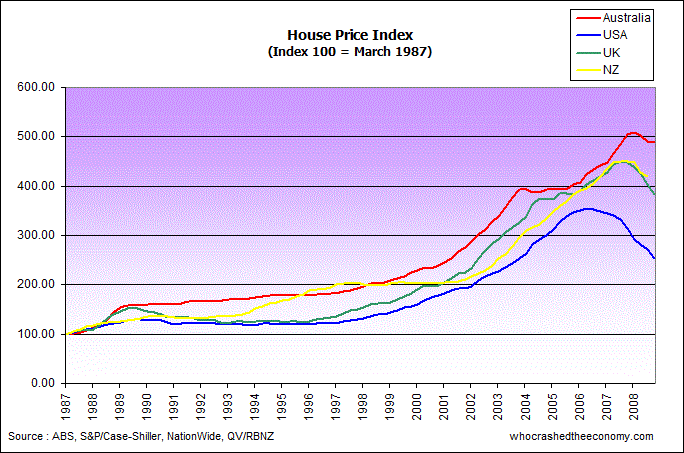
Renting looks good....
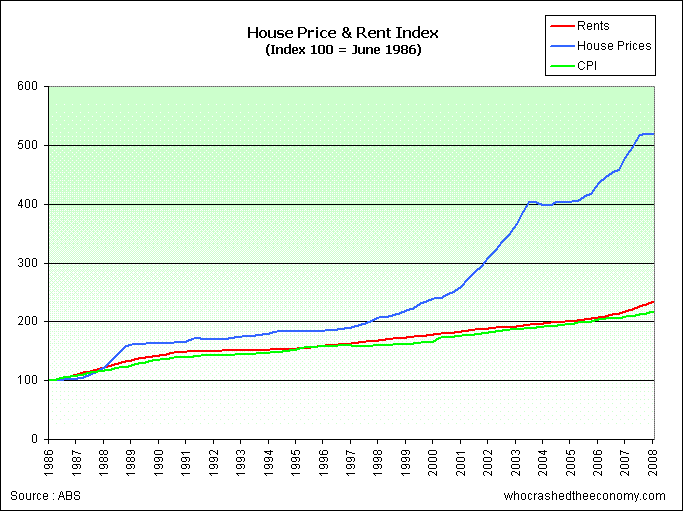
This seems reasonable for BrisVegas prices, imo..

But Dont worry Kev's on the job...
10 June 2009
the aussie debt that dare not speak its name
Sterling work from a library, where else?
Australia has always been a net recipient of overseas funds.
Australia’s foreign debt has grown rapidly. Between 1976 and 2008, the level of gross foreign debt increased from $8 billion to $1 072 billion, or from 9 to 95 per cent of gross domestic product (GDP). Net foreign debt increased from $3 billion to $600 billion, or from 4 to 53 per cent of GDP. (Table 1.)
Gross interest paid overseas averaged around half of one per cent of GDP through the 1960s and most of the 1970s. It then increased rapidly and by 2007–08 was equal to 3.8 per cent of GDP, or its second highest level ever. (Table 2.)
Estimates of Australia’s gross foreign debt are available back to 1901. These show that at 95 per cent of GDP, Australia’s gross foreign debt in 2008 was at its highest level ever. (Table 3.)
The general government and Reserve Bank’s share of gross foreign debt has fallen sharply since the 1980s, as has the share held by private non-financial corporations. At 74 per cent of GDP, the largest holders of debt in 2008 were private financial corporations. (Table 4.)
The proportion of debt denominated in Australian dollars increased from 15 per cent in 1981 to peak at 47 per cent in 1995. In 2008 it was equal to 39 per cent. (Table 5.)
The most important creditor countries for Australia are the United Kingdom and the United States which, in 2007, accounted for 23 and 22 per cent (respectively) of Australia’s gross foreign debt. (Table 6.)
The turnover of foreign debt is rapid with many loans outstanding due within a very short period. In 2008, 37 per cent of loans were due within 90 days. (Table 7.)
Exchange rate movements can have a significant impact on the level of debt. (Table 8.)
Debt accounted for 87 per cent of net investment in 2008; the corresponding figure in 1980 was just 29 per cent. (Table 9.)
Australia has always been a net recipient of overseas funds.
Australia’s foreign debt has grown rapidly. Between 1976 and 2008, the level of gross foreign debt increased from $8 billion to $1 072 billion, or from 9 to 95 per cent of gross domestic product (GDP). Net foreign debt increased from $3 billion to $600 billion, or from 4 to 53 per cent of GDP. (Table 1.)
Gross interest paid overseas averaged around half of one per cent of GDP through the 1960s and most of the 1970s. It then increased rapidly and by 2007–08 was equal to 3.8 per cent of GDP, or its second highest level ever. (Table 2.)
Estimates of Australia’s gross foreign debt are available back to 1901. These show that at 95 per cent of GDP, Australia’s gross foreign debt in 2008 was at its highest level ever. (Table 3.)
The general government and Reserve Bank’s share of gross foreign debt has fallen sharply since the 1980s, as has the share held by private non-financial corporations. At 74 per cent of GDP, the largest holders of debt in 2008 were private financial corporations. (Table 4.)
The proportion of debt denominated in Australian dollars increased from 15 per cent in 1981 to peak at 47 per cent in 1995. In 2008 it was equal to 39 per cent. (Table 5.)
The most important creditor countries for Australia are the United Kingdom and the United States which, in 2007, accounted for 23 and 22 per cent (respectively) of Australia’s gross foreign debt. (Table 6.)
The turnover of foreign debt is rapid with many loans outstanding due within a very short period. In 2008, 37 per cent of loans were due within 90 days. (Table 7.)
Exchange rate movements can have a significant impact on the level of debt. (Table 8.)
Debt accounted for 87 per cent of net investment in 2008; the corresponding figure in 1980 was just 29 per cent. (Table 9.)
My mate computers biggers than your mates so House prices will RISE!! Get it..
Doesn't Michael Pascoe know that the RBA and the big boys can only acknowledge disaster after it would be profoundly impoosible to deny it and still maintain a shread of credibility, many reports aren't predictions, they are expectation management...
House prices NOT tipped to slide
What a dangerous thing an economist with a model can be, capable of scaring the horses, wrecking the financial system and generating internet traffic.
Yesterday's strange call by JPMorgan that Australian house prices will fall by 14 per cent in the next year is a case in point. It provided a scary headline that certainly had readers clicking their mice and probably worried some home buyers. I don't know what the horses thought.
And it was most likely hopelessly wrong. If it's a choice between JPMorgan's model echoing the Dr Steven Keen's doomsday scenario on one hand and the combined efforts of the Reserve Bank of Australia, the Australian Prudential Regulation Authority and Macquarie Bank's Rory Robertson on the other, my money is on the latter.
The RBA and APRA also run economic models, on, I suspect, more powerful computers than JPMorgan's Australian office - and they're not worried about house prices at all.
The most public faces of the house price debate have been Robertson vs Keen thanks to their bet on the issue with the loser having to walk to Mt Kosciusko. We reported Robertson's debunking of Keen's 40 per cent forecast three months ago and since then the Macquarie interest rate strategist has strengthened his case with the help of the official family.
The JPMorgan milder version of doom - just a 14 per cent crash - first and foremost fails the historical test of what happened here in the last recession - average house prices actually rose. JPMorgan's model might claim house prices fall by 1.25 per cent for every one per cent rise in unemployment, but the real world doesn't.
The are a number of reasons why the Australian housing market is fundamentally different from those of the US and UK, including our tax policies, that we had a housing boom that topped out in 2003, monetary policy that was rising ahead of this global recession, economic counter-measures put in place early in our slow-down, our banks not completely losing the plot, our home loans are not non-recourse and that we have something like a shortage of housing, as opposed to the over-building that occurred elsewhere.
For hard-core buffs of housing number crunching, papers by the RBA's economic analysis department head, Anthony Richards and financial stability department head Luci Ellis should leave your equines quite relaxed and confident.
Of course it's not good news at the top of the market, but despite all the attention given to Mosman, Toorak, Peppermint Grove and Noosa, that's only a small fraction of total Australian housing and doesn't matter very much in the overall economic scheme of things.
Certainly APRA is very relaxed about any impact the housing market might have on Australia's banks. Indeed, the rivers of gold flowing from residential mortgages to the banks is one of the key ingredients in our financial system's present stability.
Yes, rising unemployment is not good for maintaining house prices, but sharply lower interest rates are. Of those who do lose their jobs, relatively few will actually face foreclosure. Most Australian workers actually don't have a mortgage and of the rest, most have built up a healthy equity buffer to see them through a period of unemployment - which is why our big banks are prepared to capitalise repayments for a year.
On the other hand, as Rory Robertson has repeatedly stressed, monetary policy does work: lift interest rates as the RBA did during the boom and it creates pent-up demand; cut interest rates as the RBA did as the economy slowed and that pent-up demand is unleashed.
But mere history and all the work done by much larger teams of economic thinkers with bigger computers won't stand in the way of a headline and an economist with a model with a nasty prediction.
Which brings one to the whole question of economic models and their serious flaws.
It was a couple of elementary, almost childish flaws in the models used by dopey credit rating agencies that enabled the sub-prime crisis to occur, that falsely blessed rubbish loans with AAA ratings. Fitch had a model that simply assumed house prices rose every year. And when they didn't, the model - and the US economy - clearly failed.
But not only is it likely that things that are too good to be true aren't true, things that are too bad to be true generally aren't true either.
One of the nicest jobs of putting models in their flawed place was done by the Bank of England's executive director for financial stability, Andrew Haldane, in a February speech on risk management. With dry British wit, take it away Andrew Haldane:
"Back in August 2007, the chief financial officer of Goldman Sachs, David Viniar, commented to the Financial Times:
'We are seeing things that were 25-standard deviation moves, several days in a row'
To provide some context, assuming a normal distribution, a 7.26-sigma daily loss would be expected to occur once every 13.7 billion or so years. That is roughly the estimated age of the universe.
A 25-sigma event would be expected to occur once every 6 x 10 to the 124th power lives of the universe. That is quite a lot of human histories.
When I tried to calculate the probability of a 25-sigma event occurring on several successive days, the lights visibly dimmed over London and, in a scene reminiscent of that Lit-tle Britain sketch, the computer said 'No'."
Suffice to say, time is very unlikely to tell whether Mr Viniar's empirical observation proves correct.
Fortunately, there is a simpler explanation - the model was wrong.
Of course, all models are wrong. The only model that is not wrong is reality and reality is not, by definition, a model.
But risk management models have during this crisis proved themselves wrong in a more fundamental sense. They failed Keynes' test - that it is better to be roughly right than precisely wrong. With hindsight, these models were both very precise and very wrong.
For that reason, 2008 might well be remembered as the year stress-testing failed.
Failed those institutions who invested in it in the hope it would transform their management of risk.
Failed the authorities who had relied - perhaps over-relied - on the signal it provided about financial firms' risk management capabilities.
And, perhaps most important of all, failed the financial system as a whole by contributing, first, to the decade of credit boom and, latterly, the credit bust.
Michael Pascoe is a BusinessDay contributing editor.
This story was found at: http://business.smh.com.au/business/house-prices-not-tipped-to-slide-20090603-bv6p.html
http://business.smh.com.au/business/house-prices-not-tipped-to-slide-20090603-bv6p.html?page=-1
House prices NOT tipped to slide
What a dangerous thing an economist with a model can be, capable of scaring the horses, wrecking the financial system and generating internet traffic.
Yesterday's strange call by JPMorgan that Australian house prices will fall by 14 per cent in the next year is a case in point. It provided a scary headline that certainly had readers clicking their mice and probably worried some home buyers. I don't know what the horses thought.
And it was most likely hopelessly wrong. If it's a choice between JPMorgan's model echoing the Dr Steven Keen's doomsday scenario on one hand and the combined efforts of the Reserve Bank of Australia, the Australian Prudential Regulation Authority and Macquarie Bank's Rory Robertson on the other, my money is on the latter.
The RBA and APRA also run economic models, on, I suspect, more powerful computers than JPMorgan's Australian office - and they're not worried about house prices at all.
The most public faces of the house price debate have been Robertson vs Keen thanks to their bet on the issue with the loser having to walk to Mt Kosciusko. We reported Robertson's debunking of Keen's 40 per cent forecast three months ago and since then the Macquarie interest rate strategist has strengthened his case with the help of the official family.
The JPMorgan milder version of doom - just a 14 per cent crash - first and foremost fails the historical test of what happened here in the last recession - average house prices actually rose. JPMorgan's model might claim house prices fall by 1.25 per cent for every one per cent rise in unemployment, but the real world doesn't.
The are a number of reasons why the Australian housing market is fundamentally different from those of the US and UK, including our tax policies, that we had a housing boom that topped out in 2003, monetary policy that was rising ahead of this global recession, economic counter-measures put in place early in our slow-down, our banks not completely losing the plot, our home loans are not non-recourse and that we have something like a shortage of housing, as opposed to the over-building that occurred elsewhere.
For hard-core buffs of housing number crunching, papers by the RBA's economic analysis department head, Anthony Richards and financial stability department head Luci Ellis should leave your equines quite relaxed and confident.
Of course it's not good news at the top of the market, but despite all the attention given to Mosman, Toorak, Peppermint Grove and Noosa, that's only a small fraction of total Australian housing and doesn't matter very much in the overall economic scheme of things.
Certainly APRA is very relaxed about any impact the housing market might have on Australia's banks. Indeed, the rivers of gold flowing from residential mortgages to the banks is one of the key ingredients in our financial system's present stability.
Yes, rising unemployment is not good for maintaining house prices, but sharply lower interest rates are. Of those who do lose their jobs, relatively few will actually face foreclosure. Most Australian workers actually don't have a mortgage and of the rest, most have built up a healthy equity buffer to see them through a period of unemployment - which is why our big banks are prepared to capitalise repayments for a year.
On the other hand, as Rory Robertson has repeatedly stressed, monetary policy does work: lift interest rates as the RBA did during the boom and it creates pent-up demand; cut interest rates as the RBA did as the economy slowed and that pent-up demand is unleashed.
But mere history and all the work done by much larger teams of economic thinkers with bigger computers won't stand in the way of a headline and an economist with a model with a nasty prediction.
Which brings one to the whole question of economic models and their serious flaws.
It was a couple of elementary, almost childish flaws in the models used by dopey credit rating agencies that enabled the sub-prime crisis to occur, that falsely blessed rubbish loans with AAA ratings. Fitch had a model that simply assumed house prices rose every year. And when they didn't, the model - and the US economy - clearly failed.
But not only is it likely that things that are too good to be true aren't true, things that are too bad to be true generally aren't true either.
One of the nicest jobs of putting models in their flawed place was done by the Bank of England's executive director for financial stability, Andrew Haldane, in a February speech on risk management. With dry British wit, take it away Andrew Haldane:
"Back in August 2007, the chief financial officer of Goldman Sachs, David Viniar, commented to the Financial Times:
'We are seeing things that were 25-standard deviation moves, several days in a row'
To provide some context, assuming a normal distribution, a 7.26-sigma daily loss would be expected to occur once every 13.7 billion or so years. That is roughly the estimated age of the universe.
A 25-sigma event would be expected to occur once every 6 x 10 to the 124th power lives of the universe. That is quite a lot of human histories.
When I tried to calculate the probability of a 25-sigma event occurring on several successive days, the lights visibly dimmed over London and, in a scene reminiscent of that Lit-tle Britain sketch, the computer said 'No'."
Suffice to say, time is very unlikely to tell whether Mr Viniar's empirical observation proves correct.
Fortunately, there is a simpler explanation - the model was wrong.
Of course, all models are wrong. The only model that is not wrong is reality and reality is not, by definition, a model.
But risk management models have during this crisis proved themselves wrong in a more fundamental sense. They failed Keynes' test - that it is better to be roughly right than precisely wrong. With hindsight, these models were both very precise and very wrong.
For that reason, 2008 might well be remembered as the year stress-testing failed.
Failed those institutions who invested in it in the hope it would transform their management of risk.
Failed the authorities who had relied - perhaps over-relied - on the signal it provided about financial firms' risk management capabilities.
And, perhaps most important of all, failed the financial system as a whole by contributing, first, to the decade of credit boom and, latterly, the credit bust.
Michael Pascoe is a BusinessDay contributing editor.
This story was found at: http://business.smh.com.au/business/house-prices-not-tipped-to-slide-20090603-bv6p.html
http://business.smh.com.au/business/house-prices-not-tipped-to-slide-20090603-bv6p.html?page=-1
4 May 2009
Double digit unemployment in Australia by 2010 ~ Keen
So confidence is not “all it is about”: confidence played its role over the last thirty years as it “beguiled its victims into debt”, in Fisher’s evocative phrase. We don’t need more of it now, so much as less of it back then–but of course, we can’t amend history.
The victims of past overconfidence include Central Bankers, whose rescues of the financial system simply encouraged it to search out a new group of potential borrowers to replace those who had already been debt-saturated. They were victims of debt, as much as were the borrowers, because the naive theory of economics they followed ignored the role of debt completely. They therefore couldn’t see the process that was leading to crisis, even as their interventions egged that process on to heights that it could never have reached without them.
Had Greenspan and his equivalents around the world not intervened in 1987, it is quite possible that we would have experienced a mild Depression back then–mild because debt was only equivalent to 1929 levels then, because a larger Government sector than in the 1920s would have counterbalanced the private sector downturn, and because higher inflation in the late 80s would have helped reduced the real burden of debt.
Now we are sitting on the precipice of a mountain of debt twice as high as in the Great Depression, with low inflation turning into deflation as Fisher warned, and with Central Bankers who do not have a clue why the economy has suddenly gone from “the Great Moderation” to “the Greatest Crisis Since the Great Depression”.
Over-confidence in the face of rising debt did beguile us during the long boom. Confidence in the face of deleveraging will not save us during the coming Depression.
END OF COMMENTARY
Comments on the Australian Data
Debt levels in Australia are very close to falling in nominal terms, and in fact only mortgage debt is still rising: both business and personal debt (other than mortgages) have fallen in the last few months. It is conceivable that, were it not for the “First Home Buyers Boost”, mortgage debt as well would be falling now too (the scheme is more aptly described as the “First Home Vendors Boost”, since prices at the low end of the market have been driven up by far more than the $7,000 increase in the grant).
As a result, the debt to GDP ratio has fallen for the last four months–though this is to some extent masked by Australia’s practice of summing the previous four quarters of GDP data to derive annual GDP, versus the American practice of simply multiplying the current quarter’s GDP figure by 4. Using the Australian approach, our debt to GDP ratio is now 160%; using the American, it is 162%, since GDP fell by 0.5% in the previous quarter.
Whichever way you cut it, deleveraging is now well and truly underway, and unemployment will therefore rise dramatically in the next few months. Most neoclassical economists are predicting 7.5% unemployment by mid-2010; I expect it will have entered double figures by early in 2010.
http://www.debtdeflation.com/blogs/2009/05/04/debtwatch-no-34-the-confidence-trick/
The victims of past overconfidence include Central Bankers, whose rescues of the financial system simply encouraged it to search out a new group of potential borrowers to replace those who had already been debt-saturated. They were victims of debt, as much as were the borrowers, because the naive theory of economics they followed ignored the role of debt completely. They therefore couldn’t see the process that was leading to crisis, even as their interventions egged that process on to heights that it could never have reached without them.
Had Greenspan and his equivalents around the world not intervened in 1987, it is quite possible that we would have experienced a mild Depression back then–mild because debt was only equivalent to 1929 levels then, because a larger Government sector than in the 1920s would have counterbalanced the private sector downturn, and because higher inflation in the late 80s would have helped reduced the real burden of debt.
Now we are sitting on the precipice of a mountain of debt twice as high as in the Great Depression, with low inflation turning into deflation as Fisher warned, and with Central Bankers who do not have a clue why the economy has suddenly gone from “the Great Moderation” to “the Greatest Crisis Since the Great Depression”.
Over-confidence in the face of rising debt did beguile us during the long boom. Confidence in the face of deleveraging will not save us during the coming Depression.
END OF COMMENTARY
Comments on the Australian Data
Debt levels in Australia are very close to falling in nominal terms, and in fact only mortgage debt is still rising: both business and personal debt (other than mortgages) have fallen in the last few months. It is conceivable that, were it not for the “First Home Buyers Boost”, mortgage debt as well would be falling now too (the scheme is more aptly described as the “First Home Vendors Boost”, since prices at the low end of the market have been driven up by far more than the $7,000 increase in the grant).
As a result, the debt to GDP ratio has fallen for the last four months–though this is to some extent masked by Australia’s practice of summing the previous four quarters of GDP data to derive annual GDP, versus the American practice of simply multiplying the current quarter’s GDP figure by 4. Using the Australian approach, our debt to GDP ratio is now 160%; using the American, it is 162%, since GDP fell by 0.5% in the previous quarter.
Whichever way you cut it, deleveraging is now well and truly underway, and unemployment will therefore rise dramatically in the next few months. Most neoclassical economists are predicting 7.5% unemployment by mid-2010; I expect it will have entered double figures by early in 2010.
http://www.debtdeflation.com/blogs/2009/05/04/debtwatch-no-34-the-confidence-trick/
23 April 2009
Last domino falls ~ Australian Economy in rapid decline
THE Australian economy will shrink faster than the global average this year, the International Monetary Fund said last night, foreshadowing another dire batch of revisions in next month's budget.
The predictions followed the release of mixed figures on inflation by the Bureau of Statistics. They showed inflation was falling, but perhaps not fast enough to trigger interest rate cuts by the Reserve Bank.
Australia's economy is set to contract by 1.4 per cent in 2009, the IMF said, before growing just 0.6 per cent next year.
The IMF's forecast is markedly worse than the 1 per cent growth for 2008-09 predicted by the Government in February, and is likely to be matched when revised figures are released in next month's budget. The Prime Minister, Kevin Rudd, told a business lunch in Perth that Australia was now in recession and the budget had been "ravaged".
Forecast revenue had plunged 63 per cent from that estimated in last May's budget and it would worsen further, he said.
Mr Rudd began setting the scene for Australia to go deeper into debt by saying "every responsible government around the world is being forced into greater levels of temporary borrowing". He said Malcolm Turnbull's promises had already committed the Opposition to a $177 billion debt and the Opposition Leader should "explain how he could provide economic stimulus while revenues are collapsing without undertaking further borrowing".
The Treasurer, Wayne Swan, said there had probably never been a more difficult time to put together a budget.
The budget would "support jobs, provide economic stimulus" and "make the necessary investments for the future so that when world growth returns we can take the maximum opportunities from that revival".
"Tough measures" are expected to include the means-testing of so-called middle-class welfare measures such as the Medicare safety net and the child care rebate.
The Government is also targeting tax loopholes such as using holiday homes and hobby farms as tax deductions.
In its latest World Economic Outlook, released ahead of its spring meetings in Washington this weekend, the IMF was far more gloomy about the outlook than its report in January.
Despite the efforts at stimulus worldwide, the IMF said global activity would decline 1.3 per cent in 2009. In January, it had predicted 0.5 per cent growth. "This downturn represents by far the deepest global recession since the Great Depression," it said.
It predicted Australia's economy would go backwards by 1.4 per cent this year and unemployment would hit 6.8 per cent, rising to 7.8 per cent in 2010.
The revisions have been driven by the severity of the slowdown in advanced economies since October 2008.
Advanced economies shrunk by an "unprecedented" 7.5 per cent in late 2008, the IMF said, and it is likely they contracted by a similar amount in the first three months of 2009. In advanced economies, GDP will contract by an average 3.8 per cent in 2009. But some nations - particularly those relying on manufactured exports such as Japan, Germany and Singapore - will be even more severely battered.
China is expected to maintain growth of 6.5 per cent in 2009.
The Bureau of Statistics said inflation increased by 0.1 per cent in the three months to the end of March, taking the yearly rate to a comfortable 2.5 per cent.
But the Reserve Bank's preferred measure of core inflation - which strips out volatile price swings - increased 1.1 per cent in the quarter, and remains above 4 per cent. Economists said the Reserve could use the relatively high result as an opportunity to wait before cutting rates further.
with Anne Davies
http://business.brisbanetimes.com.au/business/economy-in-rapid-decline-20090423-afkk.html
The predictions followed the release of mixed figures on inflation by the Bureau of Statistics. They showed inflation was falling, but perhaps not fast enough to trigger interest rate cuts by the Reserve Bank.
Australia's economy is set to contract by 1.4 per cent in 2009, the IMF said, before growing just 0.6 per cent next year.
The IMF's forecast is markedly worse than the 1 per cent growth for 2008-09 predicted by the Government in February, and is likely to be matched when revised figures are released in next month's budget. The Prime Minister, Kevin Rudd, told a business lunch in Perth that Australia was now in recession and the budget had been "ravaged".
Forecast revenue had plunged 63 per cent from that estimated in last May's budget and it would worsen further, he said.
Mr Rudd began setting the scene for Australia to go deeper into debt by saying "every responsible government around the world is being forced into greater levels of temporary borrowing". He said Malcolm Turnbull's promises had already committed the Opposition to a $177 billion debt and the Opposition Leader should "explain how he could provide economic stimulus while revenues are collapsing without undertaking further borrowing".
The Treasurer, Wayne Swan, said there had probably never been a more difficult time to put together a budget.
The budget would "support jobs, provide economic stimulus" and "make the necessary investments for the future so that when world growth returns we can take the maximum opportunities from that revival".
"Tough measures" are expected to include the means-testing of so-called middle-class welfare measures such as the Medicare safety net and the child care rebate.
The Government is also targeting tax loopholes such as using holiday homes and hobby farms as tax deductions.
In its latest World Economic Outlook, released ahead of its spring meetings in Washington this weekend, the IMF was far more gloomy about the outlook than its report in January.
Despite the efforts at stimulus worldwide, the IMF said global activity would decline 1.3 per cent in 2009. In January, it had predicted 0.5 per cent growth. "This downturn represents by far the deepest global recession since the Great Depression," it said.
It predicted Australia's economy would go backwards by 1.4 per cent this year and unemployment would hit 6.8 per cent, rising to 7.8 per cent in 2010.
The revisions have been driven by the severity of the slowdown in advanced economies since October 2008.
Advanced economies shrunk by an "unprecedented" 7.5 per cent in late 2008, the IMF said, and it is likely they contracted by a similar amount in the first three months of 2009. In advanced economies, GDP will contract by an average 3.8 per cent in 2009. But some nations - particularly those relying on manufactured exports such as Japan, Germany and Singapore - will be even more severely battered.
China is expected to maintain growth of 6.5 per cent in 2009.
The Bureau of Statistics said inflation increased by 0.1 per cent in the three months to the end of March, taking the yearly rate to a comfortable 2.5 per cent.
But the Reserve Bank's preferred measure of core inflation - which strips out volatile price swings - increased 1.1 per cent in the quarter, and remains above 4 per cent. Economists said the Reserve could use the relatively high result as an opportunity to wait before cutting rates further.
with Anne Davies
http://business.brisbanetimes.com.au/business/economy-in-rapid-decline-20090423-afkk.html
21 April 2009
One in four firms to cut staff ~ SMH
TWENTY-FIVE per cent of small to medium-sized businesses in NSW expect to sack staff within three months, a survey by the NSW Business Chamber has found.
The findings came as the Prime Minister, Kevin Rudd, conceded the economy would fall into recession for the first time in almost two decades.
"The severity of the global recession has made it impossible for Australia to avoid a further period of negative economic growth," Mr Rudd told a jobs forum in Adelaide.
"The worst global economic recession in 75 years means it's inevitable that Australia, too, will be dragged into recession."
Also yesterday, the Commonwealth Bank defied Government calls to pass on interest rate cuts and said it would raise its fixed rate mortgages by between 20 and 45 basis points from today.
NSW has the highest jobless rate in the country, at 6.9 per cent, but that is expected to increase.
Phone calls by business to the chamber seeking advice about about termination and redundancy have increased 60 per cent since the middle of last year.
One in four of the 440 companies surveyed said they had reduced staff hours in the first three months of this year.
Another 24 per cent say they expect to sack someone over the next three months while only 9 per cent expect to hire staff.
"Many employers are loyal to their employees and are doing their hardest to keep their staff on by altering work practices and reducing hours but it's an uphill battle in this economic environment," said the chamber's chief executive, Kevin MacDonald.
This is despite an official survey released yesterday which found prices paid by business fell sharply in the first three months of this year.
The Bureau of Statistics' "producer price index" found prices paid by firms fell 0.4 per cent - the second biggest drop in the survey's 10-year history. Prices were up 4 per cent over the year - although this is a slower pace than the 6.4 per cent growth rate clocked in the previous survey.
Yesterday was the first time Mr Rudd had used the word recession; it was an admission the Government now expects growth for the March quarter to be negative. The December quarter was negative and a recession is defined technically as two successive quarters of negative growth.
The Government will argue circumstances would be worse if not for the two stimulus packages, worth $52 billion.
"The challenge for government is to cushion the impact of the recession on business and jobs through the actions we take through our economic stimulus strategy," Mr Rudd said.
Inflation figures due tomorrow are expected to show the rate back in the Reserve Bank's target band of 2 to 3 per cent.
Falling prices mean companies are under less pressure to increase the prices consumers pay and open the way for discounting to tempt wary customers.
The NSW Business Chamber's survey confirms concern about growth have replaced concerns about rising costs.
Nearly half of firms surveyed believed business conditions had deteriorated in NSW in the previous three months.
"With nearly one in every two businesses reporting deteriorating business conditions, the need for us to kick-start the NSW economy has never been more urgent," Mr MacDonald said.
Lack of access to new credit remains a pressing issue, with one in three NSW companies saying they had trouble being able to borrow from their bank.
"These figures show that the financial crisis is far from over. More must be done to assist businesses in obtaining the finance they need to operate. The flow of credit is the lifeblood of the economy."
The Government has been softening up the electorate for a recession for some time. Chris Richardson, the director of Access Economics, said Mr Rudd had confirmed what the financial world had long known.
"It means nothing to markets," he said of Mr Rudd's declaration.
http://business.smh.com.au/business/one-in-four-firms-to-cut-staff-20090420-acp8.html
The findings came as the Prime Minister, Kevin Rudd, conceded the economy would fall into recession for the first time in almost two decades.
"The severity of the global recession has made it impossible for Australia to avoid a further period of negative economic growth," Mr Rudd told a jobs forum in Adelaide.
"The worst global economic recession in 75 years means it's inevitable that Australia, too, will be dragged into recession."
Also yesterday, the Commonwealth Bank defied Government calls to pass on interest rate cuts and said it would raise its fixed rate mortgages by between 20 and 45 basis points from today.
NSW has the highest jobless rate in the country, at 6.9 per cent, but that is expected to increase.
Phone calls by business to the chamber seeking advice about about termination and redundancy have increased 60 per cent since the middle of last year.
One in four of the 440 companies surveyed said they had reduced staff hours in the first three months of this year.
Another 24 per cent say they expect to sack someone over the next three months while only 9 per cent expect to hire staff.
"Many employers are loyal to their employees and are doing their hardest to keep their staff on by altering work practices and reducing hours but it's an uphill battle in this economic environment," said the chamber's chief executive, Kevin MacDonald.
This is despite an official survey released yesterday which found prices paid by business fell sharply in the first three months of this year.
The Bureau of Statistics' "producer price index" found prices paid by firms fell 0.4 per cent - the second biggest drop in the survey's 10-year history. Prices were up 4 per cent over the year - although this is a slower pace than the 6.4 per cent growth rate clocked in the previous survey.
Yesterday was the first time Mr Rudd had used the word recession; it was an admission the Government now expects growth for the March quarter to be negative. The December quarter was negative and a recession is defined technically as two successive quarters of negative growth.
The Government will argue circumstances would be worse if not for the two stimulus packages, worth $52 billion.
"The challenge for government is to cushion the impact of the recession on business and jobs through the actions we take through our economic stimulus strategy," Mr Rudd said.
Inflation figures due tomorrow are expected to show the rate back in the Reserve Bank's target band of 2 to 3 per cent.
Falling prices mean companies are under less pressure to increase the prices consumers pay and open the way for discounting to tempt wary customers.
The NSW Business Chamber's survey confirms concern about growth have replaced concerns about rising costs.
Nearly half of firms surveyed believed business conditions had deteriorated in NSW in the previous three months.
"With nearly one in every two businesses reporting deteriorating business conditions, the need for us to kick-start the NSW economy has never been more urgent," Mr MacDonald said.
Lack of access to new credit remains a pressing issue, with one in three NSW companies saying they had trouble being able to borrow from their bank.
"These figures show that the financial crisis is far from over. More must be done to assist businesses in obtaining the finance they need to operate. The flow of credit is the lifeblood of the economy."
The Government has been softening up the electorate for a recession for some time. Chris Richardson, the director of Access Economics, said Mr Rudd had confirmed what the financial world had long known.
"It means nothing to markets," he said of Mr Rudd's declaration.
http://business.smh.com.au/business/one-in-four-firms-to-cut-staff-20090420-acp8.html
8 April 2009
Aussie home prices to absolutely crater ~ Keen
The ABS has only maintained a comprehensive index of Australian house prices since mid-1986–a time when the hills were alive to the sound of Alan Bond and Christopher Skase. House prices rose 60% in the first three years of the index, far above the rate of inflation at the time. They then stalled for the next few years before more than tripling over the next 17 years–again, a rate of growth that far exceeded the rate of inflation. This 30-year-plus experience of continuously rising prices has helped shape the belief that house prices “always” rise faster than consumer prices.

But “always” is a much longer time span than a mere 30 years–something Robert Shiller appreciated when he and Karl Case developed the index of US house prices now known as the Case-Shiller Index. The key comparison Shiller makes is between house prices and consumer prices; this is the premiere indicator of the American market, and there it’s clear that the bubble has popped.
If we take a 25 year view, like that which Richards used in his paper, it could be argued that the fall in the index has almost brought the real price of American housing back to the average. Having plateaued at a value of 217 between 2005 and 2007, it has now fallen to 138, which is just 11% above the 85-09 average.

But if we look at the really long term–over the whole data set from 1890 till now–it’s apparent that the American market has some way to fall before it hits the average: even though it has already fallen 30% from its peak, it still has another 46% to go, if the real price of housing is constant over the long term.
That’s an if to which Shiller gives an emphatic “yes” to, based partly on his own data–which shows no trend to rising real house prices prior to the current bubble that clearly began in 1997–and partly on a yet longer term series still: the “Herengracht Index” that shows the real price of housing on a famous canal in Amsterdam over the three and a half centuries from 1628 till 1970. This index has at times risen for extended periods–such as over the 7 decades between 1814 and 1887 when the real price of a house on the Herengracht Canal rose almost fourfold. Anyone born at the beginning of that period could have easily been persuaded that house prices “always” rise faster than consumer prices.
But over the long term, there is no trend. For the next 7 decades, house prices tended down in real terms: the index fell 55% from the 1887 peak to be 40% below the long term average of 198 in 1951, when yet another upward trend occurred.
Could a similar proposition apply to Australia? Dr Nigel Stapledon set out to answer this question in his PhD, where he observed that:
The period since the early 1970s has been one in which house prices have risen quite significantly by any measure with the median capital city house prices in Australia having risen on average 3% per annum in real terms in the period 1970-2006. While the rises in Australia have been above the average for developed countries, the picture is similar in most OECD economies and Australia is by no means unique.
The question that can be asked is whether this period is unique for housing? Eichholtz (1997) has constructed a long term series for Amsterdam in Holland which spans the period 1628-1973. The broad picture that his time series paints is one of prices essentially showing no trend for three centuries, with cycles related to the economic events. Against that long term perspective the post 1970 rise in house prices in Holland stands out. But one city is probably not convincing…” (Stapledon 2007, p. 1)
Stapledon’s key data table gave the median capital city house price in current dollars, 2005 dollars, and 2005 dollars deflated by 0.6% p.a. to reflect increasing house quality. In the following graph I take Stapledon’s CPI and quality deflated index, extended to today using the last 2 years of ABS data deflated by the CPI. I then set the value to 100 in 1890 to enable easy comparison with the Case-Shiller real house price index for the USA.

One inference from this graph is that the recent Australian house price bubble began earlier at much the same time as the USA’s (1997), but began from an already higher base that can be dated back to the 1987 Stock Market Crash.
At that time, the Australian index was only marginally higher than the USA’s–132 for Australia versus 120.5 for the USA, a 10% difference. But the 25% fall in the Australian stock market on Black Tuesday ended the Antipodean flirtation with stocks, and we piled right back into our favourite speculative play: bricks and mortar. Most of the money borrowed by Australian households for speculative purposes then drove up house prices, whereas Americans spread their leveraged dollars between stocks and houses.
As a result, Australian house prices absorbed most of the speculative excess of the last thirty years, driving them to 3.5 times the long term average versus “just” twice the average in the USA.
Of course, it could be true that, as the property lobby keeps asserting, Australia is “different”, and trends that don’t exist elsewhere in the world rule in the land of the marsupials. Especially since virtually everyone now describes this crisis as “the worst since the Great Depression, it would have helped if the RBA had referred to this publicly available data when preparing its own comparison of current house prices to “long term” trends.
The Never-Ending UnderSupply Story
Richards did express some scepticism here on behalf of the RBA that Australia’s undersupply of housing was as marked as some commentators claim, but he still came down on the side of this widely shared belief:
“Whatever the true shortfall of dwellings, we can say with some confidence that our housing market is relatively tight. This can be contrasted with the US market which many observers characterise as having been subject to overbuilding during their housing boom. And the relative tightness of the Australian housing market is one factor that will support home-building in the period ahead.”
Curiously, one group that does not share this belief is Hometrack, the local branch of the UK housing intelligence research group. Just days after Richards’ speech, it released a press release in which it stated that:
the widely quoted views of many property market commentators who believe that Australia’s current building levels are not enough to meet the future demand for housing, may be based on inaccurate data calculations.
“Our analysis indicates Australia may already have an excess of housing. We estimate there are at least 10 million dwellings in Australia compared with ABS data showing occupied dwellings of 8.3 million. The extra one to two million dwellings consists of a mixture of housing awaiting sale or development, vacant dwellings, second homes, and abandoned homes,” he said.
He went on to say that the ABS method for calculating the ratio of people per dwellings is based on ABS census data which in turn is based upon occupied dwellings. However, he said, Hometrack analysis which is based on postal address data indicates that Australia’s current level of housing relative to its population is in line with other Anglo economies.
Following on from this, Darcy said that when looked at in the context of population growth, total residential building approvals have been running above demand.
“This points to a build-up of excess stock of housing over the past six years, despite the gap between building approvals and demand narrowing over recent months,” he said.
“The concern is that business and government decisions regarding the residential housing market in Australia are being made based on demand assumptions that differ from the actual behavior of the housing market. There will always be examples of areas with an undersupply, but it’s not clear from the data that we have an overall shortage relative to future demand.”
One must read Keen's article
But “always” is a much longer time span than a mere 30 years–something Robert Shiller appreciated when he and Karl Case developed the index of US house prices now known as the Case-Shiller Index. The key comparison Shiller makes is between house prices and consumer prices; this is the premiere indicator of the American market, and there it’s clear that the bubble has popped.
If we take a 25 year view, like that which Richards used in his paper, it could be argued that the fall in the index has almost brought the real price of American housing back to the average. Having plateaued at a value of 217 between 2005 and 2007, it has now fallen to 138, which is just 11% above the 85-09 average.
But if we look at the really long term–over the whole data set from 1890 till now–it’s apparent that the American market has some way to fall before it hits the average: even though it has already fallen 30% from its peak, it still has another 46% to go, if the real price of housing is constant over the long term.
That’s an if to which Shiller gives an emphatic “yes” to, based partly on his own data–which shows no trend to rising real house prices prior to the current bubble that clearly began in 1997–and partly on a yet longer term series still: the “Herengracht Index” that shows the real price of housing on a famous canal in Amsterdam over the three and a half centuries from 1628 till 1970. This index has at times risen for extended periods–such as over the 7 decades between 1814 and 1887 when the real price of a house on the Herengracht Canal rose almost fourfold. Anyone born at the beginning of that period could have easily been persuaded that house prices “always” rise faster than consumer prices.
But over the long term, there is no trend. For the next 7 decades, house prices tended down in real terms: the index fell 55% from the 1887 peak to be 40% below the long term average of 198 in 1951, when yet another upward trend occurred.
Could a similar proposition apply to Australia? Dr Nigel Stapledon set out to answer this question in his PhD, where he observed that:
The period since the early 1970s has been one in which house prices have risen quite significantly by any measure with the median capital city house prices in Australia having risen on average 3% per annum in real terms in the period 1970-2006. While the rises in Australia have been above the average for developed countries, the picture is similar in most OECD economies and Australia is by no means unique.
The question that can be asked is whether this period is unique for housing? Eichholtz (1997) has constructed a long term series for Amsterdam in Holland which spans the period 1628-1973. The broad picture that his time series paints is one of prices essentially showing no trend for three centuries, with cycles related to the economic events. Against that long term perspective the post 1970 rise in house prices in Holland stands out. But one city is probably not convincing…” (Stapledon 2007, p. 1)
Stapledon’s key data table gave the median capital city house price in current dollars, 2005 dollars, and 2005 dollars deflated by 0.6% p.a. to reflect increasing house quality. In the following graph I take Stapledon’s CPI and quality deflated index, extended to today using the last 2 years of ABS data deflated by the CPI. I then set the value to 100 in 1890 to enable easy comparison with the Case-Shiller real house price index for the USA.
One inference from this graph is that the recent Australian house price bubble began earlier at much the same time as the USA’s (1997), but began from an already higher base that can be dated back to the 1987 Stock Market Crash.
At that time, the Australian index was only marginally higher than the USA’s–132 for Australia versus 120.5 for the USA, a 10% difference. But the 25% fall in the Australian stock market on Black Tuesday ended the Antipodean flirtation with stocks, and we piled right back into our favourite speculative play: bricks and mortar. Most of the money borrowed by Australian households for speculative purposes then drove up house prices, whereas Americans spread their leveraged dollars between stocks and houses.
As a result, Australian house prices absorbed most of the speculative excess of the last thirty years, driving them to 3.5 times the long term average versus “just” twice the average in the USA.
Of course, it could be true that, as the property lobby keeps asserting, Australia is “different”, and trends that don’t exist elsewhere in the world rule in the land of the marsupials. Especially since virtually everyone now describes this crisis as “the worst since the Great Depression, it would have helped if the RBA had referred to this publicly available data when preparing its own comparison of current house prices to “long term” trends.
The Never-Ending UnderSupply Story
Richards did express some scepticism here on behalf of the RBA that Australia’s undersupply of housing was as marked as some commentators claim, but he still came down on the side of this widely shared belief:
“Whatever the true shortfall of dwellings, we can say with some confidence that our housing market is relatively tight. This can be contrasted with the US market which many observers characterise as having been subject to overbuilding during their housing boom. And the relative tightness of the Australian housing market is one factor that will support home-building in the period ahead.”
Curiously, one group that does not share this belief is Hometrack, the local branch of the UK housing intelligence research group. Just days after Richards’ speech, it released a press release in which it stated that:
the widely quoted views of many property market commentators who believe that Australia’s current building levels are not enough to meet the future demand for housing, may be based on inaccurate data calculations.
“Our analysis indicates Australia may already have an excess of housing. We estimate there are at least 10 million dwellings in Australia compared with ABS data showing occupied dwellings of 8.3 million. The extra one to two million dwellings consists of a mixture of housing awaiting sale or development, vacant dwellings, second homes, and abandoned homes,” he said.
He went on to say that the ABS method for calculating the ratio of people per dwellings is based on ABS census data which in turn is based upon occupied dwellings. However, he said, Hometrack analysis which is based on postal address data indicates that Australia’s current level of housing relative to its population is in line with other Anglo economies.
Following on from this, Darcy said that when looked at in the context of population growth, total residential building approvals have been running above demand.
“This points to a build-up of excess stock of housing over the past six years, despite the gap between building approvals and demand narrowing over recent months,” he said.
“The concern is that business and government decisions regarding the residential housing market in Australia are being made based on demand assumptions that differ from the actual behavior of the housing market. There will always be examples of areas with an undersupply, but it’s not clear from the data that we have an overall shortage relative to future demand.”
One must read Keen's article
18 March 2009
Aussie home prices to fall 30% ~ No Question!!
This is a given, we are merely the last dominio to fall.....
THE Australian housing market is facing the prospect of a "perfect storm" of financial pressures - including high mortgage debt, overvalued homes and rising unemployment - in which prices could eventually fall by as much as 30 per cent, investors have been warned.
Research compiled by international analysts has indicated that while domestic house prices held up well amid the breaking global financial crisis, in the impact of the worsening local downturn they have come off their peak.
Prices are beginning to slide in line with declines in the US and Britain, the report suggests.
There, the fall in housing values has exacerbated recessions and prices have started dropping below or sharply back to what is described as "fair value" levels after nearly 10 years of soaring property costs.
The special report was compiled by BCA Research in Canada. It shows that the residential market fell 25 per cent in the US and 18 per cent in Britain last year.
By contrast, Australian prices slipped a "mere" 4 per cent from the all-time highs recorded in the first quarter of last year.
The authors of the report say the "ferocity of the price collapses" in the US and Britain was made worse by the meltdown in the financial services industry - a factor that is affecting Australia's two financial centres, Sydney and Melbourne.
"The housing market is looking particularly vulnerable, with overinflated prices, deteriorating affordability and slowing household income growth," the report says. "There is an increasing possibility of a major housing bust in Australia."
The authors of last month's report, which is now circulating among local investors, accept that a variety of positive factors could help cushion any fall.
These include past budget surpluses, the Federal Government's two stimulus packages, the strength of the Australian banks, which have avoided a "disastrous lending binge", falling interest rates and the drop in the value of the Australian dollar.
The report's conclusions are set against a background of tentative signs that the housing market is shrugging off the immediate effects of the downturn, helped in part by the Government's $14,000 first-home buyer's grant and an extra $7000 for people who purchase new homes.
Latest figures showed that $8 billion of new home loans were taken out at the end of January of which a quarter were advanced to first-time buyers who are driving a mini-revival in sales at the lower end of the market.
That has prompted the Sydney Chamber of Commerce to press the Federal Government to extend the level of cash support to first-time buyers beyond the current June 30 cut-off point.
Warning t the grant's removal could send the housing market into a tailspin, the chamber's executive director, Patricia Forsythe, said: "Next to the massive reduction in interest rates, the first-home buyer boost has been the most successful stimulatory measure for the economy."
link
THE Australian housing market is facing the prospect of a "perfect storm" of financial pressures - including high mortgage debt, overvalued homes and rising unemployment - in which prices could eventually fall by as much as 30 per cent, investors have been warned.
Research compiled by international analysts has indicated that while domestic house prices held up well amid the breaking global financial crisis, in the impact of the worsening local downturn they have come off their peak.
Prices are beginning to slide in line with declines in the US and Britain, the report suggests.
There, the fall in housing values has exacerbated recessions and prices have started dropping below or sharply back to what is described as "fair value" levels after nearly 10 years of soaring property costs.
The special report was compiled by BCA Research in Canada. It shows that the residential market fell 25 per cent in the US and 18 per cent in Britain last year.
By contrast, Australian prices slipped a "mere" 4 per cent from the all-time highs recorded in the first quarter of last year.
The authors of the report say the "ferocity of the price collapses" in the US and Britain was made worse by the meltdown in the financial services industry - a factor that is affecting Australia's two financial centres, Sydney and Melbourne.
"The housing market is looking particularly vulnerable, with overinflated prices, deteriorating affordability and slowing household income growth," the report says. "There is an increasing possibility of a major housing bust in Australia."
The authors of last month's report, which is now circulating among local investors, accept that a variety of positive factors could help cushion any fall.
These include past budget surpluses, the Federal Government's two stimulus packages, the strength of the Australian banks, which have avoided a "disastrous lending binge", falling interest rates and the drop in the value of the Australian dollar.
The report's conclusions are set against a background of tentative signs that the housing market is shrugging off the immediate effects of the downturn, helped in part by the Government's $14,000 first-home buyer's grant and an extra $7000 for people who purchase new homes.
Latest figures showed that $8 billion of new home loans were taken out at the end of January of which a quarter were advanced to first-time buyers who are driving a mini-revival in sales at the lower end of the market.
That has prompted the Sydney Chamber of Commerce to press the Federal Government to extend the level of cash support to first-time buyers beyond the current June 30 cut-off point.
Warning t the grant's removal could send the housing market into a tailspin, the chamber's executive director, Patricia Forsythe, said: "Next to the massive reduction in interest rates, the first-home buyer boost has been the most successful stimulatory measure for the economy."
link
Subscribe to:
Posts (Atom)