Showing posts with label hubris. Show all posts

22 May 2009

Move from one economic chaotic attractor to another begins

I admire Jim Willie because he is not afraid to call a spade a spade. The Europeans at Leap 2020 also speck a major disconnect, as does your humble blogger; we don't agree on the details but few know them, if in fact they are knowable at all. The extent to which these processes are driven by the momentum of competing systems, planned geopolitical moves or an abrupt change in the network topology of the global infosphere caused by slow drift in the weightings of each node is difficult to determine.

Shit happens because stability breeds instability so I'd favour the third hypothesis because it accomodates the butterfly effect we see at inflection points in history.

I do rule out the Illuminati, the Elders of Zion or the alien lizard people, either individually or in cohoots, being behind the crisis, imaginary entities can be powerfull, surely, but their main power here is in the minds of those desperately seeking explanations that leave their ideology and victimhood intact without disturbing deeply rooted truisms. The dissonance between the values of the american revolution and the enormous energy and vitality of its civilisation in its heyday and the confusion of the bust must be accomodated.

But its difficult to assign blame, these processes of social and economic progress and decay seem to trancend the fashions of political or economic theory; they seem to me to require a syncretic theory of civilisational growth and decay, because the patterns seem general while the specifics vary wildly.

We only hope that while the locus of Western Civilisation may move east that the vitality of its promise remains and that even this massive geopolitical and monetary crisis is part of a larger theraputic process, a necessary breakdown on the rode to maturity.

OK, well, Gold is hot, imo......and less I digress further leave Jim Willie to speculate.....


The gold chart is wildly bullish, with a 1300 target. The gold price follows the cenHead & Shoulders pattern. The neckline is at 1000 and the top of the head is at 715. The nearly 300 point potential indicates a 1300 target, a number that has come up frequently in several different patterns identified. Notice the upward vector in both moving averages, as well as the cyclical index. The only resistance will be the illegal kind from naked shorting of futures contracts by the usual villains who operate at the behest of governments, protected from prosecution. They will not be able to stop what comes. A challenge of the 1000 level could come very soon. Once 1000 is penetrated in clear fashion, with excitement and attention, an overshoot of 1300 could even occur.tral banks monetization and diverse federal fiscal stimulus worldwide, and has ignored season. As the big banks struggle to survive, the central banks take extraordinary measures, and frontal assaults are waged against hedge funds, all patterns have been departed from. What replenishes big banks also leaks generally into the system in time. As the economic recessions show stubbornness, expect fiscal stimulus to be monstrous and almost endless. The reversal pattern is unmistakable, the classic Head & Shoulders pattern. The neckline is at 1000 and the top of the head is at 715. The nearly 300 point potential indicates a 1300 target, a number that has come up frequently in several different patterns identified. Notice the upward vector in both moving averages, as well as the cyclical index. The only resistance will be the illegal kind from naked shorting of futures contracts by the usual villains who operate at the behest of governments, protected from prosecution. They will not be able to stop what comes. A challenge of the 1000 level could come very soon. Once 1000 is penetrated in clear fashion, with excitement and attention, an overshoot of 1300 could even occur.

1) The US-UK banking systems are shattered by deep bond asset losses, shrouded in fraud, deep with leverage, teeming with collusion, which renders them as insolvent and in need of transfusions. The reality is that Wall Street firms remain in control of the USGovt financial operations despite their responsibility for both the collapse and clear legal violations. The USDollar image is badly tarnished.

2) Incredible volumes of money have been committed by the US Federal Reserve and the USGovt, much already delivered, with staggering future rescues, bailouts, and stimulus packages assured. The sums total $12.8 trillion at last count. The undermine, if not debauchery, to the USDollar and its vehicle the USTreasury Bond is vividly clear, a palpable threat to foreign creditors.

3) Foreigners have begun to worry openly about the onset of profound price inflation. What normally had been less than 4% in excess bank reserves is now 92%. US banks will channel the bulk of their excess reserves into loans and investments, when considered safe. The baseless ‘All Clear’ signal can be witnessed, orchestrated and phony. For political and credit market reasons, do not expect any noticeable central bank drain. Price inflation awaits the landscape on a path of least resistance. The USTBond yield would rise, and lose colossal sums of money for foreign bondholders.

4) Foreign creditors have owned over half the US$-based government and mortgage agency bonds for almost a decade. With the dependence upon foreign institutions (central banks and sovereign wealth funds), the United States has quietly lost control of its fate. It can no longer make decisions without consulting major creditors.

5)The USMilitary has tacitly been supporting the value of the USDollar. By pressuring the Saudis on a regular basis, they have maintained the Petro-Dollar standard without a peep of objection for a few decades. When South Korea expressed interest in diversifying out of USTreasury Bonds a few years ago, suddenly some US naval exercises occurred off their coast. The pattern is clear to foreigners.

6) Some recognition has come that the aggressive USMilitary of recent years depends heavily upon USTreasury Bond sales in order to continue their adventures. As long as the USDollar is pre-eminent, the USMilitary will continue to play in neighbor’s back yards doing whatever.

7) The Chinese have been taking numerous steps to establish the yuan currency more as a global currency for international commerce. The more important step has been to set up numerous yuan swap facilities across the globe, the latest being in Argentina and Brazil. Others are across Europe and Asia. Such facilities make easier trade in high volumes, without need for settlement in US$ denomination, as has been the custom for a few decades.

8) The Chinese have begun to switch from a US$ basis to a yuan basis in their banking system domestically. They also have given a giant assist to the new emergency fund for the extended ASEAN group of SouthEast nations. My belief is that the fund, based in yuan currency, will morph into a regional development fund. Conversation already has lead in that direction.

9) The Chinese gave authorization to two banks outside the Middle Kingdom proper to sell yuan-based government bonds. The HSBC (based in London) and Bank of East Asia (based in Hong Kong) have been given permission to do so, with details to follow. More broad-based formal trading of Chinese Govt bonds is coming soon to a nation near you.

10) Watch their moves toward creation of the Chinese yuan as a global reserve currency. Watch their simultaneous moves away from the USDollar and toward gold for reserves management. The merger of the two important strategic initiatives is a gold-backed yuan currency. In fact, that is precisely what was stated openly by Zheng Lianghao, managing director of the World Gold Council’s Far East division. That news came out this week. The Chinese are clearly the spearhead to dethrone the USDollar as global reserve currency.

11) Numerous nations have stated publicly that they regard the USDollar as inadequate and unqualified to serve any longer as the sole global reserve currency. The isolated revolt has turned into a uniformly global revolt. They are blaming the US$ for their internal crises.

12) Russia demanded an alternative to the USDollar before the G20 Meeting in London, at the G20, and after the G20. Russia and China endorsed the IMFund plan to create a basket currency as a global reserve alternative. My personal view is that the concept was and is a Straw Man device that will pave the way to a new global reserve currency, or set of currencies later. The motive was to direct attention away from the USDollar, and heap some disgrace at it.

13) The Arabs have been planning for over two years an asset-backed new currency for the Gulf region. New crude oil purchases would ostensibly be conducted in the new dinar denomination, bringing an end to the Petro-Dollar standard. In early May, the decision was made to locate their new central bank in Riyadh. NOW THE EXIT FROM THE MONETARY UNION BY THE UNITED ARAB EMIRATES SIGNALS SOMETHING BIGGER. MY BELIEF IS THAT THE U.A.E. REJECTED THE SAUDIS DUE TO TIGHT USGOVT BEDFELLOW RELATIONS. THE U.A.E. WILL NEXT COURT A GRANDIOSE ACCORD WITH RUSSIA. THE NEW ALLIANCE WILL INCORPORATE A NEW CURRENCY, NEW PLEDGES OF SECURITY PROTECTION, AND A COORDINATION OF CREDITOR ACTIONS. The Creditor Nations will soon tighten the noose around the necks of Debtor Nations, and force a global banking shift of power. It will be astonishing in its effect.

14) The Germans have demanded all of their gold held in custodial accounts inside the United States to be returned to German soil. The story is not public, but details have come to me from a private source close to the action. The Germans have also given counsel for Dubai to demand all of their gold held in custodial accounts inside London to be returned to Dubai, where a new gold trading center will spring up. In my view, THIS IS THE BIGGEST NEWS FOR GOLD THIS ENTIRE YEAR. The hidden arch-enemy for the US-UK on all matters pertaining to gold bullion is Germany. This is not a well-known concept. Insults were hurled at the US delegation during the London G20 by their ministers. Germany is also advising the Chinese on currency and gold matters. Can one detect some coordination?

15) Venezuela has followed the Chinese and Russian pattern to lock up the majority of domestic gold mining output. They will keep most gold output in domestic hands, primarily with the government, which will have first crack at buying it.

16) A near default was averted at the Eleventh Hour when Deutsche Bank found almost a million ounces of gold to cover its (naked) short in gold futures at the COMEX at the end of March. Thanks to the Euro Central Bank, which happened to sell over a million ounces for some reason. My conjecture is that the Germans decided the time was not right to bust the COMEX. From sources, that date might be this September in a coordinated attack that requires preparations to remove the levers and kick out the pillars that support the COMEX.

17) Germany has been the broker in creating a Russian-German barter deal involving billion$ in trade between the two nations. Credits will be gained from delivery of a raft of commodities, led by energy products from Russia. In turn, Russia will receive finished products, equipment, and consumer staples. Germany has been the broker in a similar barter accord between Russia and China under similar terms. These barter deals will create entire systems that bypass the US$-denominated trade settlement.

18) The Chinese announced an increase in their gold reserves from 400 tonnes to 1050 tonnes in the last five years. At the same time, they have been harping on the extreme risk to their $2000 billion in savings, held in USTreasury Bonds, USAgency Mortgage Bonds, and USCorporate Bonds. They openly complain about US$ mismanagement, unbridled USGovt spending (for numerous crisis projects), and the resulting risk to the US$ exchange rate. They have engaged a war of words, precursor to trade war, with USDept Treasury officials, one that has lasted for at least two years. The Chinese have openly talked about a covert USTreasury Bond default, which is a very serious accusation to make.

19) The Chinese Business News (CBN) has made several queries with the GATA group, the US-based outfit challenging the USGovt on the legitimacy of the USDollar on a Constitutional basis, and challenging the USGovt on its illegal naked shorting of gold futures contracts in a long-running gold price suppression scheme. The Chinese might be building a weapon to challenge the USDollar’s legitimacy, in response to stupid currency manipulation charges lodged by the hack USGovt bureaucrats in high offices.

20) Either lawsuits or Congressional Bills have begun against the US Federal Reserve to force a formal accounting of their balance sheet, and of the gold contents at Fort Knox. A surprise would await them, to learn no gold exists at Fort Knox. Another lawsuit has begun to force the USFed to reveal the spending of the T.A.R.P. funds. Foreigners must watch the Wall Street syndicate with some degree of disgust. Watch the Supreme Court enter the picture.

21) Meanwhile, the big US banks are maneuvering themselves to return T.A.R.P. funds when their insolvency is obvious, their balance sheet accounting is phony, and numerous events have begun or are planned to raise equity capital. They are rectifying their capital inadequacy and vanished loan loss reserves. The real reason they plan to return USGovt funds is to put an end to the extreme risk of underlings at the USDept Treasury, Congressional Budget Office, Govt Accountability Office, and various Congressional Banking Committees who have had access to records, the paper trails. Eight months have passed since TARP funds were injected into big banks, giving way too many eyes too much access. The situation is not manageable, an unexpected grand intrusion after fund confiscation. The financial (crime) syndicate must be protected. Quite a contrast event, in view of foreign actions listed above.


more

30 April 2009

Unspun News from "Of two minds"


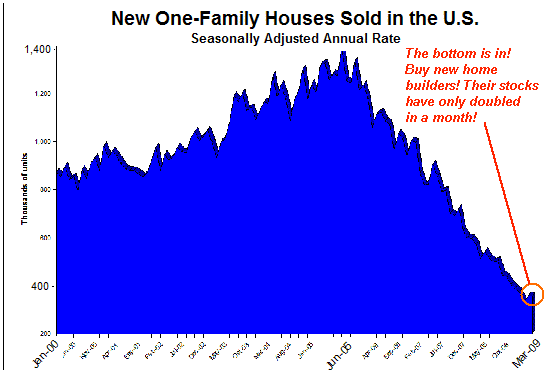
New Home Sales Plummet 30%; Govt and RE Industry Spin Phony "Bottom"

What few comment on is the complicity of all who remain silent in the face of the Big Lie because they have a self-serving interest in the Big Lie's success. Everyone with a stake in housing or the stock market is hoping the 24/7 propaganda tsunami succeeds in creating a renewed surge in stocks, housing, borrowing and spending, even as they know in their hearts and in their minds it's all lies, fabrications, dissembling, distortions, manipulation and brainwashing repetition of half-truths.

We all know the data is being spun so hard it's become a blur. New home sales fall from 1.4 million units a year to 350,000? Great! the bottom is in!

GDP is tanking? Great! Inventories will need to be restocked soon on a gigantic scale.

Banks made obscene profits from trading tricks and the usual accounting frauds? Great! The banking sector is healthy again! (Had a loss in December? Just drop that month from your reporting--it works every time!)

Ford only lost $1.4 billion last quarter? Great! It doesn't need a bailout (yet) so let's triple the stock because "the bottom is in."

http://www.oftwominds.com/blog.html

15 April 2009

Summers. He's just an average person in a world where the average person is a crook.

And the sickening stench hasn't ended. The same greedy, destructive Boomers and Gen-Xers who brought about this disaster are continuing to do so and continuing to lie about it.

One of the slimiest performances I've seen was last week's presentation at Washington's Economic Club by Lawrence Summers, White House National Economic Council. Summers bragged about his life's accomplishments and then, smiling smugly, he said, "I think the sense of a ball falling off the table -- which is what the economy has felt like since the middle of last fall -- I think we can be reasonably confident that that's going to end within the next few months and you will no longer have that sense of freefall."

Well, you can just look at the above graph and see that he's lying. Industrial production figures in all the G7 (developed) countries have been like "a ball falling off the table." And you can look at all sorts of other data. There's absolutely nothing to justify Summers' claims.

Now, I don't really care if someone makes a lot of money, even someone like Summers, who made $5.2 million in 2008 from hedge funds, plus $2.7 million in speaking fees, and who also consulted for hedge funds when he was President of Harvard University. If the Harvard University trustees don't care, then why should I care?

But I'm offended when someone like that becomes the economic front man for the Administration, and then openly lies, especially after a year of hearing a lot of crap during the campaign that the Obama administration was going to be completely open and honest, without even the appearance of impropriety.

But I don't mean to pick on just Summers. He's just an average person in a world where the average person is a crook. The same generations of people who perpetrated the fraud, who created the worthless mortgage-backed securities and worthless CDS securities contracts, and sold them to the public as risk-free AAA securities are still in charge. Those people haven't disappeared; they're still pulling scams. They're just using new variations, to take advantage of this year's opportunities.

I've been writing about these scams for years, as regular readers of this web site know. One of the most disgusting was the subprime mortgage company that I wrote about last year in January. They had made huge sums of money by defrauding thousands of people by talking them into lying on their mortgage applications, and had defrauded the lenders through these falsehoods.

The reason that that story caught my attention was that the Boomer executive vice president Walter Buczynski, 59, was married to a Gen-X wife, 37. When the company went bankrupt, the wife decided to dump the husband and take the kids (why not?), in order to get as much money as possible. Buczynski killed his wife, then killed himself.

And even after all this, the remaining company officers were in bankruptcy court requesting that all remaining money be split among them as bonuses, rather than give it to some of the people who had been defrauded.

For some reason, this story epitomizes all that's been going on. Greedy, selfish, destructive Boomers and Gen-Xers, willing to destroy anyone else's life for their own gain, and committing further destruction when their attempts are foiled. The standard today in government, business and journalism is of dishonesty and unethics (is that a word?).

I recall a job interview from late 2007, just after the credit crisis began. (For why I was looking for a job, see "Boomers and Gen-Xers: Dumbing down IT / How Digimarc Corp. self-destructed.") I was talking to a company VP, and as was my obsessive habit, I warned him that there was a great deal of fraud going on in the world, and that he should make sure that his company's assets were safe. He said, "So you think everyone in the world is a crook?" I knew he thought I was nuts, and of course I didn't get the job.

So what's interesting to me now is that the stories behind all of these frauds that I've been writing about for years are starting to come out. If anything, what I wrote in the past underestimated the situation.

I've written about the "culture of complicity" that pervades today, and the overwhelming circumstantial evidence that proves that people were knowingly committing fraud.

In a airing of Bill Moyer's journal, William K. Black, the former senior regulator who cracked down on banks during the savings and loan crisis of the 1980s, described what's been going on:

"BILL MOYERS: Is it possible that these complex instruments were deliberately created so swindlers could exploit them?


WILLIAM K. BLACK: Oh, absolutely. This stuff, the exotic stuff that you're talking about was created out of things like liars' loans, that were known to be extraordinarily bad. And now it was getting triple-A ratings. Now a triple-A rating is supposed to mean there is zero credit risk. So you take something that not only has significant, it has crushing risk. That's why it's toxic. And you create this fiction that it has zero risk. That itself, of course, is a fraudulent exercise. And again, there was nobody looking, during the Bush years. So finally, only a year ago, we started to have a Congressional investigation of some of these rating agencies, and it's scandalous what came out. What we know now is that the rating agencies never looked at a single loan file. When they finally did look, after the markets had completely collapsed, they found, and I'm quoting Fitch, the smallest of the rating agencies, "the results were disconcerting, in that there was the appearance of fraud in nearly every file we examined."

BILL MOYERS: So if your assumption is correct, your evidence is sound, the bank, the lending company, created a fraud. And the ratings agency that is supposed to test the value of these assets knowingly entered into the fraud. Both parties are committing fraud by intention.

WILLIAM K. BLACK: Right, and the investment banker that — we call it pooling — puts together these bad mortgages, these liars' loans, and creates the toxic waste of these derivatives. All of them do that. And then they sell it to the world and the world just thinks because it has a triple-A rating it must actually be safe. Well, instead, there are 60 and 80 percent losses on these things, because of course they, in reality, are toxic waste."


Black doesn't name any names, unfortunately, but makes a general argument like the one I'm making -- that the fraud was so massive, that everyone must have been involved.

In another part of the interview, he does name two government regulators who failed to do their jobs:

"WILLIAM K. BLACK: Geithner is charging, is covering up. Just like Paulson did before him. Geithner is publicly saying that it's going to take $2 trillion — a trillion is a thousand billion — $2 trillion taxpayer dollars to deal with this problem. But they're allowing all the banks to report that they're not only solvent, but fully capitalized. Both statements can't be true. It can't be that they need $2 trillion, because they have masses losses, and that they're fine.


These are all people who have failed. Paulson failed, Geithner failed. They were all promoted because they failed, not because...

BILL MOYERS: What do you mean?

WILLIAM K. BLACK: Well, Geithner has, was one of our nation's top regulators, during the entire subprime scandal, that I just described. He took absolutely no effective action. He gave no warning. He did nothing in response to the FBI warning that there was an epidemic of fraud. All this pig in the poke stuff happened under him. So, in his phrase about legacy assets. Well he's a failed legacy regulator."

Black indicts both Treasury Secretaries -- Hank Paulsen and Timothy Geithner -- and I can only agree. In this "culture of complicity," neither of them could blow the whistle or tell the truth without exposing their own complicity in the repeated fraud.

Another article, written in December, does name names, and gives specifics for how the fraud was perpetrated.

The article was written by Michael Lewis. In the 1980s, at age 24, with no business experience whatsoever, he stumbled into a job paying him a six-figure salary to advise investment bankers about something he knew nothing about. After a few years, he got out while the getting was good, and wrote a book called Liar's Poker about his experiences:

"I had no great agenda, apart from telling what I took to be a remarkable tale, but if you got a few drinks in me and then asked what effect I thought my book would have on the world, I might have said something like, “I hope that college students trying to figure out what to do with their lives will read it and decide that it’s silly to phony it up and abandon their passions to become financiers.” I hoped that some bright kid at, say, Ohio State University who really wanted to be an oceanographer would read my book, spurn the offer from Morgan Stanley, and set out to sea.
Somehow that message failed to come across. Six months after Liar’s Poker was published, I was knee-deep in letters from students at Ohio State who wanted to know if I had any other secrets to share about Wall Street. They’d read my book as a how-to manual."

Lewis was shocked at this response at the time, and indeed it's still shocking today. These were Generation-X students at Ohio State University looking for ways to get into the business of defrauding people. What kind of college must Ohio State University be to graduate a class of crooks? It's pretty safe to say that ethics is not a strong point at Ohio State...

Generational dynamics

10 April 2009

The "Disaster Stage" of the "Great Unwind"

Thx to Jesse for this one

Thirty to forty years ago, the early fruits of financialization in this country - the first credit cards, retirement accounts , money market funds and ATM machines - struck most Americans as a convenience and boon. The savings and loan implosion and junk bonds of the 1980s switched on some yellow warning lights, and the tech bubble and market mania of the nineties flashed some red ones. But neither Wall Street nor Washington stopped or even slowed down.

In August, 2007, the housing-linked crisis of the credit markets predicted the arriving disaster-stage, the Crash of September-November 2008 confirmed the debacle, and now an angry, fearful citizenry awaits a further unfolding. There is probably no need to fear a second coming of nineteen-thirties Depression economics. This is not the same thing; the day-to-day pain shouldn't be as severe.

Indeed, for all that the 1930s evoke national trauma, that decade was in fact a waiting room for national glory and wellbeing. World War Two ushered in American global ascendancy, the "Happy Days" of the 1950s and an unprecedented middle-class prosperity.

Today's disaster stage of American financialization - the bursting of the huge 25-year, almost $50 trillion debt bubble that helped underwrite the hijacking of the U.S. economy by a rabid financial sector -- won't be nearly so kind. It is already ushering in the reverse: a global realignment in which the United States loses the global economic leadership won in World War Two. The ignominy deserved by Wall Street after 1929-1933 is peanuts compared with the opprobrium the U.S. financial sector and its political and regulatory allies deserve this time.

My 2002 book, Wealth and Democracy, in its section on the "Financialization of America" noted that the "finance, insurance and real estate (FIRE) sector overtook manufacturing during the 1990s, moving ahead in the national income and GDP charts by 1995. By the first years of the next decade, it had taken a clear lead in actual profits. Back in 1960, parenthetically, manufacturing profits had been four times as big, and in 1980, twice as big." Hardly anyone was paying attention. By 2006, the FIRE sector, its components mixed together like linguine by the 1999 repeal of the old New Deal restraints against mergers of commercial banks, investment firms and insurance, had ballooned to 20.6% of U.S. GDP versus just 12% for manufacturing. The FIRE Sector, now calling itself the Financial Services Sector, lopsidedly dominated the private economy. A detailed chart appears on page 31 of Bad Money. Some New York publications and politicians try to insist that finance per se is only 8%, but the post-1999 commingling makes that absurd.

This represented a staggering transformation of the U.S. economy - doubly staggering now because of the crushing burden of its collapse. You would think that that opinion molders and the national media would have been probing its every aperture and orifice. Not at all.

Thus, it was pleasing to read MIT economics professor Simon Johnson's piece in the April Atlantic fingering financial "elites" who captured the government for the latterday financial debacle. This is broadly true, and judging from my e.mail, even some conservatives accept Johnson's analysis and indictment. After the furor over the AIG bonuses, the public and some politicians may be ready to start identifying and blaming culprits. This would be useful. Having an elite to blame is a often prerequisite of serious reform.

Nevertheless, the extremes of financialization, together with the havoc we now know it to have wrought, represent a much more complicated historical and economic genesis, one which U.S. leaders must be obliged to confront if not fully acknowledge. Elite avarice and culpability has multiple and longstanding dimensions. It has been fifteen years since Graef Crystal, a wellknown employment compensation expert, brought out his incendiary In Search of Excess: the Overcompensation of American Executives. The data was blistering. Over the last decade, New York Times reporter David Cay Johnston has published two books - Perfectly Legal and Free Lunch - describing how the U.S. tax code, in particular, has been turned into a feeding trough for the richest one percent of Americans (especially the richest one tenth of one percent).

The backstop to avarice provided by a wealth culture and market mania from the late 1980s through the Clinton years to the George W. Bush administration, prompted another set of indictments that still resonate: William Greider's Secrets of the Temple: How the Federal Reserve Runs The Country (1987), Robert Kuttner's Everything For Sale (1997), Thomas Frank's One Market Under God (2000) and John Gray's False Dawn (1998). More recently, Paul Krugman's books have been equalled or exceeded in timeliness by his New York Times columns blasting the perversity of the Obama-Geithner financial bail-out and the malfeasance of the financial sector. James K. Galbraith, in his 2008 book The Predator State, has elaborated the valid point that too many conservatives over last few decades betrayed their free market rhetoric by supporting a relentless use of state power and government financial bail-outs to advance upper-income and corporate causes. On the other hand, some conservative economists of the Austrian school make related indictments of liberal bail-out penchants.

This could be a powerful framework. All of these critiques have merit, and ideally they might converge as earlier indictments of elite and governmental abuse did during the Progressive and New Deal eras. But I have to return to whether the public will ever be given full information on the fatal magnitude of financialization, who was responsible, and how it failed and crashed in 2007-2009. So far, political and media discussion has been so minimal that the early 21st century American electorate has much less readily available information on what took place than did the electorates of those earlier reform eras.

Towards this end, my initial emphasis in the new material included in the 2009 edition of Bad Money is on what techniques, practices and leverage the financial sector used between the mid-1980s and 2007 to metastasize early-stage financialization into an economic and governmental coup and, ultimately, a national disaster. Perhaps not surprisingly, I found that the principal building blocks that the sector used to enlarge itself from 10-12% of Gross National Product around 1980 to a mind-boggling 20.6% of Gross Domestic Product in 2004 involved essentially the same combination of credit-mongering, massive sector borrowing, highly leveraged speculation, reckless, greedy pioneering of new experimental vehicles and securities (derivatives and securitization) and mega-trillion-dollar abuse of the mortgage and housing markets that became infamous as hallmarks of the 2007-2009 disaster. During Alan Greenspan's 1987-2006 tenure as Federal Reserve Chairman, financial bubble-blowing became a Washington art and total credit market debt in the U.S. quadrupled from $11 trillion to $46 trillion.

To try to put 20-30 pages into a nutshell, the financial sector hyped consumer demand - from teen-ager credit cards to mortgages for the unqualified - to make credit into one of the nation's biggest industries; nearly $15 trillion was borrowed over two decades to leverage de facto gambling at 20:1 and 30:1 ratios; banks, investment firms, mortgage lenders, insurers et al were all merged together to do almost anything they wanted; exotic securities and instruments that even investment chiefs couldn't understand were marketed by the trillions. To achieve fat financial-sector profits, the housing and mortgage markets might as well have been merged with Las Vegas.

The principal inventors, hustlers , borrowers and culprits were the nation's 15-20 largest and best known financial institutions - including the ones that keep making headlines by demanding more bail-out money from Washington and giving huge bonuses. These same institutions got much of the early bail-out money and as of December 2008 they accounted for over half of the bad assets written off. The reason these needed so much money is that they government had let them merge, speculate, expand and experiment on dimensions beyond all logic. That is why the complicit politicians and regulators have to talk about $100 billion here and $1 trillion there even while they pretend that it's all under control and that the run-amok financial sector remains sound.

This is a much grander-scale disaster than anything that happened in 1929-33. Worse, it dwarfs the abuses of debt, finance and financialization that brought down previous leading world economic powers like Britain and Holland (back when New York was New Amsterdam). I will return to these little-mentioned precedents in another post this week.

But for the moment, let me underscore: the average American knows little of the dimensions of the financial sector aggrandizement and misbehavior involved. Until this is remedied, there probably will not be enough informed, focused indignation to achieve far-reaching reform in the teeth of financial sector money and influence. Equivocation will triumph. This will not displease politicians and regulators leery of offending their contributors and backers.

---

Kevin Phillips's 2008 book Bad Money: Reckless Finance. Failed Politics and the Global Crisis of American Capitalism has just been published in a new post-election edition by Viking Penguin


http://tpmcafe.talkingpointsmemo.com/2009/04/07/the_disaster_stage_of_us_financialization/

12 March 2009

Gambling, economic growth and imagination

By Spengler

America's homeowners feel like busted gamblers after a bender in Vegas. They wagered not only the nest egg, but the nest, with the abandon of tulip-bulb traders in 17th century Holland. Americans are hard put to explain how the American dream turned into a chip on the craps table. The focal point of speculation was the asset one usually associates with secure domesticity. What happened to the risk-averse Economic Man of textbooks?

The textbook was misleading to begin with: we are all gamblers and always have been, argues Reuven Brenner, the Repap Professor of Business at McGill University. In a series of books beginning in 1983 with History: The Human Gamble and culminating with his latest volume, A World of Chance: Betting on Religion, Games, Wall Street [1], Brenner yanks economics


inside-out by placing risky behavior at the center of the economic model.

Conventional economics describes an artificial world of slight deviations from equilibrium; Brenner presents the real world, in all its danger and uncertainty. Man lives not only by the sweat of his brow, but by the fortitude of his intestines, for survival demands that we take mortal leaps of a kind that are unknown to the conventional model. Men who would prefer to be timid risk everything to leapfrog their peers before they themselves are left behind.

Rather than award yet another Nobel Prize to an economist who put bells and whistles on the conventional model (Princeton University Professor Paul Krugman was honored this past weekend ''for his analysis of trade patterns and location of economic activity",) the Swedish Academy should have honored Brenner, who gives us a model that makes sense in the real world of tumult and uncertainty - 2008 should have been Brenner's year, given the cataclysmic breakdown of the conventional model. Only a few months ago, the governments of the world went about their business as if nothing unusual was at work; now they are lurching from one emergency plan to another and warning of a new Great Depression.

This sort of thing isn't supposed to happen in the imaginary world of the consensus economic model. Radical changes, though, are the underlying premises of Brenner's approach, which "deals with jumps - relatively large changes. The traditional economic models can deal with small changes, where people adapt passively but do not bet on any new idea," he writes. People take risks because they know that gambling may be the only survival strategy under given circumstances.

Why, for example, would Americans bet their homes? Within Brenner's framework, we need to look to the circumstances that prompt apparent risk-friendliness, rather than click our tongues over an outbreak of collective madness. As Brenner and his wife, economist Gabrielle Brenner, explain:
If people reach the age of fifty or fifty-five and have not "made it", what are their financial options to still live the good life? Except for allocating a few bucks to buy lottery tickets, it is hard to think of any other option. If people find themselves down on their luck and see no immediate opportunities to get rich, what can they do to sustain their hopes and dreams? Allocating a fraction of their portfolios on games with a chance to win a large prize is among the options. And when people are leapfrogged - that is, when some "Joneses" who were "below" them jump ahead - how can they catch up? They will tend to challenge their luck too for a while, taking risks that they might have contemplated before in business, financial markets, and other areas but did not follow up with action.
As it happens, a huge number of Americans began to turn 50 or 55 during the past 10 years, as the baby boomers approached retirement. Between 2005 and 2025, the number of Americans aged 60 or over will jump from around 15% of the population to 25%.

Between 1990 and 2000, that is, the baby boomers reached the age at which workers are supposed to earn their highest lifetime compensation and salt away most of their retirement savings. Americans who saved money during the 1990s put a great deal of it into the stock market and were bitterly disappointed. An American saver who invested in 1996, just as the boom was getting underway, would have given up all his gains by October 2002, at the stock market's following the technology stock collapse. If the same investor held on to a broad market portfolio all the way to the present, he would only break even after inflation.

American asset markets did not offer returns high enough for the baby boomers to earn enough to retire. There are a number of reasons for this. One is that not only Americans, but Europeans, Japanese, and above all Middle Easterners are aging rapidly and seeking retirement assets, such that the price of all capital assets rose and their prospective rate of return fell. Capital markets, as I have argued in the past, come down to old people lending money to young people, and the declining numbers of young people in the industrial world during the past generation are reflected in shrinking investment opportunities.

The prospective retirees of the world had no choice but to take more risk in order to earn the returns they required. Riskier assets were brought to the marketplace, such as subprime mortgages and high-yield loans. Professional gamblers - the hedge funds - raised US$4 trillion to bet on the riskiest portion of pools of mortgages and corporate credit. Americans found that the global demand for mortgage bonds created an inexhaustible supply of cheap credit even for the riskiest borrowers.

With home prices rising 10% a year between 1998 and 2006, Americans found that they could use leverage to achieve triple-digit returns on their equity (if you buy a $200,000 house with $10,000 down and its price rises by 10%, or $20,000, your return on equity is 200%).

In retrospect, it may seem silly for the baby boomers to have assumed that they could double the price of their homes and then all sell their homes to each other and retire on the proceeds. Demographics ultimately destroyed the home price bubble.

As a group, the baby boomers did not have sufficient funds on which to retire, and, given the condition of American asset markets, could not earn sufficient returns on conventional assets. Instead, they chose to "leap into uncertainty", in Brenner's phrase. This sounds fairly general, but Brenner has elaborated his view in a number of startling ways. How, for example, do entrepreneurs set prices for new products, where demand is unknown? Brenner demonstrates (in "Rivalry") that the mechanism by which they do so depends on the creation of new markets. In effect, Brenner has replaced the view of human behavior at the center of economics, and from this elaborated a set of theories, each of which has enormous analytic power.

In Brenner's model, survival means maintaining one's social status, one's place in the pecking order or the corporate food chain, because falling behind decreases the likelihood of survival. Rivalry is the driving force, not an abstract measure of utility. There is something profoundly Biblical in this view: "I considered all labor and all excelling in work, that it is a man's rivalry with his neighbor. This also is vanity and a striving after wind." - Ecclesiastes 4:4.

The Jewish sages of late antiquity spoke of an "evil impulse", variously identified with competitive or sexual drives, without which no one would build a house, start a family or open a business. The entrepreneur, in Brenner's view, resembles Goethe's Mephistopheles, who introduces himself as "the spirit that always wishes evil, but always does good".

Brenner strongly believes that the greatest contribution to welfare comes from letting individuals bet on ideas, pursue innovations, and overturn the existing order of things. A profound faith in a beneficent providence is required to draw this conclusion, for it is easy to argue that betting on ideas may produce apocalyptically harmful outcomes.

Rivalry between nations never was so clear cut as in the preparations for World War l. Each European nation feared being leapfrogged by the others. France feared Germany's high population growth rate, Russia feared Germany's intrusion into the restive western wing of its empire, Germany feared Russian industrialization, England feared the losses of its ability to control the continental balance of power, Italy felt left out, and so forth. All had excellent reasons to fight rather than be left behind, but the result was the collective ruin of all the European nations.

At the outbreak of the war in 1914, some of Europe's best minds exulted in the "leap into uncertainty". Thomas Mann, arguably the greatest writer of the past century, wrote a famous essay entitled "Thoughts in War" comparing the risk-taking attitude of the artist and that of the soldier. A great sense of liberation from the ordinary swept over Europe as its nations prepared to risk everything for their place at the head of the queue. The trouble is that they risked everything, and they all lost everything.

The stench of brimstone precedes the entrepreneur. As God told Mephistopheles in the Prologue in Heaven of Goethe's Faust, human beings tend toward unconditional rest, and to keep them on their toes God assigns them a companion who must act as and be perceived as a devil. The great theorist of entrepreneurship, Frank Knight, of the University of Chicago, is one of Reuven Brenner's spiritual ancestors. His 1921 book Risk, Uncertainty and Profit showed that entrepreneurs' compensation derives from the leap into uncertainty, that is, the assumption of unhedgable risk.

Knight, unlike Brenner, thought that entrepreneurship did not add enough wealth to justify the disruption that it occasioned. Joseph Schumpeter, who took from Mephisto the notion of creative destruction and applied it to economics, was pessimistic about the future of capitalism. He thought communism would triumph.

The apogee of gambling on ideas well might have been the Internet stock bubble of the late 1990s, when any undergraduate with a few computer science credits could launch a company on the equity market. It is hard to find the fault in the system from a pure economic standpoint, for America's markets were the world's most efficient. The trouble is that when we speak of a leap into uncertainty, we leave the realm of probability distributions and enter the realm of the imagination. The entrepreneur's vision of society five or 10 or 20 years ahead is what counts - how lives, mores and tastes will change.

Thomas Alva Edison had one sort of vision of the future when he invented the electric light bulb and the phonograph. The Internet entrepreneurs of 1999 had quite a different one, in which the delights of youth culture would somehow substitute for cash flow. Once investors concluded that music downloads, multi-player games, chat rooms and pornography did not justify a market capitalization larger than America's manufacturing plant, the illusion was gone and so were the valuations.

For that matter, the ill-fated markets for structured credit and mortgages of the past 10 years had the undivided attention of some of the world's best applied mathematicians. Never before were risks so parsed, measured, cut, dried and marketed to different investor groups with different risk preferences. Professional gamblers, or "hedge funds", were enlisted to manage the riskiest part of the capital structure, while legions of mathematicians arranged other securities to be as safe as possible - for example, AAA-rated securities backed by subprime mortgages that are now trading at 50 cents on the dollar.

We have no choice but to leap into uncertainty, where imagination takes the place of probability distributions. Standing still and doing nothing is the most dangerous strategy of all. The one thing we know about all places and all times is that if you stay in the same place doing the same thing long enough, someone is going to come along and rape the crops, burn the women and take you out of the picture.

But what if our imagination goes wrong? If Ecclesiastes (4:4) recognized that business stems from rivalry, as Reuven Brenner maintains, this must be balanced against Jeremiah (7:24), which warns that the people "walked in the counsels and in the imagination of their evil heart, and went backward, and not forward". Brenner has given us as much as economics possibly can: he walks us to the moment of the mortal leap, describes the conditions that motivate it, and reminds us that we have no choice.

But it is important to keep in mind that economics does not explain everything. If we decline to raise a next generation, and abandon ourselves to so-called youth culture, ultimately we will encounter imbalances that economic policy cannot cure. Our imagination is the basis on which we make leaps into uncertainty, and how we cultivate this imagination ultimately may be of greater import than economics as such.

Note: 1. A World of Chance: Betting on Religion, Games, Wall Street, by Reuven and Gabrielle A Brenner with Aaron Brown. Cambridge University Press (August, 2008). ISBN-10: 0521711576. Price US$29.99, 352 pages.

link

14 December 2008

Another Swiss giant on the edge ~ Glencore

The hard ball players Xtrata and idiots at UBS and the old complacent criminals, the Zug boys that took care of Alan Bond look like all being punished for their hubris by the gods. The secrecy laws and the status made them feel bulletproof enough but in the light of the infinities of arbitrage and leverage opportunities of the last twenty years all remaining caution would have been discredited by the outflanking of the prudent by the reckless.


CDS chart on Glencore unsecured debt.

In case you have never heard of this company, then now is the critical time. Glencore is the largest enterprise by turnover in Switzerland, recording record sales of 142.3 billion USD in 2007. According to its own data, Glencore directly or indirectly employs 52,000 employees. And obviously some of it has gone pear-shaped.

From Wikipedia:
Glencore International AG (management buy out of Marc Rich & Co AG) is one of the world's largest suppliers of commodities and raw materials, and is also among the world's largest privately held companies. As of 2006, it was Europe's sixth-largest company in terms of turnover.[1] According to The Sunday Times,[2] the company had USD 10.9 billion in shareholders' equity at the end of 2006 and is completely owned by its management.

With production facilities around the world, Glencore supplies metals, minerals, crude oil, oil products, coal, natural gas and agricultural products to international customers in the automotive, power generation, steel production and food processing industries.


According to an Australian Public Radio report, "Glencore's history reads like a spy novel".[3] The company was founded as Marc Rich & Co. AG in 1974 by billionaire commodity trader Marc Rich, who was charged with tax evasion and illegal business dealings with Iran in the U.S., but pardoned by President Bill Clinton in 2001. In 1993 and 1994, Rich sold all of his majority share in Marc Rich & Co. AG back to the company.[4] The enterprise, renamed Glencore, is now owned and run by his former associates, including former Glencore CEO Willy Strothotte and present CEO Ivan Glasenberg. In 2005, proceeds from an oil sale to Glencore were seized as fraudulent, in an investigation into corruption in the Republic of Congo[5].

"Sorry everyone....what you've been pursuing has all been a lie, a big Ponzi, a rat-hole to nowhere....". Re-boot.

Postscript:

I want to acknowledge that the post below came from a wonderful blog, Cassandra does Tokyo and was originally titled "Bernie Comes Out of the Closet". Many thanks and apoligies to those to whom, in the heat of my enthusiam to inform and a passionate desire to widely disseminate cutting edge analysis and comment, have been short changed by my rush to republish.

We will slowly morph to a more formal review of market action, be more considerate of content providers and post more of the my original comment that has, at last, started to appear and been well received.


"Not a year has gone by during the past fifteen that I have not contemplated what Bernie Madoff did (or didn't do) to make his money. Seventy to one-hundred basis-points-a-month. Net. Net. Net. During tempests, earthquakes, panics and crashes - even during the closure of the exchange itself, Bernie apparently minted coin like few others. Even Renaissance and Shaw tripped occasionally. Not Bernie. Yet no one knew what he did. It was one of the best kept secrets in the world. Oh yeah, sure, split-strike conversions were the official line. But every skeptical arb trader knew this couldn't be true.

I also never came across an ex-Madoff trader the way one meets ex-Shaw, ex-Moore Cap, or ex-Citadel employees. Resumes are sent in reply to postings and guys have done the rounds, even if they weren't unhappy and making a moral statement. A spouse moves...whatever. Surely there must be disgruntled Madoffians somewhere, right?. Were they ummm underground? I mean, literally? My friends at a large IB (who were soliciting business from them years ago) who'd been to their offices said they looked like the bridge from the USS Enterprise (the Starship - The Next Generation version). Entry to the IM sub was strictly verboten. Uh huh. He said it was a paperless office. No paper trails. Hmmmm. Violators were fired. Weird. No one transgressed.

Whatever he did, he came a long way from arbing the odd-lots that were the reputed foundation of his activities. I knew his shop from London where he was one of the few to make markets in US stocks out of hours, and if my clients for whatever (mostly ill-advised) reason needed to trade instantly, Bernie would make a price. Not necessarily a good price, but a price. But one does so at their peril since the folk with material non-public information are more predisposed to want to trade outside hours, so the pick-off risk was huge. But he never complained.

Next thing I know, he's at the center of an electronic trading revolution - an electronic market-maker facilitator at the center of the trading universe. Yet even Timber Hill has bad hair days. Volkswagen ord-pref days. Not Bernie. Is he arbing the exchange fee structure? Is he algorithmically scalping cause he's seeing the order flow before it gets to the exchange? Maybe. Profitably? Who knows? But I didn't have a problem with an old Jewish guy making markets. This is what we DO. But there are these investment funds - Fairfield Sentry and Kingate, and these are the issue. They are Madoff-only feeders reputed to be $7bn each. Are they funding his market-making? Why does he need so much capital? What the f*ck f*ck f*cking f*ck could he be doing in the equity markets with that much capital and still keep it a secret AND deliver returns? They say they are doing these split strike conversions but I can't see how the numbers work. Nor can anyone else. The Wall Street Journal raises the red flags in an article, but it's dismissed as hyperbole disseminated by jealous competitors. But the nagging thing is: there are lots of smart guys out there. More than sixty of them near Stonybrook with Simons focused on cracking the nut faster, better quicker, and this activity and result, I can understand. But there is no sign of such exactitude or intellectual firepower at Madoff. Just 70 to 100 bps per month, secretiveness, and dissonance.

In 2000, I advised a family-office on their alternative investments and constructed a portfolio on their behalf. I had free rein. Included in their legacy portfolio was a sizable Madoff position. As a fiduciary - and a conservative one - coming on the heels of LTCM which also lacked transparency and which made it hard for me to raise capital - I dug, asked every well-connected equity-finance, prime-broker, electronic trader and HF allocator type I knew and it still didn't add up. The best and brightest still had no more insight than I, though the skeptical shared my suspicions. So, I strongly suggested they "dump it". "One isn't being compensated sufficiently for not knowing, and something just isn't right here. Yeah maybe it's OK, but I think it's not". But they liked "it" and they liked "him". "He's always paid", they said. "We've been with him a long time". Old school they were. Trusting. What the f*ck did I know anyway?

Well, it seemed to me that the "split-strike conversions" were profit shifting bookkeeping tools. Money invested in the feeders did obtain split-strike conversion positions on their books that had an implied "yield" equal to their return but it seemed these were pre-arranged combinations that shifted return back to the investment vehicles and were "phantom" positions vs. Madoff securities. In the interim, Madoff presumably has use of the entire pool of capital, to do what he pleased, plus whatever that pool could command in terms of leverage from bank lines and financing sources. It could be in anything and everything. He could be doing mutual fund timing, or mutual fund market impact trades. Credit arbitrage. Funding coup d'etats in Africa. Or buying GSCI commodity swaps. More plausibly, he could be doing option and index-option market impact trades since he was ostensibly at the center of market flow, or he could be at the center of a loan-sharking network across America earning 50%pa, and here he was passing a paltry 9% back to investors. Either he was crooked beyond belief or he was an evil contrapreneurial genius. Who would have have thought he was both??!!

Some crimes are too perfect. Some facades too well-painted to be original or convincing. A good hustler knows he must lose sometimes in order to win. THAT is the reflection of reality that makes it believable, and gives confidence to the punter who will shortly be taken out. THAT was what was wrong with Bernie Madoff's Ponzi. The people who were taken - like the Family Office and many other investors who in time will go public on their fleecing - wanted badly to believe they were onto something that was so good that they ignored the most obvious signs of bogusness. It just didn't make sense. It just didn't add up. Even Jim Simons earns it. There is no free lunch.

There is something fitting and just in the timing of this. It is emblematic of America since Reagan and the Great Leveraging. Something for nothing. Thank you, Mr Laffer. But as a philosophy and modus operandi it is, quite literally, bankrupt and without merit. And Laffer has since been proven to be full of sh*t. Now, Americans will have to confront this, the premise that greed is good and self-guiding and somehow omnisciently beneficial, for it has had repercussions down to the core of our society and values. "Sorry everyone....what you've been pursuing has all been a lie, a big Ponzi, a rat-hole to nowhere....". Re-boot."

11 December 2008

Can't fix what you don't understand, can you

"They have been raised solely within the neoclassical approach to economics, which has dominated the academic discipline of economics since the mid-1970s. They have been trained to uncritically believe in models of the economy based on the fantasies of hyper-rational individuals (who can predict the future), that markets that are always in equilibrium where money is simply a veil over barter.

One excellent question put to James by Henry Blodget is worth quoting in its entirety. Blodget quite justifiably expressed the belief that in their training economists look at history–a statement that shows he didn’t himself do an economics degree, because one of the first subjects that neoclassical economists eliminated to make way for their obsessions with “microeconomics” and “econometrics” was economic history:

Blodget: But obviously in training economists, especially academics who go through an incredible period where they’re learning and studying history, and you look back over history where you’ve had many of these complete crashes that were unforeseen at the time. How does academia deal with that? Is the story always told that “Oh yes, but we were stupid and unsophisticated then, and now we’re smart and therefore we’ll see it”? How do people explain that?

James’s reply was:

Galbraith: That’s an excellent question, but the reality is that training in economics does not involve coming to grips with history. Economic history is barely taught in graduate economics departments, and the history of economic thought isn’t taught at all. So figures that have been fundamental to understanding phenomena like the Great Depression–or for that matter the Great Crash–are simply not in the curriculum.

Keynes, who taught my father John Kenneth Galbraith–who understood the Great Depression as well as any figure in the 20th century–… you won’t find them on the reading lists. That is in some sense the shocking commentary on the intellectual direction that the profession has taken.

There’s much more worth listening to in this interview. There is, also, hope. The fact that serious intellectuals who are critical of neoclassical economics are now being listened to by the media and the markets–though not yet governments–is a sign that, possibly, the days of the delusional neoclassical approach to economics are coming to a close.

Unfortunately, it has taken a serious economic crisis–possibly the most serious in history–to bring that delusion to its knees. But in the meantime, people trained in that delusion are still in control of economic policy, and are charged with helping overcome a problem they did not foresee, and still do not understand."